


- Impatient to capture Kostiantynivka, a key Ukrainian strongpoint in the east, the Russians tried flooding it
- Bombing a reservoir west of the city, the Russians impeded Ukrainian reinforcements in late February
- But the Russians had their own problems as their communications collapsed
- Kostiantynivka holds, but tenuously
On 24 February, the Russian air force lobbed a 3-ton guided bomb at the earthen dam across the Khrushchove Reservoir just west of the fortress city of Kostiantynivka in eastern Ukraine's Donetsk Oblast.
It was a key supporting effort for a Russian assault on the western edge of Kostiantynivka, one of the few remaining urban strongpoints standing between the Russian Center Group of Forces and the twin free cities of Sloviansk and Kramatorsk, 20 km to the north.
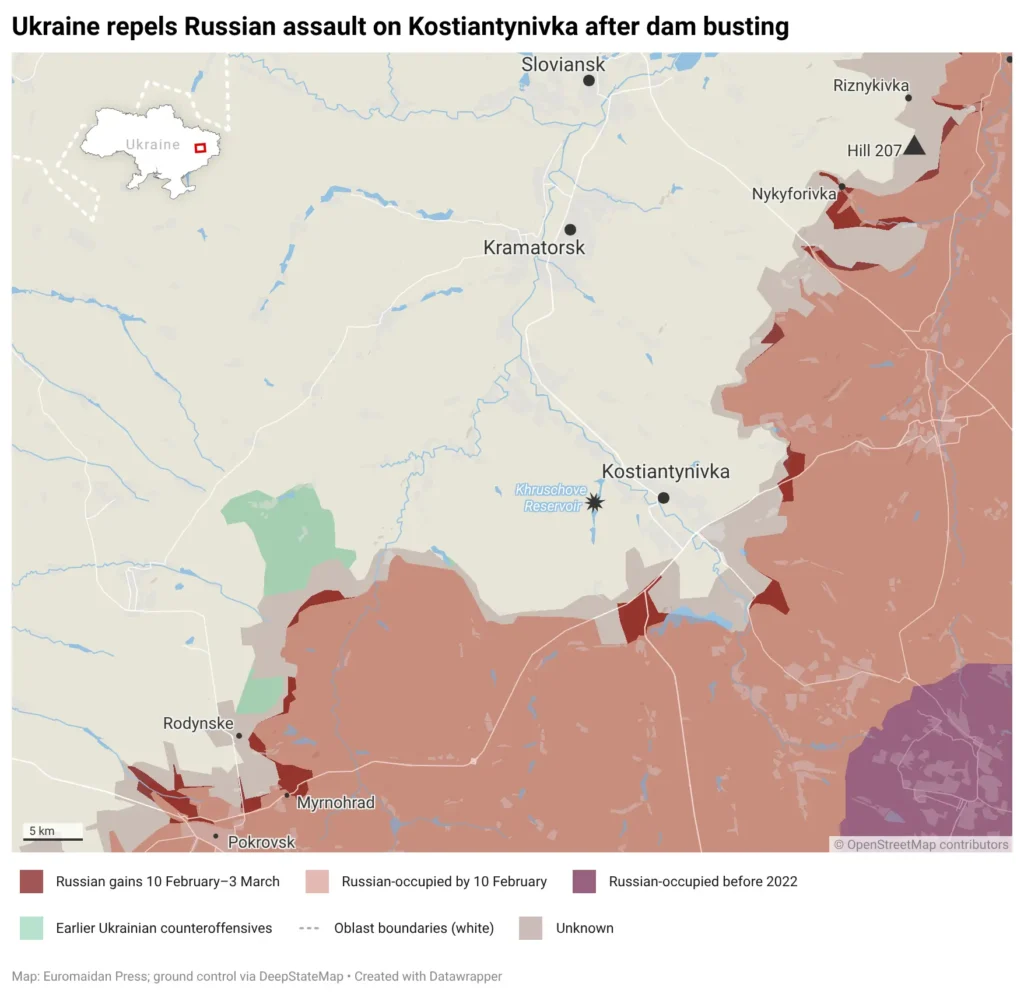
For a few days, it may have seemed like the Russians were poised for a major advance into Kostiantynivka. But Ukrainian forces counterattacked and pushed the Russians back.
Kostiantynivka holds. But for how long?
For much of 2025, all eyes were on the Kostiantynivka and the cities of Myrnohrad and Pokrovsk to the west. The Russians steadily advanced toward Myrnohrad and Pokrovsk and, under the cover of a thick winter fog in early November, finally marched into Pokrovsk. A few weeks later, the Russians controlled most of both cities. The Ukrainians' urban defenses south of Kramatorsk were on the verge of fully shattering.
But the garrison in Kostiantynivka fought on even as the Russians captured key villages just south of the city. In mid-February, the Russians organized a simultaneous attack on Kostiantynivka from the ground and from the air.
Dam busting
Around 23 February, the Russian 13th Assault Company infiltrated the Khutir neighborhood in southwestern Kostiantynivka. A day later, the Russian air force busted the Khrushchove Reservoir dam, flooding the area just west of the city and blocking the most direct route for Ukrainian reinforcements aiming to counterattack the 13th Assault Company.
It was a pivotal moment in the long battle for Kostiantynivka. Luckily for the Ukrainians, the Russians were struggling to communicate after Elon Musk's Starlink blocked Russian forces' thousands of smuggled and stolen satellite communications terminals.
Trending Now
The abrupt Starlink bricking blinded many Russian drones and blocked the most reliable comms channel between Russian headquarters and their front-line troops. The Russians' reaction time slowed all along the 1,200-km front line of Russia's 49-month wider war on Ukraine.
Sensing opportunity, Ukrainian forces counterattacked. Especially in the southeast where Dnipropetrovsk Oblast meets Zaporizhzhia Oblast. But also in Kostiantynivka. The Ukrainian 100th Mechanized Brigade, garrisoned between the shattered dam and Kostiantynivka, rolled into Khutir and drove out the Russian assault groups.
The counterattack had the effect of "partially stabilizing the situation in the western part of the city," according to mapper Thorkill.
The stabilization may not last. The few supply lines into the city from the north and west are under constant Russian fire, compelling the Ukrainian garrison to receive the bulk of its supplies via unmanned ground vehicles that mostly roll out under the cover of darkness.
In what mapper Playfra described as a "significant Russian advancement" in mid-February, Russian forces captured the hills south of Kostiantynivka. Yes, their comms were disrupted, but Playfra predicted Russian drone teams to stage on the hills and "further complicate the already very difficult logistics to Kostiantynivka city."
The result is slow strangulation as Ukrainian troops bravely fight on with less food, ammunition, and heavy equipment. Kostiantynivka holds, but tenuously. And it's still a top target for Russian forces in the east as the weather warms and they look to resume major offensive action all along the front.


