


Every time an air raid alarm sounds in Ukraine, it does something beyond forcing people into shelters: it quietly degrades the economy’s ability to function. A study published this week by researchers from Bocconi University and the National Bank of Ukraine (NBU) has put a number on what Ukrainian businesses already know in their bones.
Using data from the country’s largest job platform, the authors measured how often employers and job seekers actually found each other.
Using data from Work.ua, the country’s largest job platform, the authors measured how often employers and job seekers actually found each other—before and after February 2022, across every region of the country.
The east-west split
Think of it as a hit rate: out of every ten open jobs and ten job seekers, how many actually connect? Since the full-scale invasion, that hit rate fell about 15% nationally—but for context, the United States lost more ground during the 2008 financial crisis.
What kept Ukraine’s labor market from collapsing—women moving into male-dominated roles, remote work, wage flexibility, and older workers filling gaps—has been documented before. That’s not the new finding.

The new finding is geographic—and it’s about sound, not just strikes.
In the oblasts most exposed to the conflict, the hit rate dropped roughly 20%. Western regions, further from the front lines, held up significantly better. In some partially occupied and contested areas, local labor markets have almost entirely ceased to exist.
“It is not only major shocks that matter, but also daily disruptions that generate fear, uncertainty, damage to infrastructure, and blackouts.”
And the culprit isn’t only direct strikes. “It is not only major shocks that matter,” the authors write, “but also daily disruptions that generate fear, uncertainty, damage to infrastructure, and blackouts.” The alarm itself is the weapon—and it has been firing every day for three years.
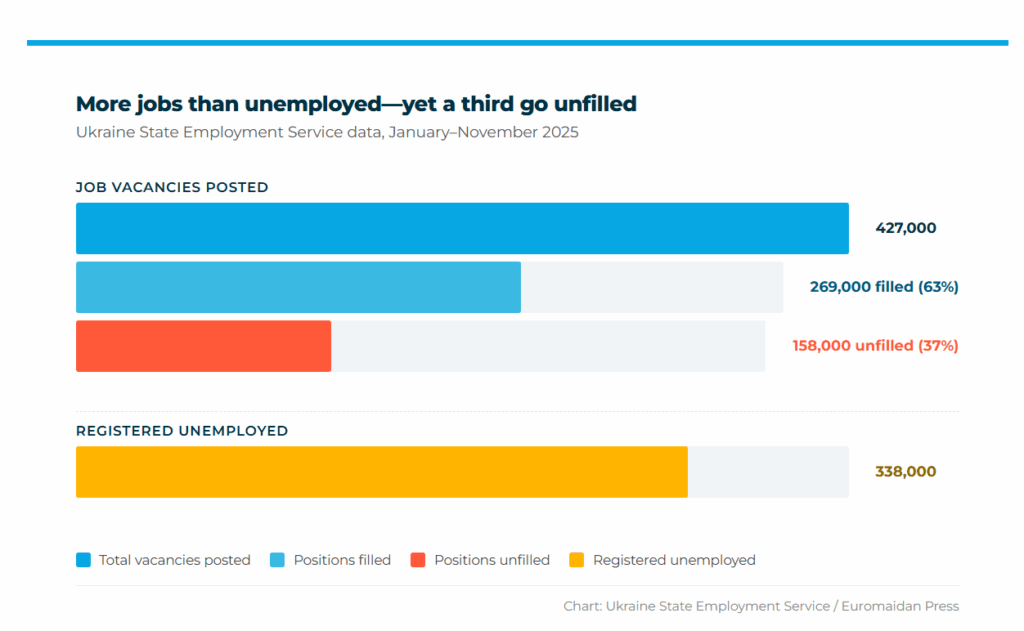
The numbers from the ground
Trending Now
Ukraine’s current business data confirms the pattern. A February 2026 survey by the European Business Association (EBA) found 78% of Ukrainian companies citing skilled worker shortages as a major constraint—second only to energy infrastructure attacks at 82%.
The share of CEOs viewing their situation positively fell from 40% to 32% year-on-year. Those viewing it negatively nearly doubled, from 14% to 23%.
The ceiling isn’t just demographic. Part of it is acoustic.
The alarm triggers fear and disruption; disruption reduces the hit rate; a lower hit rate compounds a workforce shortage already capping GDP growth at 2% in 2026, per every major forecaster. The ceiling isn’t just demographic. Part of it is acoustic.
The researchers draw one direct policy conclusion: mobilization decisions should account for regional labor market exposure, because conscripting workers from already-depleted frontline economies compounds the damage the sirens have already done.
Russia doesn’t need to destroy a factory to damage its output. It just needs to keep the alarms going.
Read also
-
Russia’s winter campaign was supposed to freeze Ukraine, split its grid, and stop its factories. None of it worked, ISW says
-
Russia struck two trains within 24 hours — and Ukrzaliznytsia says rolling stock is now a primary target
-
Three-year loans up 50%, five-year up 72%—but Ukraine’s workforce just keeps shrinking


