

Moscow cut state support for its small businesses by a third last year. This year, their taxes go up. Together, they amount to a government choosing its war over its own economy.
By year-end, Moscow was supporting just 2.2% of all of Russia’s small businesses and self-employed workers.
Total financial support to small and medium enterprises dropped from 529.5 billion rubles (~$6.2 billion) to 354 billion rubles (~$4.2 billion) in 2025—a cut of 33%—according to HSE Centre calculations published this week. The number of businesses receiving anything dropped by 20%.
Fewer businesses received support, and those that did got a quarter less. By year-end, Moscow was supporting just 2.2% of all of Russia’s small businesses and self-employed workers—down from 3.3% the year before.
The smallest were cut off first
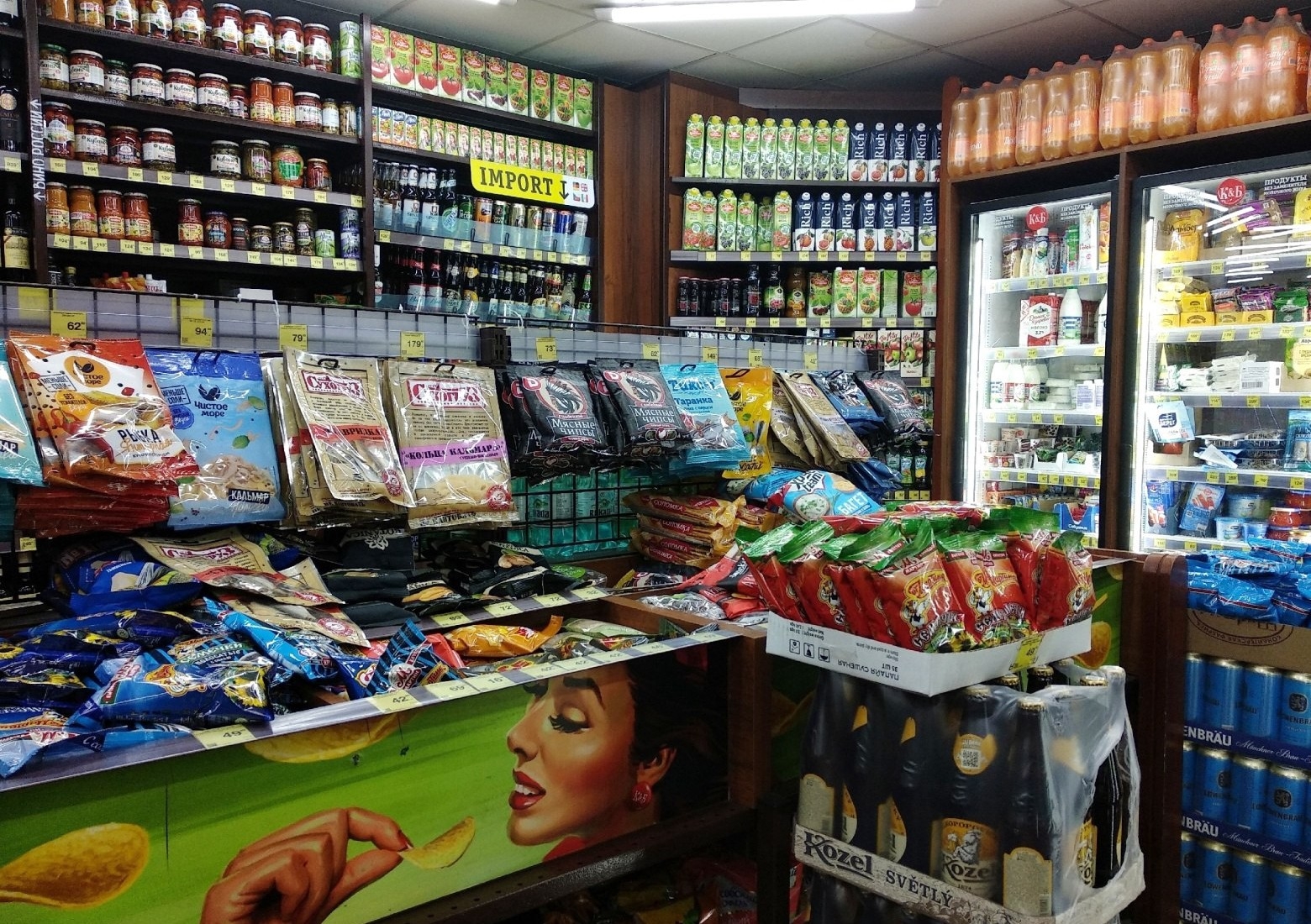
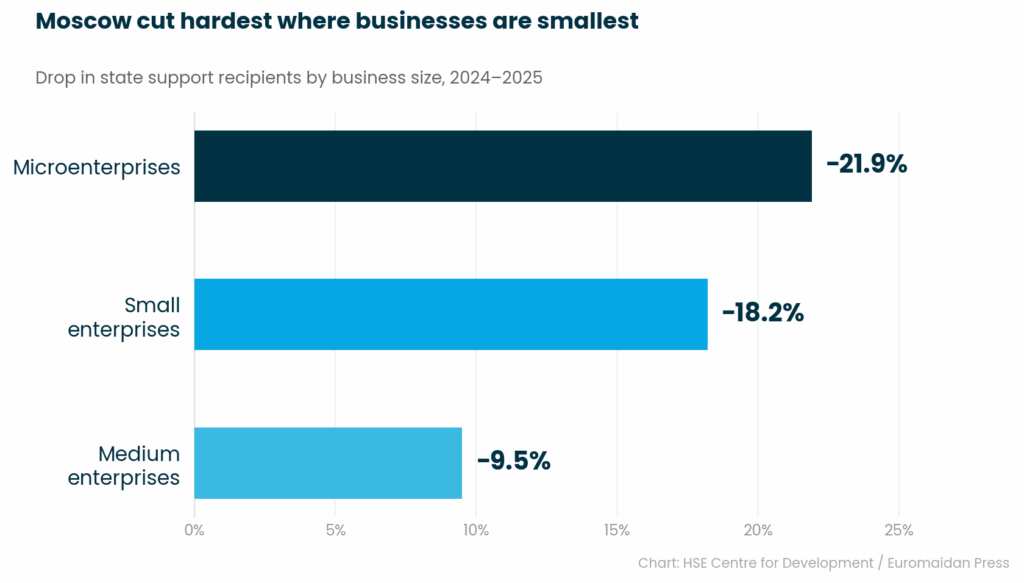
The Kremlin’s cuts fell hardest on the smallest companies. Nearly a fifth of microenterprises—corner shops, small workshops, one-person service businesses—lost their support entirely in 2025. Larger enterprises, better placed to lobby and absorb costs, lost somewhat less.
Sberbank, Russia’s largest lender, has since acknowledged its rising bad-loan problem is concentrated in small and micro businesses.
By mid-2025, Russia’s Central Bank recorded 788 billion rubles (~$9.3 billion) in loans that small businesses could no longer repay on schedule—5% of the entire small business loan book, the highest level in years.
Sberbank, Russia’s largest lender, has since acknowledged its rising bad-loan problem is concentrated in small and micro businesses. Moscow withdrew the safety net just as the floor was giving way.
Then came the tax hike
With a budget deficit of 5.7 trillion rubles (~$67 billion) in 2025—and another 1.7 trillion rubles (~$20 billion) added in January 2026 alone—Moscow raised VAT from 20% to 22% this year and began cutting the threshold below which small businesses are exempt from paying it.
The backlash from business groups was sharp enough that the government agreed to phase it in over three years.
The original proposal would have dropped the exemption threshold from 60 million rubles (~$706,000) to 10 million rubles (~$118,000) at a stroke. The backlash from business groups was sharp enough that the government agreed to phase it in over three years, starting at 20 million rubles (~$235,000) in 2026.
Business outlet The Bell estimated the changes will ultimately pull up to 500,000 small firms into the VAT system. The blow is drawn out. It is not cancelled.
Trending Now
A budget consuming its own economy
Russia’s GDP grew just 1% in 2025, Putin confirmed in February—down sharply from 4.3% in 2024. The IMF projects 0.8% for 2026. A Kremlin-linked think tank declared in January that Russia’s banking system now meets the IMF’s formal criteria for systemic crisis, with small business loans among the worst-performing assets.
Russia’s GDP growth collapsed 76%—a Kremlin think tank says worse is coming (INFOGRAPHIC)
Russian factories have now shed workers for three consecutive months, at the fastest pace since June, as Euromaidan Press reported Tuesday. Military spending and debt service are set to consume 46% of Russia’s 2026 budget; healthcare, education, and housing combined get 13%.
The businesses tied to the defense sector are growing. The rest must survive without state support, pay higher taxes, and borrow at record cost.
Russia’s war budget caught a brief break this week when the US-Israeli strikes on Iran pushed oil prices toward Moscow’s budget assumption—though well short of what Russia needs to stop drawing down its reserves.
The windfall flows to missiles, not to corner shops. The businesses tied to Russia’s defense sector are growing. The rest must now survive without the state support they relied on, pay higher taxes, and borrow at record cost—all at once.


