
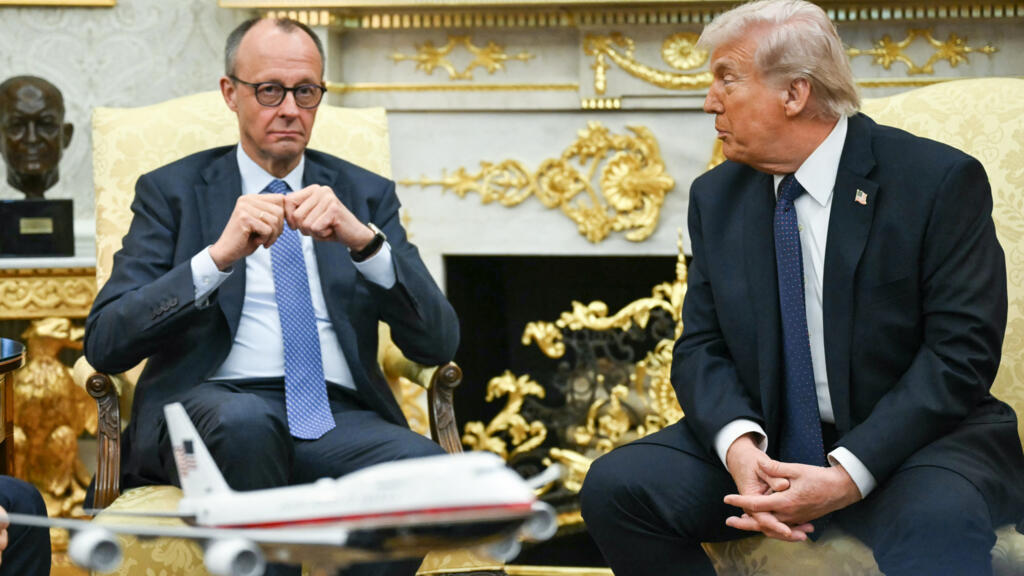
German Chancellor Friedrich Merz brought a map of Ukraine's front lines to his Oval Office meeting with US President Donald Trump on 6 February, using it to argue that Ukraine cannot afford territorial concessions — and came away saying he believed Trump now better understood what was at stake, Politico reports.
"I have gained the impression that the president is now more understanding what is at stake for this country," Merz told reporters after the meeting. He also said he had told Trump that the EU-US trade agreement reached last summer "is not up for debate."
Trump, for his part, reaffirmed that ending the war in Ukraine was a top priority. "What about Russia and Ukraine, where is it on my list of priorities? Very high!" he told reporters at the White House, according to Ukrinform. He said he had believed stopping the war "would be one of the easier tasks" — a judgment he now appears to be revisiting.
The US president repeated his characterization of the relationship between the two leaders as defined by personal animosity. "Between President Putin and President Zelensky — there is tremendous hatred, tremendous hatred," Trump said. "I've seen a lot of hatred in my life, but I think this is at the highest level." He added: "Sometimes I blame one, sometimes the other."
Trump cited casualty figures as his motivation for wanting to end the fighting, claiming that roughly 32,000 soldiers had been killed in the previous four weeks, with a monthly average of 25,000 to 30,000. "This is the worst thing that has happened since World War II," he said. Asked what could be done if a deal remained out of reach, Trump said: "The only thing you can do is make every effort."
The meeting was the centerpiece of Merz's Washington visit, which he had framed around a strategy of private persuasion rather than public confrontation. The chancellor said nothing when Trump threatened to "cut off all trade with Spain" over Madrid's criticism of US strikes on Iran and its refusal to meet NATO's 5-percent-of-GDP defense spending target. Nor did Merz respond when Trump attacked British Prime Minister Keir Starmer — "this is not Winston Churchill that we're dealing with" — over a dispute involving the Chagos Islands.
Merz later said he had defended both leaders behind closed doors. On Starmer, he told Trump the British prime minister was making "a really very, very large, very, very valuable contribution in the E3 format to ending the war in Ukraine, and that I consider this criticism of him to be unjustified." On Spain, Merz said after the meeting: "There is no way that Spain will be treated particularly badly" on trade as a member of the EU.
The chancellor was explicit about why he kept his disagreements off camera. "I did this behind closed doors because, as I said, I did not want to play out the conflict on the open stage there," Merz said.
Trump called Merz a "friend" and praised him for doing "really a great job," noting the chancellor's public support for US strikes on Iran. "He's been helping us out" and "very nice" on the matter, Trump said. In the Oval Office, as Trump described the damage inflicted on Iran — "just about everything has been knocked out" — Merz said Germany was on the "same page" on the need to eliminate the regime in Tehran.
On the trade front, Merz said European patience had limits. "Here in Washington, they know that we on the European side have reached a limit in terms of what we are willing to accept," he said, adding that he believed Trump and his staff understood that. In front of the cameras, however, Trump threatened to intensify his trade wars and complained of having given away "massive amounts of ammunition" to Ukraine.
Zelenskyy has said that the next peace talks are scheduled for Abu Dhabi in early March and have not been cancelled, Ukrinform reports.