


Russia's military command is still operating in "an alternate reality, setting wildly unrealistic deadlines that do not match Russia's actual battlefield capabilities," the Institute for the Study of War assessed in its 3 March report. At the same time, Ukrainian forces produced their strongest territorial results since the summer 2023 counteroffensive — roughly two and a half years ago.
A command that has never adjusted its ambitions
The dysfunction is not new. ISW traces it to the opening of the full-scale invasion, when Russia's command attempted to seize Kyiv within days in February 2022. Since then, "the Russian military command has issued deadlines for the seizure of all of Donetsk Oblast multiple times, with Russian forces failing each time." The command has "not adjusted its demands despite these failures and justified complaints" — including from Russian milbloggers, who have repeatedly criticized leadership for ordering costly attacks against unrealistic and broad objectives and driving up casualties.
The current ambitions make all previous failures look modest. Ukraine's President Volodymyr Zelenskyy stated on 2 March that Russian military plans for 2025–2027 call for seizing the remainder of Donetsk and Luhansk oblasts, continuing advances in Zaporizhzhia and Kherson oblasts, and moving to "advance into and seize all of Odesa Oblast."
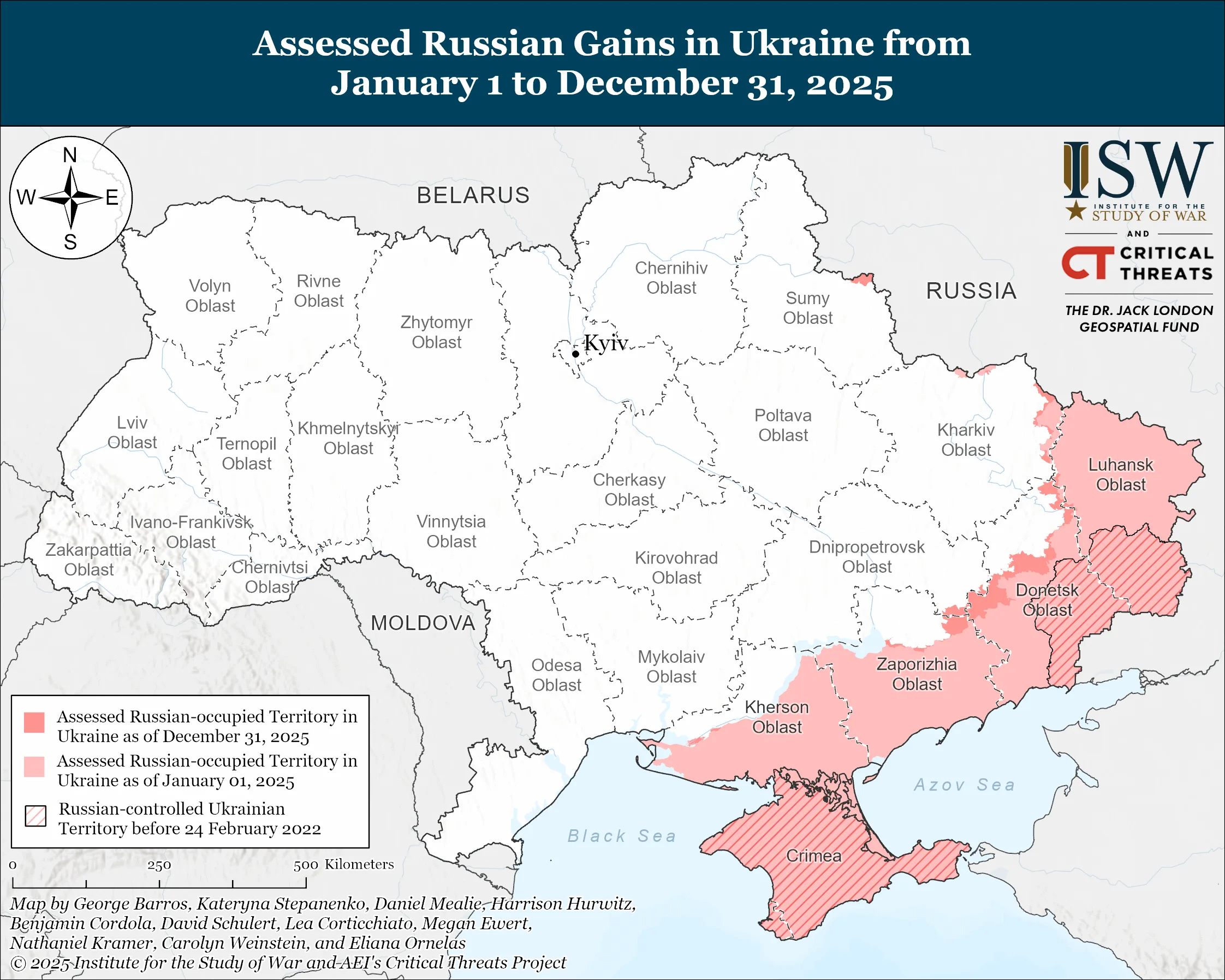
ISW assessed that Russian forces are "highly unlikely to be able to advance to Odesa City, let alone seize the entire oblast." The Odesa plans also confirm the Kremlin has no intention of freezing the line in the south — and maintains territorial ambitions beyond even the five Ukrainian regions it has illegally annexed, as ISW has long assessed.
Ukraine's February gains throw Russia's spring timetable into disarray
Ukrainian forces gained almost 33 km² in the week of 14–20 February, then roughly 57 km² the following week, according to ISW. Since 1 January, ISW assessed total Ukrainian liberation at roughly 257 km² — though the institute acknowledges this figure underestimates real Ukrainian advances. ISW maps only the furthest confirmed extent of Russian positions, updating terrain assessments only once sufficient open-source evidence accumulates. The increasingly porous, non-contiguous front line adds further complexity. Zelenskyy, in an interview published on 3 March, put the figure at 460 km² recaptured since the start of 2026.

Russia’s winter offensive ground to a halt as Ukraine recaptured more land than it lost in February, Syrskyi says
The last comparable period came during the summer 2023 counteroffensive, when Ukrainian forces netted 377 km² in June, 257 km² in July, and 1.47 km² in September. ISW cautioned the current localized counterattacks are "unlikely to grow into a large-scale counteroffensive," and that Russian forces "will very likely stabilize their positions and begin advancing again."
The immediate strategic damage to Moscow is already real, however: Ukraine's gains "have disrupted Russian efforts to set conditions for their Spring-Summer 2026 offensive and will force Russian troops to establish stable defenses before starting the fight to regain lost ground."
Read also
-
With Kharkiv under growing artillery fire, Zelenskyy demands buffer zone on Russian soil
-
Russia’s Starlink replacement is giving away its positions — Ukrainian brigade tracks drone pilots by their Wi-Fi antennas
-
“Life expectancy of Russian soldier here is 12 minutes”: Moscow deploys two elite airborne divisions for one village next to Zaporizhzhia


