

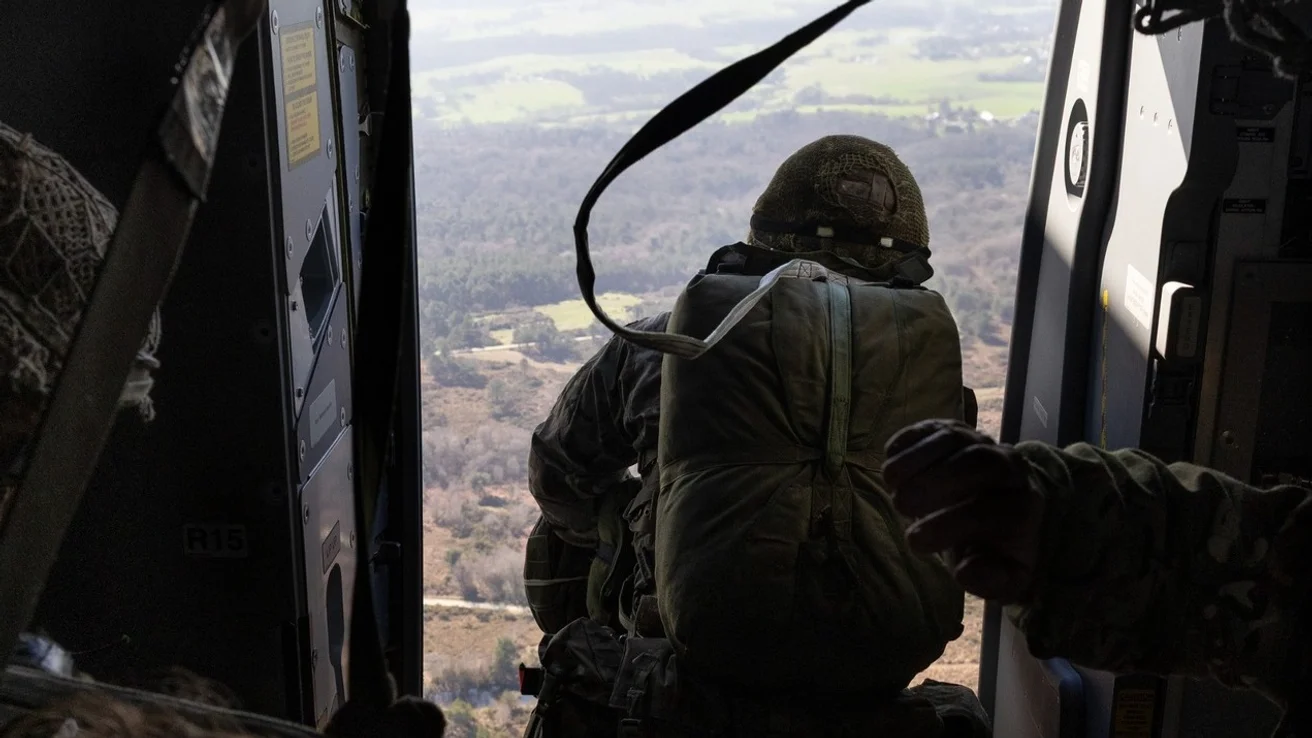
More than 1,500 British and French paratroopers launched a nine-day airborne drill in Brittany on 24 Feb. — the fourth anniversary of Russia's full-scale invasion of Ukraine — rehearsing rapid deployment that could underpin a future peacekeeping force on Ukrainian soil, the Telegraph reports.
The exercise, code-named Orion, is France's largest military drill since the Cold War. Run from a French-led headquarters at Orléans-Bricy airbase near Paris, it paired over 600 soldiers from the UK's 16 Air Assault Brigade with comrades from the French 11e Brigade Parachutiste for a mock airborne raid on the St Cyr-Coëtquidan training area in western France, according to the Telegraph and Euronews.
The drill came weeks after UK Prime Minister Keir Starmer said he was "ready and willing" to deploy British troops to Ukraine, and after both London and Paris stated they could lead a peacekeeping contingent once a ceasefire is agreed.
Ukrainian President Volodymyr Zelenskyy said the UK and France had each committed to sending about 5,000 troops in the event of a peace deal with Russia, the Telegraph reports.
How the exercise unfolded
British Pathfinders and France's Groupe Commando Parachutiste landed first at the drop zone, destroyed simulated enemy air defenses, and marked landing areas for the main force. Soldiers from the 2nd Battalion The Parachute Regiment then jumped in alongside two French battlegroups. A platoon from Italy's Brigata Paracadutisti Folgore also took part before an RAF A400M dropped supplies, according to the Telegraph.
The UK Ministry of Defence said the training was designed to prepare troops "for the realities of 21st-century conflict." It focused on three objectives: speed, endurance, and autonomy.
"Airborne forces dropped into an area must be able to hold out for 48 to 72 hours using their own drones, batteries and ammunition," said Colonel Colomban de Poncharra, commander of France's 3rd Marine Infantry Parachute Regiment.
General Renaud Rondet, the French commander in charge of the exercise, said the training was critical. "This exercise also allows us to test new structures and equipment, particularly in the areas of hybrid communication networks and drone integration. The ability to innovate and adapt quickly is now a key factor in retaining superiority on the battlefield," he said.
Readiness questions
The units that would deploy on a peacekeeping mission have not been announced. But soldiers of 16 Air Assault Brigade are part of Britain's high-readiness force and can deploy with NATO at short notice, the Telegraph notes.
"These guys are the tip of the spear of the conventional army. They are the most ready people to go and do anything," a defence source told the Telegraph.
However, questions persist over Britain's capacity to field such a force. The British Army has shrunk to about 70,000 troops — its smallest in more than 200 years, the Telegraph reports. Starmer was warned this week that sending a fully equipped brigade to Ukraine would require pulling troops out of Estonia and Cyprus.
Armed Forces Minister Al Carns said on Wednesday the UK was three years away from readiness for a major war. "When it comes to deterring Russia, we have three to five years before we have to fight a significant confrontation with a major state," he told The Times. "The reality is, whether we like it or not our military in a lot of cases hasn't changed from the 1990s and 1990s. We've got to move faster, and on everything."
Broader context
Exercise Orion is part of a three-month cycle mobilizing 12,500 troops, 25 ships, and 140 aircraft from France and 24 partner nations, preparing for what military planners call high-intensity conflict amid escalating threats from Russia.


