

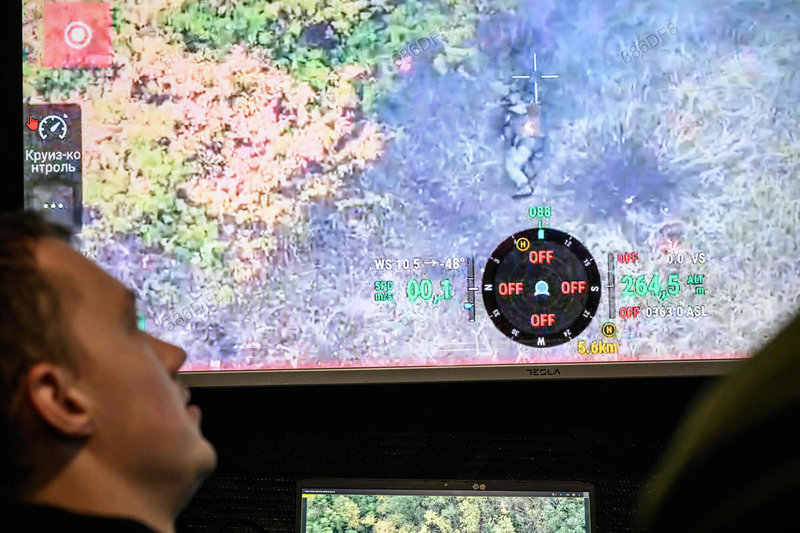
Months after Ukrainian forces encircled a Russian incursion into Kupiansk, the besieged occupiers are being hunted down with no prospect of relief.
Ukrainian signals intelligence detected about 20 active Russian radio call signs in the besieged high-rises on 25 February, Viktor Trehubov, spokesman for Ukraine's Joint Forces Group, told Pershyi TV. The call signs represent individual transmitters detected through signals intelligence.
Trapped occupiers are concentrated in several apartment blocks near the city hospital on Kupiansk's northern edge. They are "just slowly ending there," Trehubov said. The actual number of soldiers is somewhat higher than 20, on the order of several dozen, consistent with previous estimates.
"These are several high-rises, in which about 20 active Russian call signs were detected yesterday. They are just slowly dying off there." —Viktor Trehubov, spokesman, Joint Forces Group
The slow death of Russia's Kupiansk gamble
The numbers tell a story of steady attrition. In late November 2025, Russian General Sergei Kuzovlev told Putin that his forces had "completed the liberation of Kupiansk." Putin awarded him Russia's highest military honor. Three days later, Zelenskyy filmed himself at the city's entrance. "I went to Kupiansk myself to show the world that Putin is lying," he said.
At the peak of the incursion, an estimated 200–300 Russian soldiers occupied parts of the city. Intercepted radio traffic indicated about 100 remained by 22 December. By Christmas, the count had dropped to 50. Mid-February brought it down to 22. Now, 20.
Supply lines were cut months ago. Drones are their only lifeline—and those carry little.
A city that refused to fall
Before the full-scale invasion, Kupiansk was a quiet railway hub of about 27,000 people in northeastern Kharkiv Oblast. Soviet-era apartment blocks lined its streets. A central market served the surrounding villages. Russia seized the city in the invasion's opening days in February 2022; Ukraine liberated it that September in the lightning Kharkiv counteroffensive.
What followed was 22 months of grinding Russian attempts to retake it—a campaign that devoured at least two combined-arms armies and over 13,000 soldiers. All for a bridgehead that collapsed the moment Ukraine counterattacked in earnest. Moscow had reportedly ordered Kupiansk seized by February 2026. That deadline has passed. Its last troops are cornered in apartment buildings, surviving on whatever drones can drop through Ukrainian fire.
Moscow ordered Kupiansk taken by February 2026. The deadline passed. Its last troops survive on drone-dropped supplies in apartment blocks they can't leave.
Broader pressure continues
Russian forces are also pushing toward Lyman, Stavky, and Yampol, Trehubov noted. Their tactic is standard: mass small-group infiltration along single axes. On the Lyman direction, he flagged constant enemy attacks on infrastructure and logistics routes as a persistent problem.
Fighting continues in Sumy Oblast as well. Occupiers hold the village of Hrabovske and are attempting to seize Popivka and Pokrovka. "Within the region, it's not much," Trehubov acknowledged, "but the very fact that Russians are on Ukrainian territory at all cannot please us."
Read also
-
Ukraine reports “confident control” over Kupiansk with just dozens of Russian troops left in one quarter
-
Russia sets new February deadline to take Kupiansk, Ukrainian military says (MAP)
-
Russia ramps up pressure after Kupiansk defeat — but it may already be too late
-
“Reality speaks for itself”: Zelenskyy visits Kupiansk as Ukraine traps remaining Russian forces
-
Frontline report: Kupiansk became a graveyard for Russia’s 6th Army — and it’s still digging deeper


