

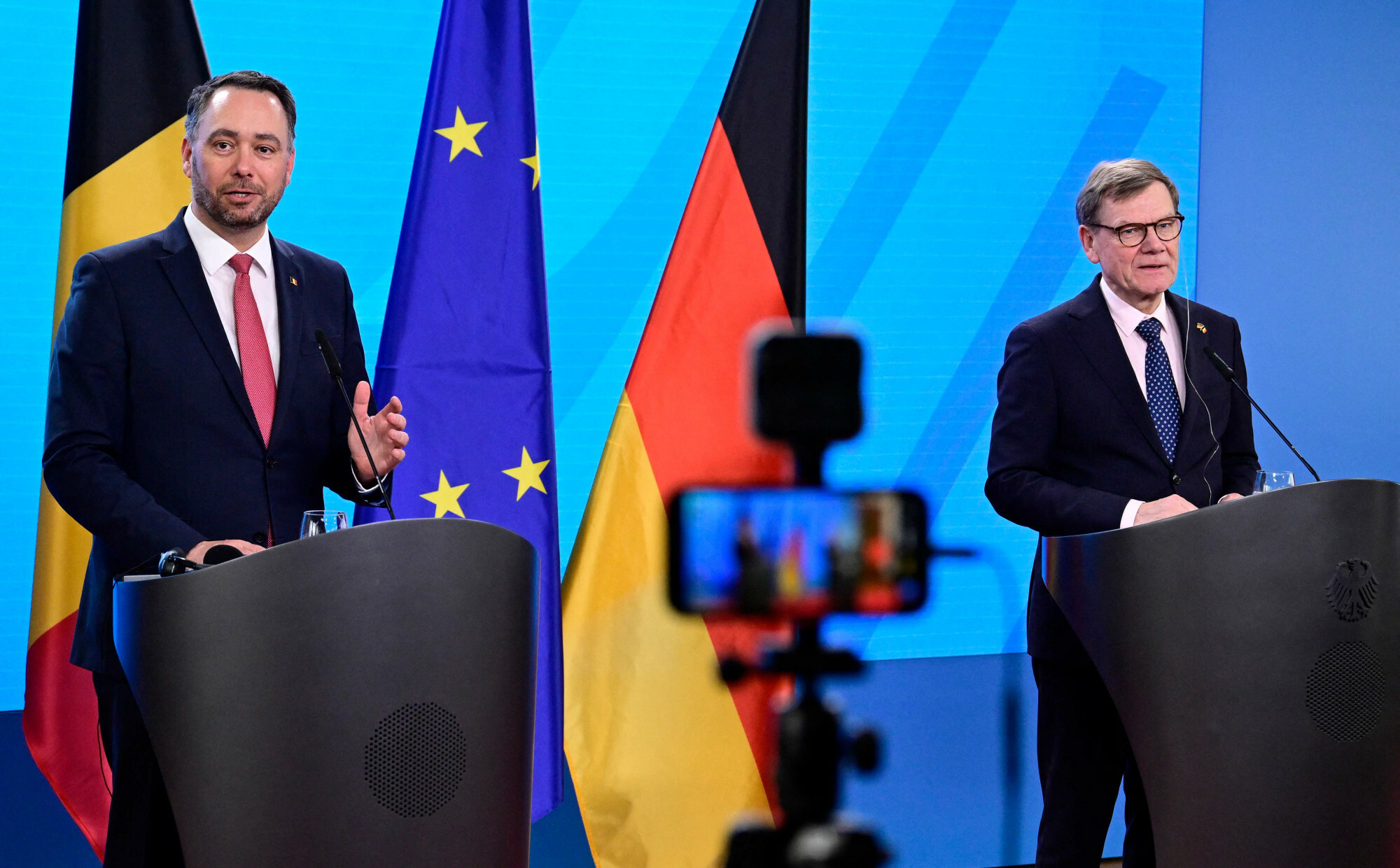
German Foreign Minister Johann Wadephul declared on 25 February that the EU will not revisit seizing €210 billion ($246 billion) in frozen Russian assets to support Ukraine, calling the matter “definitively resolved.”
He spoke at a joint press conference in Berlin with Belgian Foreign Minister Maxime Prévot, the representative of the country where the bulk of Russia’s frozen sovereign wealth is held. Prévot called it “unacceptable” that Hungary was taking Ukraine’s population “hostage in a war situation for electoral purposes.”
“That is why billions in Russian assets remain frozen. And that is why we will continue to increase the pressure on Russia.”
The statement came 48 hours after EU foreign policy chief Kaja Kallas said the opposite. With Hungary blocking the EU’s €90 billion loan to Ukraine, Kallas called frozen assets the bloc’s original “Plan A” and said the EU could “always go back” to using them.
Wadephul’s response shut that down. The day before, he had co-signed a Weimar Triangle op-ed with French Foreign Minister Jean-Noël Barrot and Polish Foreign Minister Radosław Sikorski: “That is why billions in Russian assets remain frozen. And that is why we will continue to increase the pressure on Russia.” Frozen, not seized.
Kallas opens a door, Berlin shuts it
On 23 February, Hungary vetoed both the €90 billion loan and the EU’s 20th sanctions package—breaking a December pledge not to obstruct the aid. Budapest linked its veto to the Druzhba pipeline dispute with Kyiv. Wadephul said he was “shocked” by Hungary’s actions, adding that Budapest was “betraying its own freedom struggle”—a reference to the 1989 freedom struggle.
“We had a ‘Plan A’ on the agenda, and it was about the use of Russia’s frozen assets.”
Asked whether the EU had a backup plan, Kallas pointed to the frozen assets. “We had a ‘Plan A’ on the agenda, and it was about the use of Russia’s frozen assets,” she said. “If this doesn’t work, we can always go back to the use of frozen assets. We can do it faster then.”
Two days later, Wadephul closed that window. He said the EU had found “a very good backup tool” in the €90 billion credit and that the discussion “has been definitively clarified.” The topic could return “when the discussion turns to compensation,” he added—meaning postwar reparations, not the current crisis.
Kallas acknowledged on 24 February that EU officials have done “no work” on the frozen assets option.
In December, Germany was the only country willing to share the legal risk with Belgium. Three months later, Wadephul is declaring the discussion unnecessary.
Kallas herself acknowledged on 24 February that EU officials have done “no work” on the frozen assets option since December.
Why December’s “no” still holds
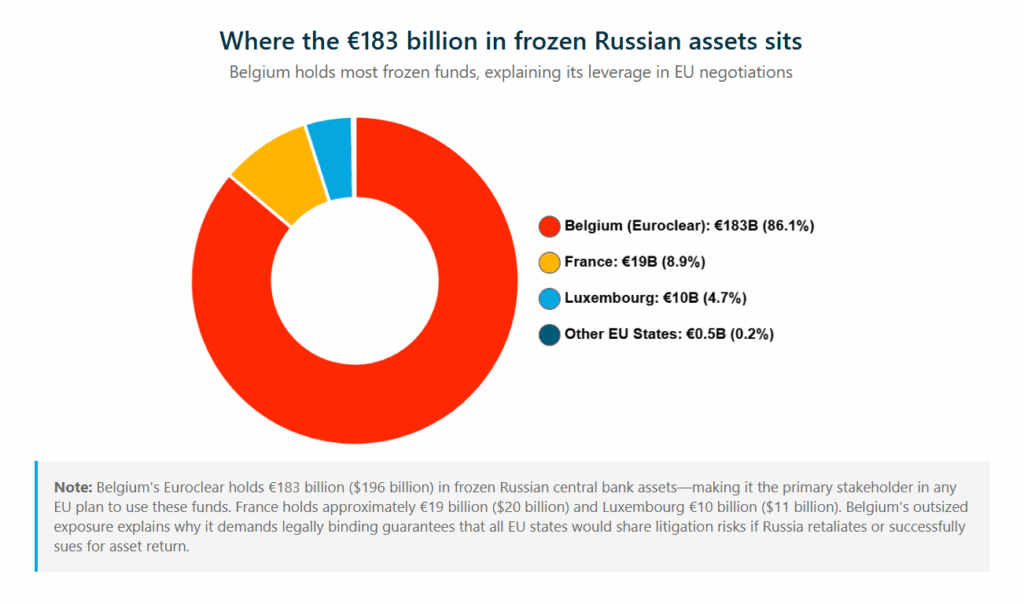
The reparations loan failed in December because Belgium demanded that all EU members share the legal risk if Russia sues over the assets. Most of the €210 billion is held at Euroclear, a financial clearinghouse in Brussels, with France holding around €20 billion and smaller sums in Luxembourg and other jurisdictions.
Belgian PM Bart De Wever warned at the time that “the fattest chicken is in Belgium, but there are other chickens around”—and none of the other holders stepped forward.
Trending Now
The largest holders of Russian state money in Europe—Belgium, France, Luxembourg, and Germany—have all resisted outright seizure.
In December, Chancellor Friedrich Merz flew to Brussels to convince Belgium to accept the reparations loan. Germany was the only country willing to share the risk. The largest holders of Russian state money in Europe—Belgium, France, Luxembourg, and Germany—have all resisted outright seizure.
EU leaders chose the €90 billion loan as a compromise backed by the common budget, with a mandate for the Commission to keep working on the reparations mechanism by the end of 2027.
None of those conditions have changed.
The veto, the workaround, and the April deadline
Hungary’s veto stands, but the EU is trying to work around it. The EU Council approved two of three required legislative acts on 24 February. Von der Leyen said in Kyiv the EU would deliver the money “one way or another.” The Commission expects Hungary to honour its December pledge not to obstruct the aid.
The third document—changes to the EU’s multiannual budget—is what Hungary blocks, and it requires unanimity. A crisis meeting on the Druzhba pipeline dispute, including Croatia as a potential alternative oil route, was scheduled for Wednesday.
Orbán faces elections on 12 April, and EU officials are concerned that pressuring him during the campaign could backfire.
Ukraine’s budget could run dry as early as April.
Without the EU loan, an $8.2 billion IMF program is also at risk. Ukraine’s budget could run dry as early as April.
EU members paid Moscow €16 billion for oil and gas in 2025—€500 million more than the EU gave Kyiv in budget support that year, according to data from Finland’s Centre for Research on Energy and Clean Air.
The €210 billion remains frozen. The reparations loan remains dead. The only approved funding mechanism remains blocked.
Read also
-
Belgian PM says Kremlin threatened him personally over frozen assets for Ukraine. Moscow’s pressure is clearly paying off
-
Belgium’s PM calls Ukrainian victory a “fairy tale” — and wants EU taxpayers to pay instead of Russia
-
Belgium says Europe’s €140 billion Ukraine plan could bankrupt it. Is that true?