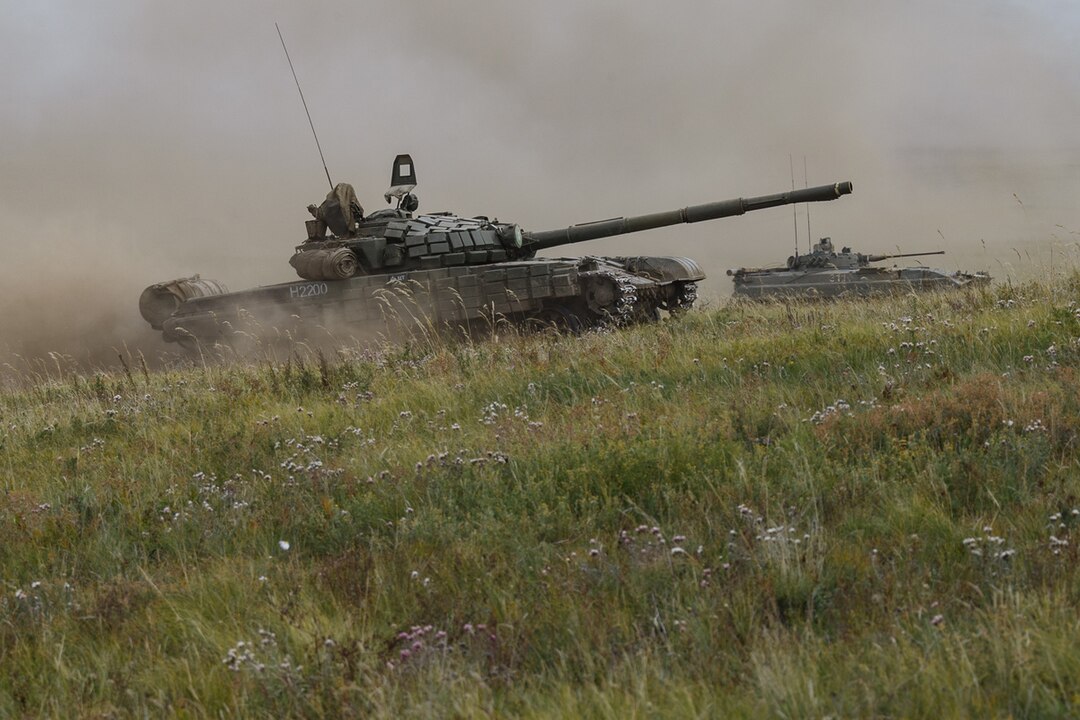

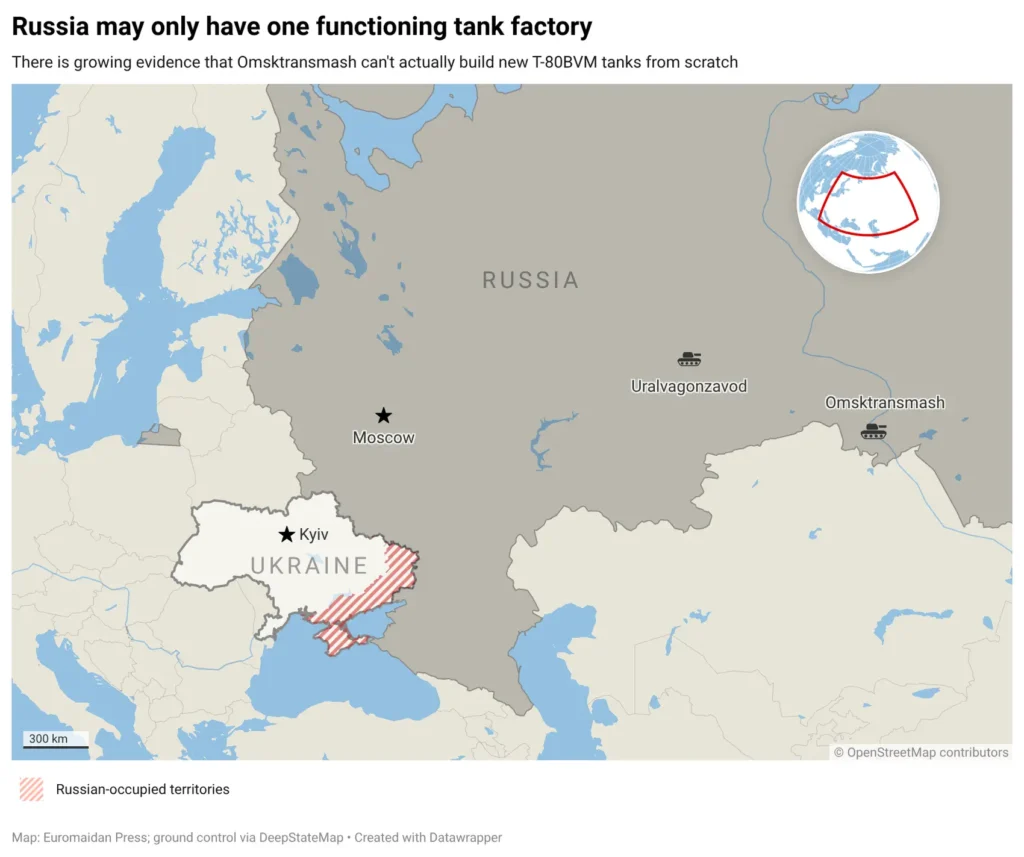
Russia isn't about to run out of tanks. But that doesn't mean the Kremlin isn't lying about the health of its tank industrial base. Indeed, it's increasingly apparent Russia has just one functioning tank factory, not two. And that has implications for Russia's capacity to wage mechanized war in the future.
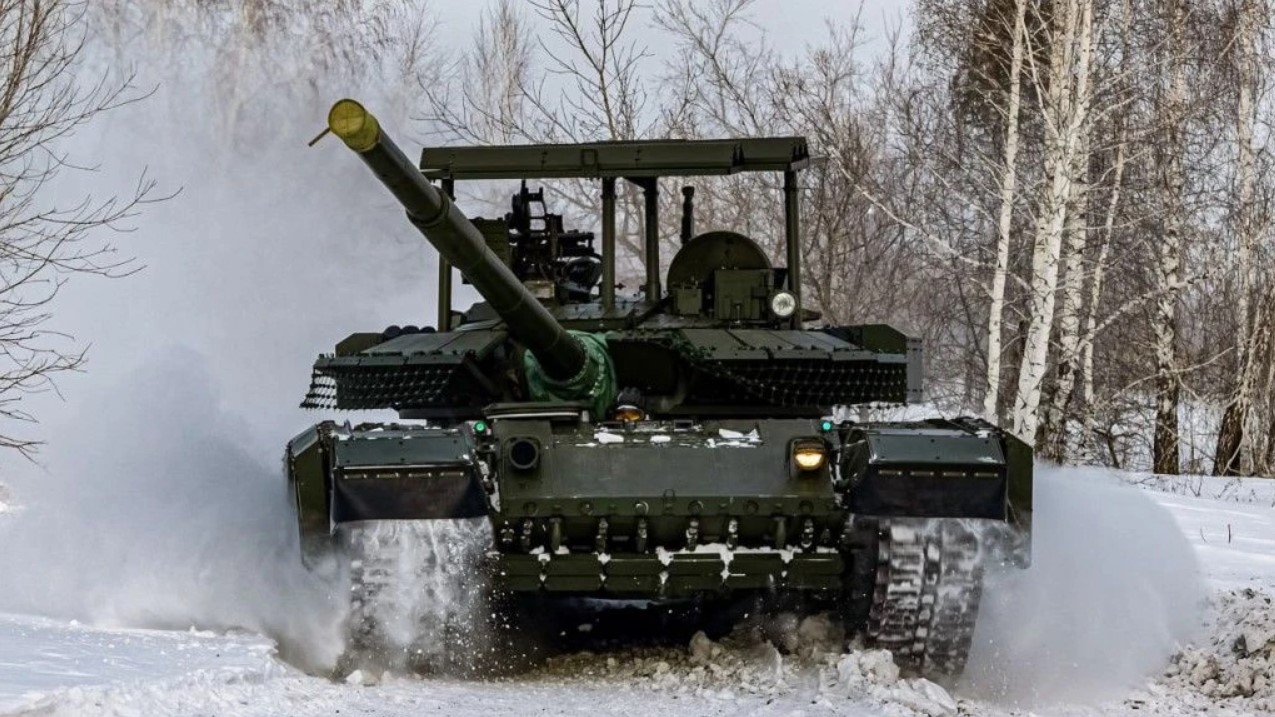
If the Omsktranshmash plant in Siberia can't actually build new T-80BVM tanks from scratch—and there's growing evidence it can't—then Russia's entire supply of modern tanks depends on a single factory. That's a strategic bottleneck with consequences for how long Moscow can sustain mechanized warfare.
Yes, Russia's main tank factory—Uralvagonzavod in Nizhny Tagil—is churning out new T-90M and T-72B3M tanks at a rate of hundreds per year. But there's a good chance the other purported tank factory—Omsktranshmash—isn't capable of making T-80BVM tanks from scratch, as Russian officials have claimed.
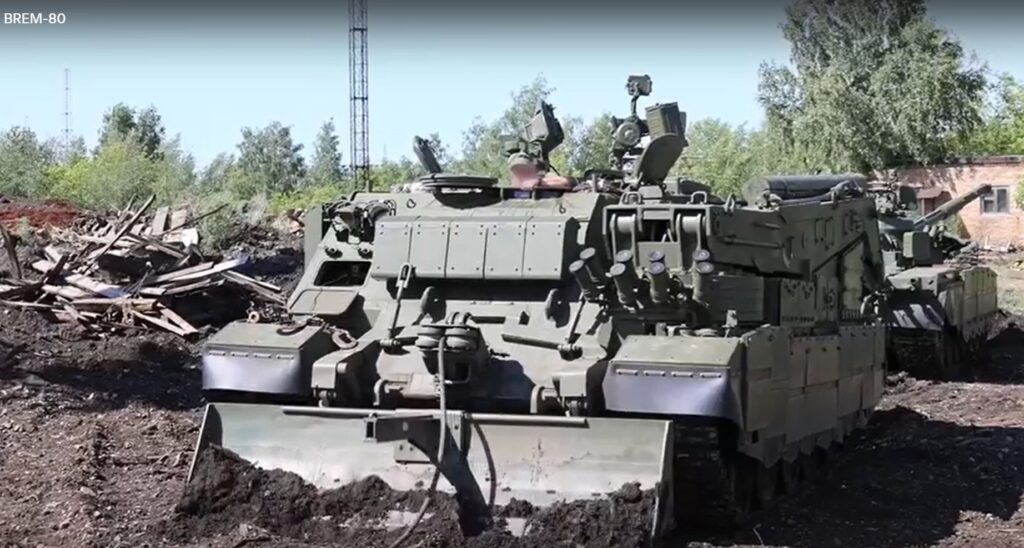
Analyst Jompy catalogued the evidence that Omsktranshmash is cannibalizing stored T-80s for parts and engineering vehicles rather than producing new tanks.
Instead, it's very possible Omsktranshmash can only produce "new" T-80s by restoring old ones left over from the Soviet era. Once the old T-80s run out—and they could do so very soon—Omsktranshmash won't have anything left to work with.
At that point, the Russian armed forces will have just one domestic source for modern tanks. Russian regiments in Ukraine have effectively parked almost all of their tanks, and are instead attacking with infantry, but mechanized forces, including tanks, could make a comeback in some future conflict.
If and when that happens, the Russians will probably count on just one factory to replace combat losses.
Two factories, one mystery
Russia has two plants associated with tank production. They serve very different roles—and one may not be doing what the Kremlin says it is.
| Factory | Location | Tank family | Claimed role | Evidence |
|---|---|---|---|---|
| Uralvagonzavod | Nizhny Tagil, Sverdlovsk Oblast | T-90M, T-72B3M | New build + modernization | Confirmed: estimated 150–250 new T-90Ms/year. Assembly line photos exist. Running 24/7, three shifts. |
| Omsktranshmash | Omsk, Siberia | T-80BVM | New build (claimed since 2023) | No assembly line photos. Deliveries appear to be restorations of stored Soviet-era T-80s, not new production. Barrels being scrapped. Engineering vehicles with T-80 hulls observed leaving factory. |
The T-90s and T-72s belong to the same basic family of vehicles and share many design elements. The T-80s descend from a different lineage—the Ukrainian-made T-64—and are powered by gas turbines instead of the diesel engines common on other Russian tank types.
That distinction matters: the two tank families require different supply chains, different expertise, and different factory tooling.
Dwindling tanks
The Russian military widened its war in Ukraine in February 2022 with 3,000 active tanks in its inventory. In 48 months of hard fighting, the Russians have lost around 4,000 tanks.
They've made good all those losses by building new T-90s and T-72s and restoring old T-80s from the 1980s, T-72s from the 1970s, T-62s from the 1960s, and even 1950s-vintage T-55s.
Trending Now
In 2023, Russian officials claimed Omsktranshmash would resume production of new T-80s in order to supplement those new T-90s and T-72s rolling out of Uralvagonzavod. Building a tank from the tracks up requires a lot of precision welding and a skilled workforce, which is why so few countries produce new tanks—and why even major powers such as the United States normally have just one tank factory.
But there's a growing body of evidence that Omsk isn't actually making new T-80s—and the Kremlin has decided to expend most of the last few hundred T-80s left in the inventory.

Analyst Jompy listed the evidence:
- There are signs Omsktranshmash is scrapping the barrels of some stored T-80s rather than repairing those barrels so the tanks can be reactivated as tanks.
- New vehicles observed leaving the Omsktranshmash factory include artillery and engineering vehicles with refurbished T-80 hulls. But deliveries of actual T-80s are vanishingly rare.
- There are photos of the T-90 and T-72 assembly lines at Uralvagonzavod. There are no photos confirming the existence of a T-80 assembly line at Omsktranshmash.
Satellite imagery indicates there are very few old T-80s left in storage. One recent OSINT analysis found just 134 T-80s still visible at Russian depots—down from more than 1,450 before the full-scale invasion. The Janes defence intelligence group noted that Russia announced plans to restart new T-80 production in 2023, but no evidence suggests this has actually happened.
So if the Russians intend to wind down the T-80 fleet, the end may come soon.
One factory to rule them all
What Omsktranshmash does next is anyone's guess. Jompy anticipates the plant "probably switching to T-72 repair, refurb[ishment] and modernization."
That would leave Uralvagonzavod as the sole source for every new Russian tank—and the Kremlin is already asking it to do more.
Leaked internal documents revealed that Uralvagonzavod aims to produce 428 T-90M and T-90M2 tanks annually by 2028, nearly double its current estimated output. All from a single plant that has already laid off roughly 10% of its workforce and frozen new hires amid sanctions pressure on its supply of Western optics, electronics, and machine tools.
Russia started this war with two tank families and two factories. It may end it with one of each—and ambitious production targets that depend on a plant already running at its limits.