

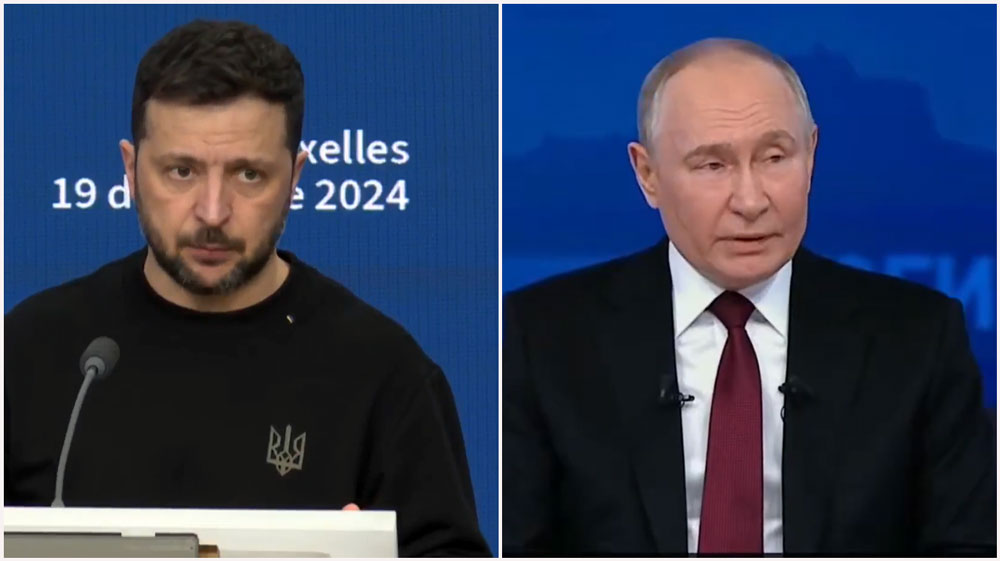
Ukrainian President Volodymyr Zelenskyy on 23 December released the latest US-Ukrainian-European 20-point peace plan, which the US will reportedly present to Russia, according to the Institute for the Study of War (ISW). The revised framework differs from the earlier 28-point plan in significant ways, clawing back several major concessions, but the Kremlin has signaled it is not interested in compromises and continues to insist on demands unchanged since the start of the full-scale invasion.
20-point plan reverses key provisions of the 28-point framework
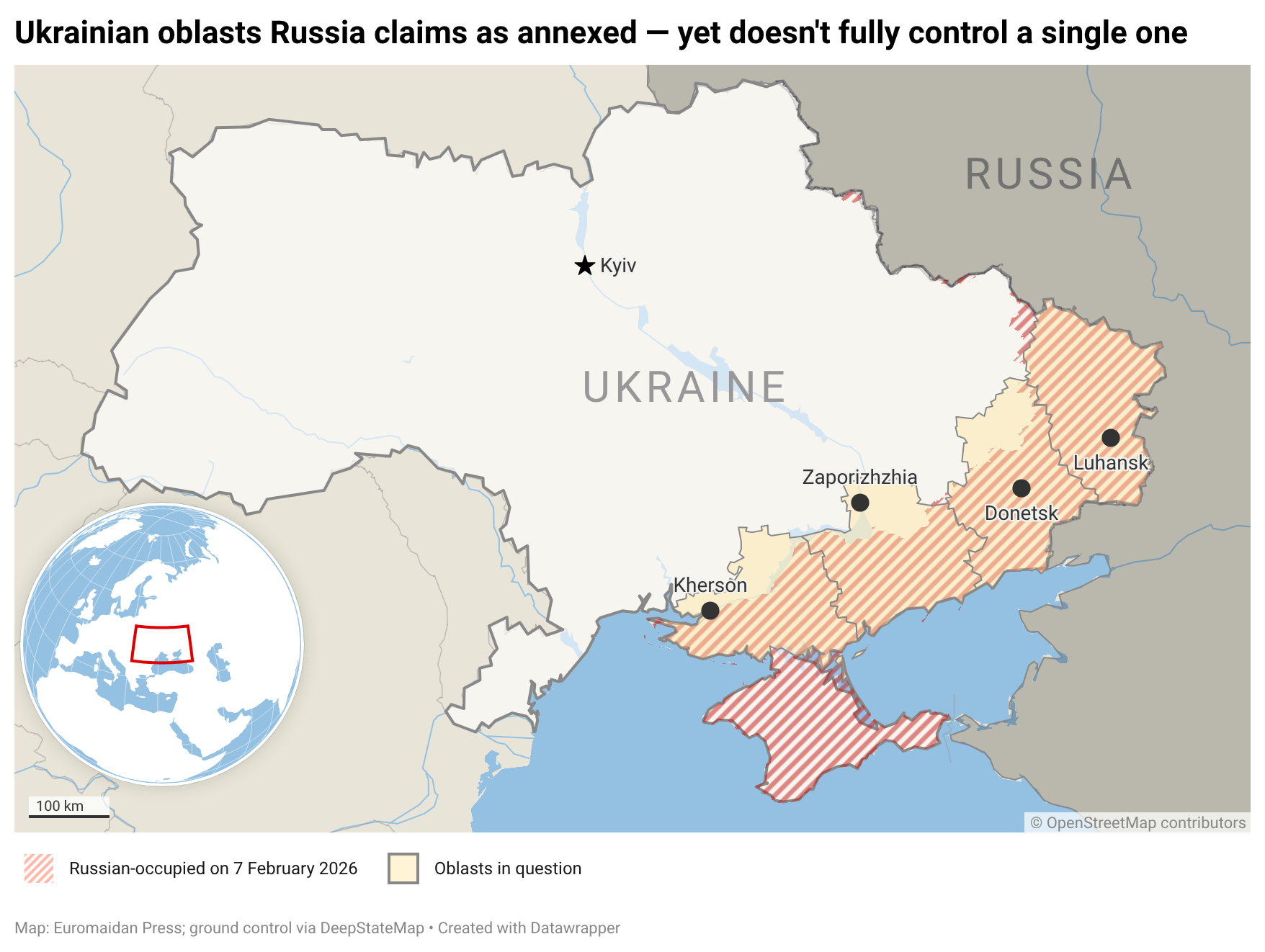
The earlier 28-point plan called for Ukraine to withdraw from unoccupied Donbas, for a demilitarized zone in Donbas internationally recognized as de facto Russian territory, and for the frontline to freeze in Zaporizhzhia and Kherson oblasts. It also capped Ukraine's peacetime military at 600,000 personnel and demanded Kyiv abandon its NATO membership bid.
The new 20-point plan instead freezes the war along the frontline in all four oblasts — Luhansk, Donetsk, Zaporizhzhia, and Kherson — as of the signing date. It raises Ukraine's peacetime troop cap to 800,000 and does not mention Ukraine's possible NATO membership, ISW noted noted. References to NATO membership may appear in the other unpublished documents, however.
Zelenskyy said three additional documents accompany the 20-point plan: a US-Ukrainian-European document on security guarantees, a bilateral US-Ukrainian document on the US military's role in those guarantees with a detailed response plan for renewed Russian aggression, and a US-Ukrainian "Roadmap for Ukraine's Prosperity" covering post-war recovery and economic development.
EU wants Russia to hold free elections and withdraw troops from Belarus, Georgia, Armenia, and Transnistria— as part of a Ukraine peace deal, leaked paper shows
Kremlin dismissed proposals before even seeing them
ISW assessed that Russia would need to abandon longstanding demands to accept either the 20-point or the earlier 28-point framework, many provisions of which directly contradict Moscow's stated positions. US Ambassador to NATO Matt Whitaker told Fox News on 23 December that "the ball is currently in [Russia's] court." Whitaker noted that despite taking heavy casualties for "very small" battlefield gains, the Kremlin has shown no sign of moving toward ending the war.
Russian Presidential Aide Yuriy Ushakov stated on 21 December — two days before the 20-point plan was even published — that he was "certain" the US-Ukrainian-European proposals would be "rather unconstructive" and would not "improve" the settlement agreement. ISW assessed that Moscow has consistently advanced demands that conflict with the 20-point framework and has demonstrated no willingness to accept a compromise-based outcome.

Geneva talks hit impasse over Medinsky’s demands as Witkoff claims “meaningful progress”
Putin himself reiterated as recently as 19 December his commitment to the demands from his June 2024 speech to the Russian Ministry of Foreign Affairs: Ukraine's withdrawal from four oblasts, abandonment of NATO aspirations and commitment to neutrality, demilitarization to a degree that Ukraine cannot defend itself, "denazification" (replacement of the current government with a pro-Russian puppet regime), international recognition of Russia's annexations including Crimea, and the lifting of all Western sanctions. Those demands essentially repeated his demands from the start of the full-scale invasion in 2022, ISW noted.
Duma deputies and Kremlin-linked sources confirm Russian discontent
The Kremlin had not officially responded to the 20-point plan as of the ISW assessment. Russian State Duma International Affairs Committee First Deputy Head Alexei Chepa criticized the plan's lack of a NATO membership prohibition and rejected proposals for Ukrainian participation in managing the ZNPP. Chepa stated Russia will make "significant adjustments" to the clause on territories, which he said will not satisfy the Kremlin.
"Russia’s demonstrated unwillingness to engage in compromises and its unwavering commitment to achieving its original war goals from 2022 suggest that the prospects for this peace agreement to end the war remain low at this time," ISW concluded.


