

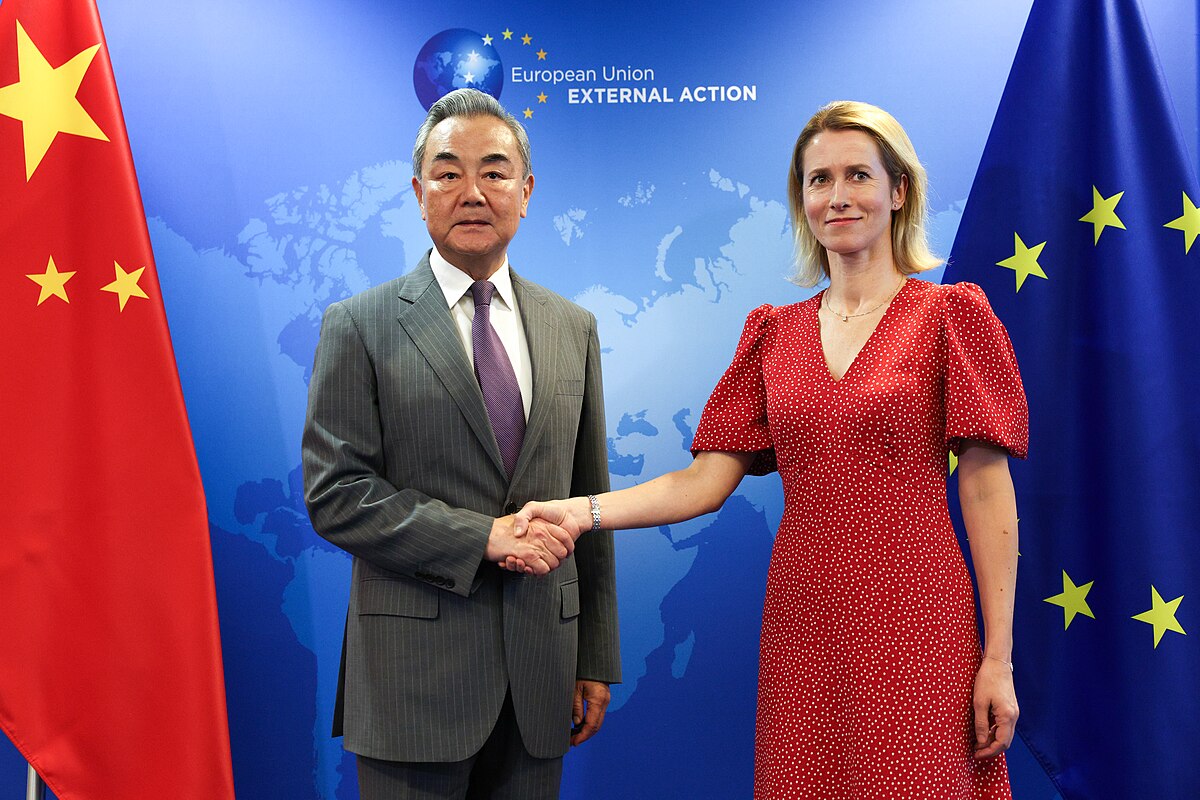
Xi Jinping announced on 14 February that China will eliminate import duties for 53 African countries starting 1 May. Every nation on the continent qualifies—except Eswatini, the last African country that recognizes Taiwan.
The announcement came on the Munich Security Conference, where US Secretary of State Marco Rubio condemned what he called “a dogmatic vision of free and unfettered trade” that had hollowed out Western manufacturing and “handed control of our critical supply chains to both adversaries and rivals.” While Rubio denounced free trade, Xi offered it to an entire continent.
The tariff offer is not charity. It is access exchanged for alignment.
China-Africa trade already reached $222 billion in early 2025. The zero-tariff deal will now extend duty-free access to major economies like Nigeria, South Africa, Kenya, and Egypt for the first time.
Many of these countries are looking for alternatives after Trump imposed steep tariffs worldwide. The Kiel Institute for the World Economy found that 96% of the US tariff burden falls on American importers and consumers, not on foreign exporters. Beijing’s timing is not subtle.
But the single exclusion—Eswatini—shows the price of entry. The tariff offer is not charity. It is access exchanged for alignment. And the same logic governs Beijing’s role in the war 5,000 kilometers north.
Aid for Ukraine, engines for Russia
At that same Munich conference on 13 February, Chinese Foreign Minister Wang Yi met his Ukrainian counterpart Andriy Sybiha and pledged a new humanitarian energy assistance package to help repair Ukraine’s battered power grid.
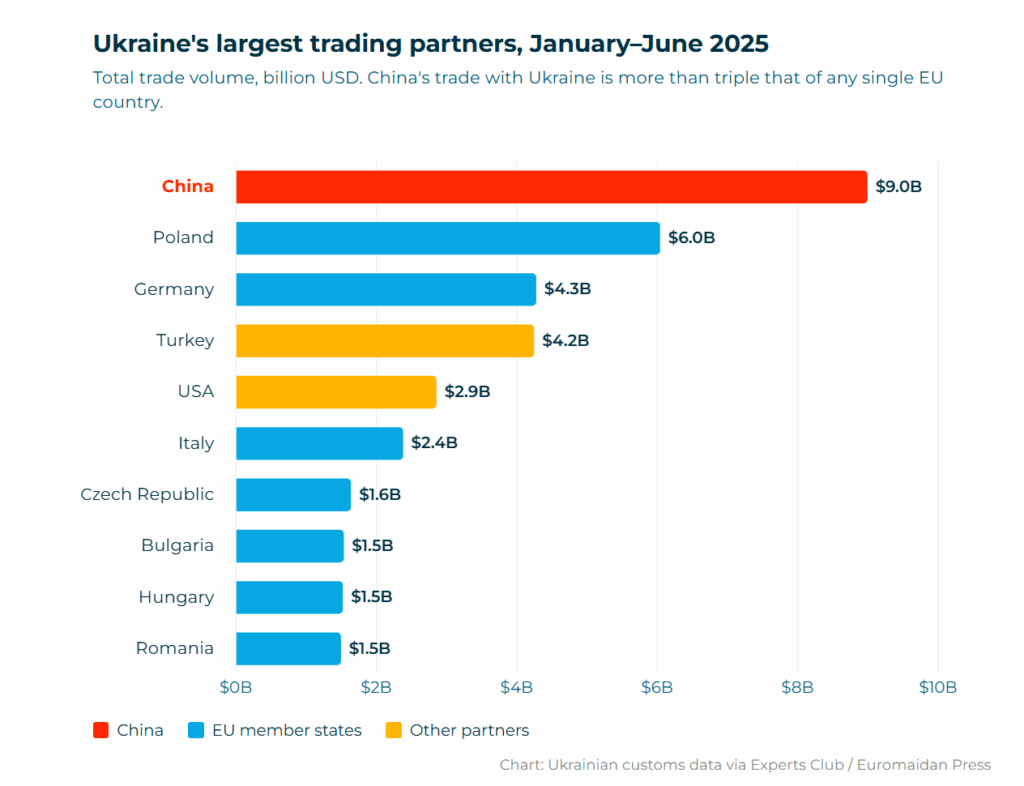
China is Ukraine’s largest trading partner.
Wang told Sybiha that China “cherishes the traditional friendship” with Kyiv and cited growing bilateral trade. Sybiha briefed Wang on Russian strikes against Ukrainian energy infrastructure—and their impact on Chinese businesses operating in Ukraine. He affirmed Ukraine’s adherence to the one-China principle.
China is Ukraine’s largest trading partner. Bilateral trade hit nearly $9 billion in the first half of 2025—more than triple any single EU country’s trade with Kyiv.
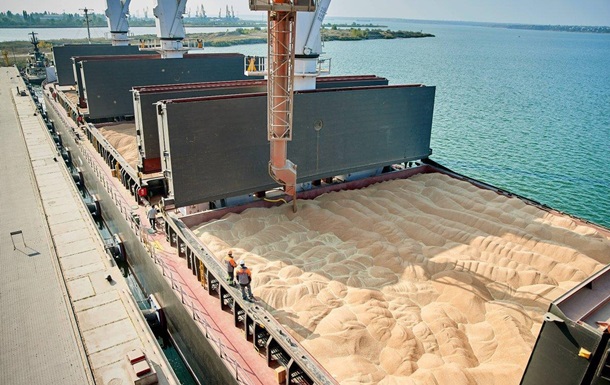
China supplied 21% of Ukraine’s imports — and the trade deficit tells you why (INFOGRAPHIC)
That same week, the other side of China’s ledger remained open. US officials estimate that China provides nearly 80% of the sanctioned components—electronics, optics, navigation systems—sustaining Russia’s military campaign.
EU diplomats have received what they call “convincing” evidence that Russia has built a drone factory on Chinese soil.
Russia contracted to produce over 6,000 Garpiya attack drones in 2025—triple the previous year’s output—with Chinese-made engines, control systems, and navigation equipment at their core, a Reuters investigation found based on contracts, invoices, and customs paperwork.
The engines were shipped labeled as “cooling units” to avoid scrutiny. Russia fires around 500 of these drones at Ukrainian targets each month, Ukrainian military intelligence told Reuters.
EU diplomats have received what they call “convincing” evidence that Russia has built a drone factory on Chinese soil—in Xinjiang province—to produce attack drones destined for use against Ukraine. Beijing says it is unaware of any such project.
What China told the EU—and what it tells Ukraine
Trending Now
In July 2025, Wang Yi told EU foreign affairs chief Kaja Kallas that China cannot accept Russia losing the war. A Russian defeat would free Washington to focus on Beijing, sources briefed on the four-hour exchange in Brussels.
Seven months later, in Munich, Wang pledged energy aid to the country whose defeat he told the EU would serve China’s interests.
“There are production lines on Russian territory where there are Chinese representatives.”
China has also restricted drone component exports in ways that hit Ukraine far harder than Russia. While formally banning sales to both sides in September 2024, Beijing blocked shipments to Baltic states and Poland that were forwarding components to Ukraine, while Russian-bound shipments continue through front companies and China’s land border.
In 2023, China shipped $14.5 million in drones directly to Russia versus $200,000 to Ukraine. As Zelenskyy told Bloomberg in May 2025: “Chinese Mavic is open for Russians but is closed for Ukrainians. There are production lines on Russian territory where there are Chinese representatives.”
Only 5% of Ukrainian defense industry firms report using no Chinese components at all.
Where this leaves Ukraine
For Ukraine, which has actively competed with Russia for African diplomatic support since 2022, China’s continental trade offer adds another front. African votes at the UN General Assembly have already tilted away from Ukraine—down from 28 in favor in 2022 to 13 in the most recent vote, with eight now siding with Russia. Duty-free access to the world’s second-largest economy is unlikely to reverse that trend.
90% of the fiber-optic thread used in drone cables still originates in China.
On the drone front, Ukraine’s defense industry is racing to reduce its reliance on China. Firms like Motor-G, Ukraine’s largest drone motor manufacturer, are scaling domestic production of components that used to come exclusively from Chinese suppliers. But 90% of the fiber-optic thread used in drone cables still originates in China. Full decoupling remains years away.
In the meantime, the pattern from this single week in February holds: energy aid and trade with Ukraine, drone components and a factory for Russia, and zero-tariff access for any African country willing to align with Beijing. The engine labeled “cooling unit” and the tariff that costs one Taiwan recognition are products of the same system.


