

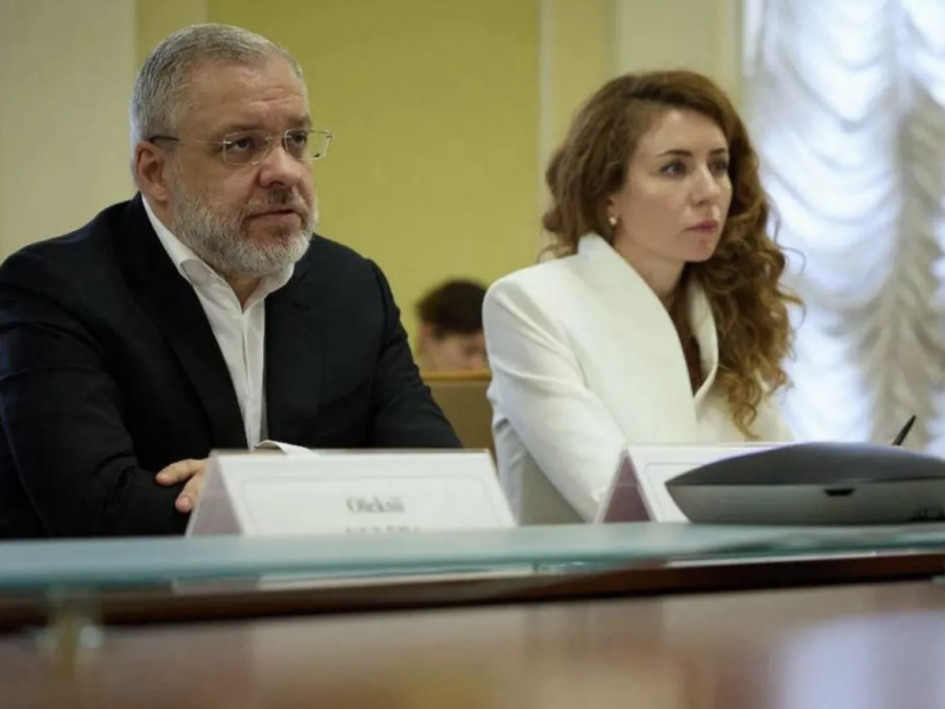
Ukraine’s former energy and justice minister, Herman Halushchenko, has been charged with money laundering and participation in a criminal organization as part of Operation Midas, after anti-corruption detectives detained him trying to cross the border on the night of 14-15 February, the National Anti-Corruption Bureau (NABU) announced on 16 February.
Halushchenko is the highest-ranking official formally charged in the investigation that has already toppled Zelenskyy’s chief of staff Andriy Yermak, forced two cabinet ministers from government, and led the president to sanction his own former business partner.
According to Ukrainska Pravda, he was pulled from a train while attempting to use his status as a father of many children to leave the country—the same children NABU says were listed as beneficiaries of shell companies channeling millions into Swiss bank accounts.
From Energoatom to Anguilla
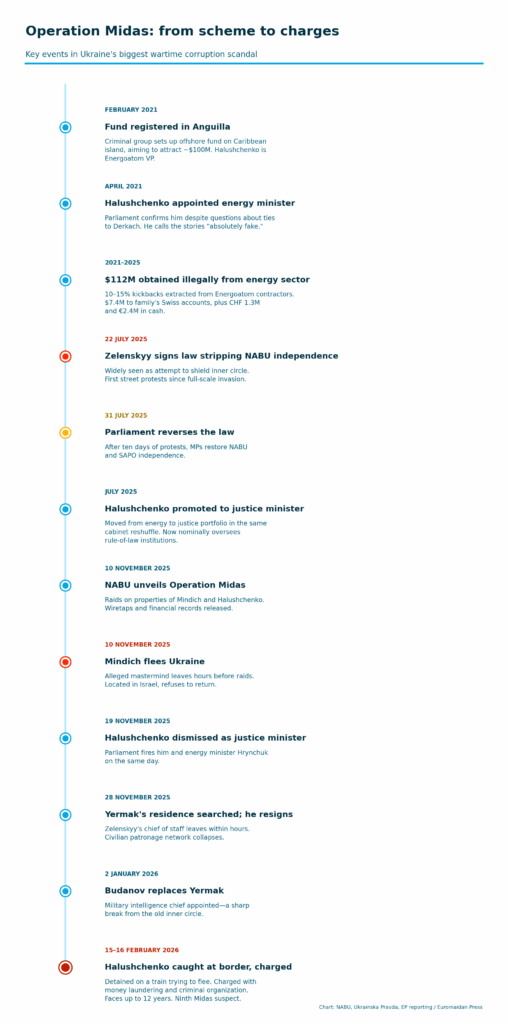
NABU’s announcement details an offshore laundering network allegedly built around Halushchenko’s family. According to investigators, members of the criminal group registered a fund on the Caribbean island of Anguilla in February 2021—two months before Halushchenko was appointed energy minister, but while he was already serving as Energoatom’s vice president, the very company at the center of the alleged scheme. The fund aimed to attract around $100 million in “investments.”
To conceal his involvement, two shell companies were set up in the Marshall Islands and linked to a trust in St. Kitts and Nevis, with Halushchenko’s ex-wife and four children listed as beneficiaries, NABU said. These companies then became “investors” in the fund, funneling money into accounts at three Swiss banks.
Part of the money went to tuition at elite Swiss schools.
During Halushchenko’s tenure as minister, over $112 million in cash was obtained illegally from the energy sector through his trusted associate, Ihor Myroniuk—codenamed “Rocket” in NABU wiretaps released in November 2025.
More than $7.4 million ended up in the fund accounts controlled by his family. An additional 1.3 million Swiss francs ($1.7 million) and 2.4 million euros ($2.85 million) were withdrawn in cash or transferred directly to his family in Switzerland, according to NABU.
Part of the money went to tuition at elite Swiss schools. Radio Liberty’s Skhemy investigative project established in December that Halushchenko’s son, Maksym, has been attending Collège Alpin Beau Soleil—one of Europe’s most expensive boarding schools—at a cost of up to $200,000 per year.
The expense appears nowhere in Halushchenko’s asset declarations. Over four years, the total cost could have reached $700,000.
The scheme that produced the suspects
The corruption centered on Energoatom—Ukraine’s nuclear power operator, which generates more than half the country’s electricity. Contractors were forced to pay kickbacks of 10-15% of their contract values under a system the suspects called “Shlagbaum” (boom barrier): pay the percentage or watch payments freeze and supplier status vanish, as Euromaidan Press reported.
“All the stories about my connections with oligarchs, and with Derkach, are absolutely fake.”
The laundered proceeds flowed through a dedicated office in central Kyiv belonging to the family of Andriy Derkach—a former Ukrainian MP now serving as a Russian senator, sanctioned by the US for attempting to influence American elections. The operation processed approximately $100 million using cryptocurrency and cash collected at 30 locations across the capital.
When Halushchenko was confirmed as energy minister in April 2021, MPs asked about his ties to Derkach—whose nomination had allegedly helped secure the appointment. “All the stories about my connections with oligarchs, and with Derkach, are absolutely fake,” Halushchenko told parliament. “So let’s stop all this hysteria.”
Zelenskyy’s shrinking inner circle
The Midas investigation has hollowed out the power structure around Zelenskyy. Its alleged mastermind, businessman Tymur Mindich—co-owner of Kvartal-95, the entertainment studio that launched Zelenskyy’s political career—fled Ukraine hours before NABU raids in November 2025 and was later located in Israel, where he refused to return.
Trending Now
If convicted, Halushchenko faces up to 12 years in prison.
The scandal forced Halushchenko and Energy Minister Svitlana Hrynchuk from the government in November. NABU’s search of Yermak’s residence on 28 November prompted the chief of staff’s resignation within hours. Zelenskyy replaced Yermak on 2 January with military intelligence chief Kyrylo Budanov—a move that signaled a sharp break from the civilian patronage network Yermak had built.
With Halushchenko, NABU has now charged nine suspects. The bureau says it is cooperating with authorities in 15 countries to trace the money trail. If convicted, Halushchenko faces up to 12 years in prison.
The institution that survived
In July 2025, Zelenskyy signed a law stripping NABU and the Special Anti-Corruption Prosecutor’s Office of their independence—a move widely seen as an attempt to shield his inner circle from exactly this kind of investigation. Street protests erupted across Ukraine, the first since Russia’s full-scale invasion. Within ten days, parliament reversed the law.
Four months later, NABU unveiled Operation Midas.
What corruption cost—and what it blocked
While Halushchenko’s family was allegedly accumulating millions in Swiss accounts, Russia was destroying Ukraine’s energy grid. The kickbacks came from contracts for nuclear facility protection—the infrastructure meant to keep power flowing during war. Millions of Ukrainians endured rolling blackouts through successive winters.
Ukraine’s energy sector inherited a Soviet-era architecture built around centralization—a handful of massive generation points, opaque decision-making, and manual control over energy flows. That structure created ideal conditions for rent-seeking: when a few insiders control access to “one big switch,” kickback schemes like Shlagbaum become almost inevitable.
“Instead of modernization and EU norms—defense of schemes. Instead of competition—rent. Instead of innovation—“traditions.””
“When you have “one big switch” and a few “chosen ones” with access to it, you have all the means to ‘monetize darkness,’” wrote Oleh Savytskyi, a climate and energy policy expert at the Ukrainian Climate Network and former senior analyst at Ukrenergo, Ukraine’s grid operator.
For years, he argued, that same logic blocked Ukraine’s commitments under the EU Green Deal: “Instead of modernization and EU norms—defense of schemes. Instead of competition—rent. Instead of innovation—“traditions.””
Russia’s systematic destruction of Ukraine’s power grid has now demolished much of that old infrastructure. Savytskyi called it Ukraine’s “last chance for structural rebuilding”—replacing Soviet-era centralization with the transparent, decentralized energy markets that EU accession demands. Whether the reconstruction money builds that system or gets captured by a new set of insiders may depend on how cases like Midas end.
Halushchenko served as energy minister from April 2021 to July 2025, when he was promoted to justice minister—a position he held until parliament dismissed him on 19 November. He has not commented on the charges.


