- Elon Musk blocked Russia's access to Starlink satellite terminals
- Ukrainian troops chose that moment to attack
- Now the Ukrainians are on the move in southeastern Ukraine
- Their gains have been modest so far
On Feb. 4, billionaire Elon Musk's Starlink satellite communications company throttled the thousands of terminals across Ukraine. At the behest of the Ukrainian government, the firm shut down all terminals moving at 75 km/hr or faster. That effectively grounded thousands of satellite-guided drones on both sides of Russia's 48-month wider war on Ukraine.
The Ukrainians quickly submitted a list of their own Starlink terminals, which Musk's company reauthorized for high-speed use. The effect of the related moves was that Ukraine retained Starlink access; Russia, which has been using smuggled and stolen Starlink systems, lost it. "Looks like the steps we took to stop the unauthorized use of Starlink by Russia have worked," Musk wrote.
For the Ukrainian armed forces, the sudden Starlink gap was an opportunity. A few days after Russia's terminals went down, Ukrainian forces counterattacked in several sectors along the 1,200-km front line—especially in Dnipropetrovsk and Zaporizhzhia Oblasts in southeastern Ukraine.
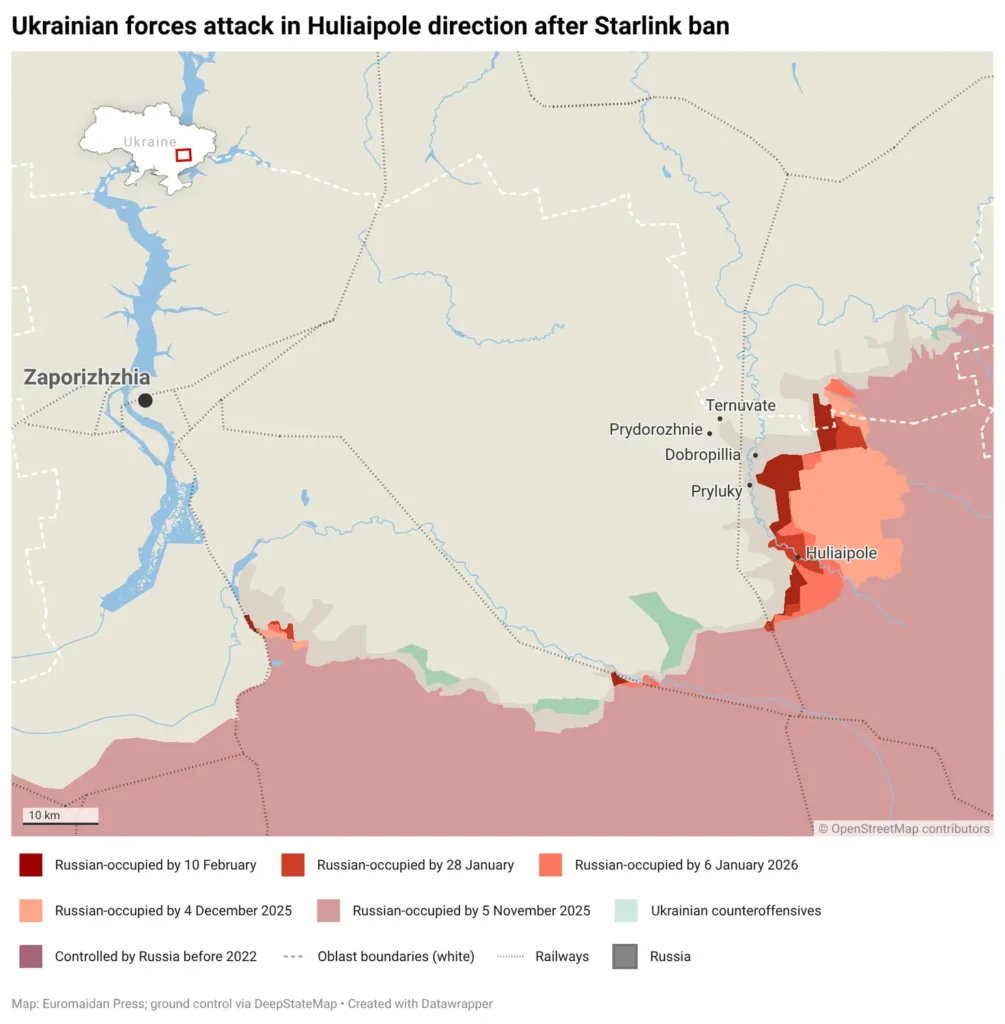
Late last year, the Ukrainians concentrated some of their best-resourced assault battalions and regiments in the southeast in a desperate bid to slow Russia's ongoing offensive around Huliaipole, a key logistics hub that fell to the Russian 127th Motor Rifle Division in late December.
Additional forces raced south to join the assault units already in the area. One of the reinforcing units, likely the 425th Assault Regiment—previously fighting around Pokrovsk in eastern Ukraine's Donetsk Oblast—brought along its newly delivered ex-Australian M-1A1 Abrams tanks. The regiment has up-armored at least some of its potentially dozens of M-1s with Russian-style "hedgehog" anti-drone armor.
On Feb. 5, the Ukrainian assault forces west of Huliaipole attacked along nine vectors, according to one mapper.
"The attacks are taking place in conjunction with the disabling of Russian Starlink terminals, which is likely having an effect on Russia's ability to defend," AMK Mapping noted.
Small drones still a threat
While smaller first-person-view drones can be steered via line-of-sight or mesh radio (a network of interconnected transmitters and receivers), bigger attack drones—the kind that have been blasting Ukrainian logistics and air bases in a zone between 20 and 200 km behind the front—generally relied on Starlink.
The attacking Ukrainians may have enjoyed some respite from deep drone strikes, which may have helped them mass forces, but they still had to contend with the drones directly over the front line. One hedgehog M-1 was immobilized and then struck by at least one FPV.
Trending Now
Despite losses, the Ukrainians are reportedly advancing through several villages around Huliaipole.
"So far, Ukrainian forces have been able to clear Ternuvate and Prydorozhnje, and have entered Dobropillia and Pryluky," AMK Mapping wrote. "According to unconfirmed reports, they were able to break through several kilometers to Berestove and Kalynivka, although Russian sources deny this."

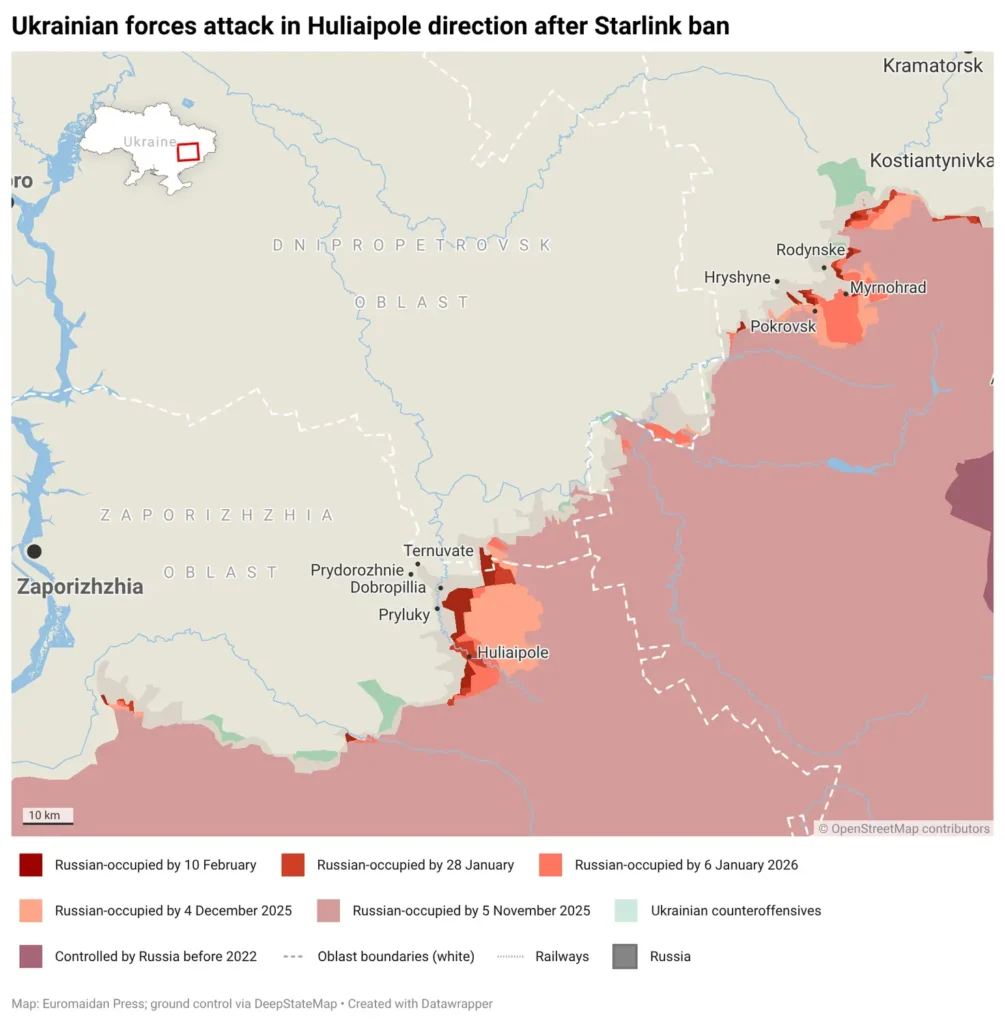
Confirmed Ukrainian gains are modest, so far. Mapper Vitaly likened the attacks to a "cheap debt bailout." That is, the Ukrainians recapturing just a small part of the many thousands of square kilometers they'd recently given up in Dnipropetrovsk and Zaporizhzhia.
Still, Ukrainians would rather be advancing than falling back. The main risk in the current attacks, besides the direct cost in people and equipment, is that—given the paucity of Ukraine's reserves—the main new units for the attacks had to come from somewhere.
And that means some Ukrainian commanders in sectors farther north have fewer troops and vehicles with which to defend.
Ukrainian positions north of Pokrovsk may be particularly vulnerable now that some or all of the 425th Assault Regiment is busy around Huliaipole. "Russian forces continue to gather in northern Pokrovsk," warned Rob Lee, and analyst with the Foreign Policy Research Institute in Philadelphia.
But for now, the momentum is with the Ukrainians. Surprisingly, given his usual friendliness toward Russia and other authoritarian states, Musk has hinted at additional measures that could further curtail Russian forces' access to satellite navigation. "Let us know if more needs to be done," Musk wrote.