


If Peter the Great were alive, he would build a new capital in Siberia. So says Sergei Karaganov, the Kremlin-linked foreign policy ideologist best known for proposing nuclear strikes on Europe. Together with Russian Security Council Secretary Sergei Shoigu, Karaganov has spent two years promoting the "Siberianization" of Russia. The idea calls for a civilizational pivot away from Europe and toward Asia.
The Jamestown Foundation—a Washington-based think tank on Eurasian security—analyzed the concept this week. The vision includes a third Russian capital, million-person cities, rare earth metal clusters, and microelectronics factories. Yet virtually none of it is happening. Russia's full-scale war against Ukraine—which Karaganov cheers on—is draining the people and money Siberian development would require.
"Russia needs to not only victoriously end the war, but also its European journey, which has dragged on for an unnecessary century and a half."—Sergei Karaganov, Kremlin-linked foreign policy ideologist
Grand plans, no money
The pitch has real institutional backing. In November 2025, Shoigu announced the Angara-Yenisei Cluster. This rare earth metals and tech center would span Krasnoyarsk Krai, Irkutsk Oblast, Khakassia, and Tuva. Putin invited investors in December. Shoigu also proposed sending war veterans to build a "new Siberian Russia."
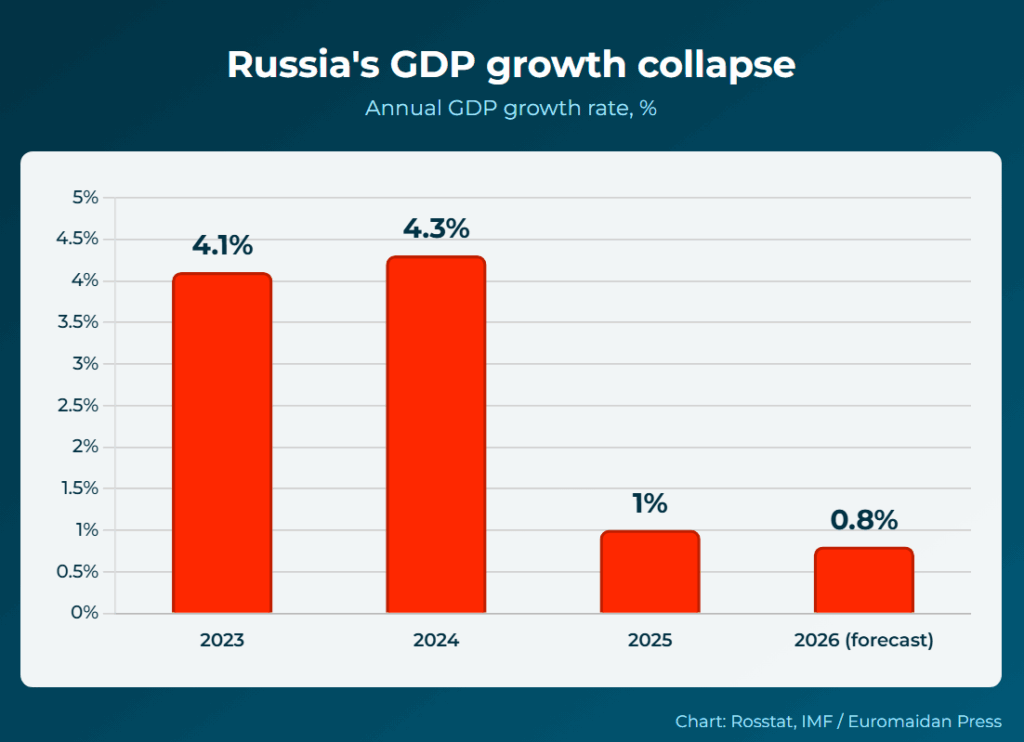
However, the cluster alone would cost over 700 bn rubles ($9 bn). Russia's war-driven budget deficit has already hit 5.7 trillion rubles ($72.3 bn)—nearly five times the planned figure. GDP growth collapsed from 4.3% to 1% in from 2024 to 2025. In 2026, military spending and debt service will consume 46% of the federal budget.
Meanwhile, Krasnoyarsk's long-promised metro—90 bn rubles ($1.17 bn), equivalent to four days of war spending—remains unbuilt.
Emptying out the East
About 287,000 economically active people leave annually—The Moscow Times, citing Russia's updated development plan through 2035
Russia's attempts to develop Siberia are centuries old—tsarist settlers, Soviet gulags, Cold War industrialization. Shoigu himself proposed five new cities of a million people in Siberia in 2021. Just one year later, as defense minister, he launched a mass mobilization that drew disproportionately from those same regions.
The demographic toll is severe. Siberia's population has fallen by 31% since 1989, from 24 million to just 16.5 million. Roughly 287,000 economically active people leave each year, The Moscow Times reported, citing Russia's updated development plan through 2035. The number of residents aged 25–44 could shrink by another 20% by 2030.
On top of that, as many as 325,000 Russian troops have been killed in the war against Ukraine, according to a January 2026 CSIS report. Men from Siberia and the Far East are overrepresented among the dead.
At the same time, the Kremlin is cracking down on Siberia's indigenous peoples, arresting 17 activists in December across six regions. Siberian regional economies are also buckling: Kemerovo's top coal companies saw profits collapse fifteenfold between 2022 and 2024.
China, for its part, fills the vacuum. Russia's microelectronics market shrank 25% by the end of 2025. Four-fifths of electronics in Russian drones now come from China. In 2023, Beijing published maps with original Chinese names for Russia's Far Eastern cities—a quiet reminder of old territorial claims.
What this means for Ukraine
Mass mobilization for the war against Ukraine strips Siberia of the industrial manpower that any development push would need. War spending, in turn, leaves no budget for it. Ukrainian intelligence has identified Siberian oblasts among Russia's most distressed regions. Separatist sentiment in republics like Yakutia has also evolved into organized movements, with fighters already serving in Ukraine's Siberian Battalion.
If Siberianization fails, Russia emerges from its war against Ukraine structurally weaker in the east. It will be more dependent on China and less able to develop the vast territory it claims.
Read also
-
Russia’s GDP growth collapsed 76%—a Kremlin think tank says worse is coming (INFOGRAPHIC)
-
Moscow’s boom, the provinces’ bust: Russia’s war economy turns predatory (MAP)
-
Russia arrests 17 indigenous activists across six regions in coordinated December crackdown
-
Russia’s oil revenues collapse 24% as global prices slide further (INFOGRAPHICS)


