


- Russia builds its most terrifying missiles at Kapustin Yar, south of Moscow—including the hypersonic Oreshniks
- Ukrainian forces have repeatedly targeted Kapustin Yar, inflicting some damage with drones
- But a recent barrage of Flamingo cruise missiles may have missed
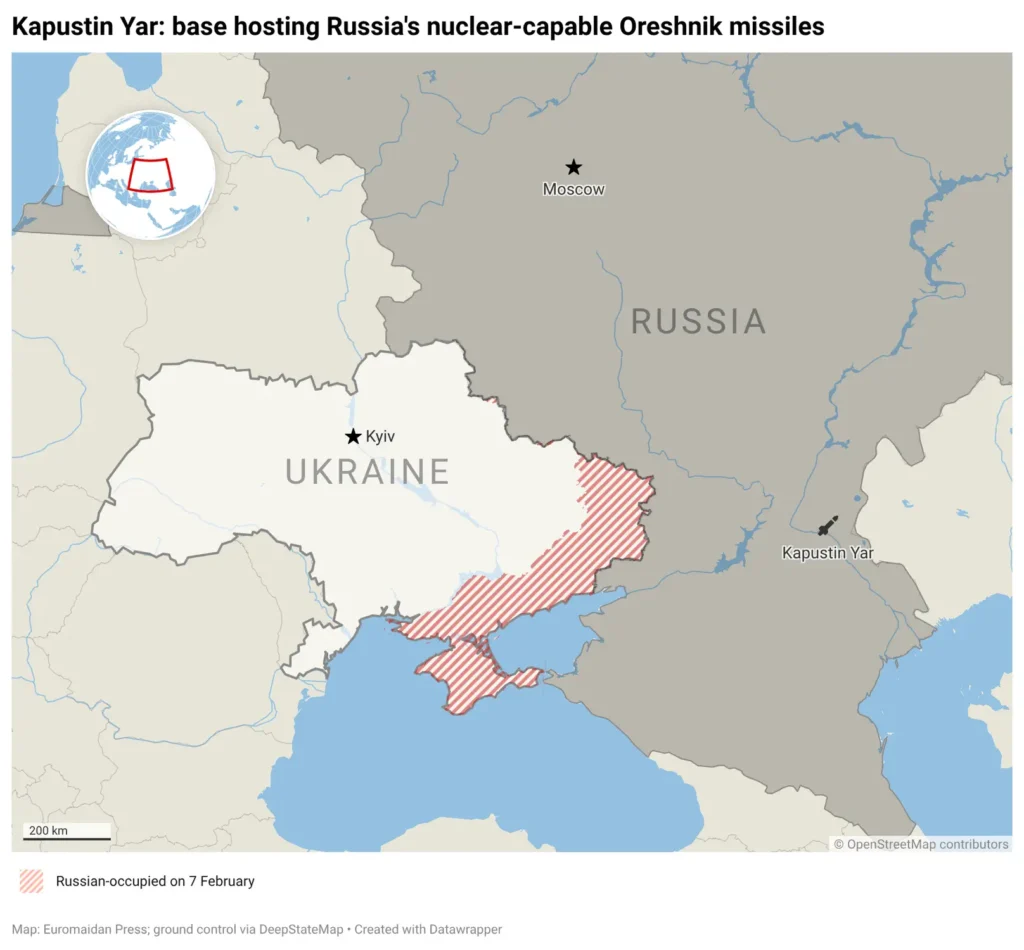
Ukrainian forces recently launched at least four Fire Point FP-5 Flamingo cruise missiles at the Russian missile base in Kapustin Yar, 1,000 km south of Moscow.
The strike matters because Kapustin Yar is where Russia assembles and tests the Oreshnik—a $30-million nuclear-capable ballistic missile that Russia has fired at Ukrainian cities twice since November 2024 and that no country in Europe can intercept. Slowing production there would blunt Moscow's most potent intimidation tool. But early evidence suggests the Flamingos didn't land where they needed to.
The good news is that the controversial FP-5 is back in action after an apparent long pause. The bad news is that there's no obvious sign the 6-ton missiles actually hit anything of value on the sprawling Kapustin Yar site, where the Russians develop, build, and test missiles such as the hypersonic Oreshnik.
Satellite images show no cruise missile impacts
The Ukrainian military circulated a video montage of the four ramp-launched FP-5s blasting off overnight sometime last month. Analysis group CyberBoroshno bought commercial satellite imagery of Kapustin Yar and scrutinized it for evidence of any FP-5 impacts on the most important parts of the facility, including sites 28 and 105. The turbojet-powered missiles pack massive, 1,000-kg warheads.
"There are no FP-5 hits on sites 105 and 28," CyberBoroshno reported. But the group did detect evidence of less destructive impacts. "There are consequences of UAV strikes," CyberBoroshno concluded.

Drones did what cruise missiles couldn't
That makes sense. Ukrainian drone units have repeatedly targeted Kapustin Yar—especially in 2024. In July of that year, at least one Ukrainian drone reportedly struck a rocket assembly building at the base, setting it ablaze.
"The historic test range in Kapustin Yar, where Stalin's rocketeers were learning to fly Nazi ballistic missiles in 1947, is apparently being de-nazified by Ukrainian drones!" Russian space historian Anatoly Zak quipped.
It wasn't until October 2025 that the Ukrainian Main Intelligence Directorate confirmed the July 2024 strike. "The operation was classified, and its results were reported only to the president of Ukraine and several leaders of foreign states at that time," the intel directorate stated.

According to Ukrainian spies, the drone strike burned down the missile assembly building and destroyed an Oreshnik that was inside at the time. The raid cost the Russians potentially tens of millions of dollars worth of munitions and infrastructure, but it didn't prevent Russia from lobbing Oreshniks at Ukraine in November 2024 and again in January of this year.

Trending Now
Big missile, small damage
The 36-ton Oreshniks probably didn't inflict much damage, possibly owing to their poor accuracy. According to missile expert Fabian Hoffmann, an Oreshnik's six individual warheads—each of which includes six separate submunitions—have a "circular error probability" of 200 m. That means the 36 non-explosive munitions packed into an Oreshnik each have a 50% chance of striking within 200 m of their aimpoints.
"The employment of the missile, both in November 2024 when it was first used and in the recent strike, suggests limited projectile accuracy," Hoffmann wrote in January. "This is likely because reentry vehicles are not individually guided; instead, they follow a gravity-driven descent after separation from the post-boost vehicle."

But the accuracy is beside the point. "Remember: Oreshnik was designed to carry nuclear weapons," Kyiv-based consultant Jimmy Rushton explained. "When it doesn't, it's not a practical or cost-effective weapon system (it's too inaccurate, and not destructive enough for the $30 million + price tag); it's a terror weapon designed to intimidate." Ukrainian experts have reached similar conclusions, describing the Oreshnik as a tool of psychological pressure rather than a battlefield weapon.
In attacking Kapustin Yar, Ukrainian forces clearly aim to slow Oreshnik production and counter that intimidation. But attacking with FP-5s might not be the optimal approach.
Five raids in nine months
It's increasingly apparent Fire Point isn't delivering on its pledge to produce hundreds of Flamingos every month. It's equally apparent the all-Ukrainian cruise missiles may suffer from the same inaccuracy that vexes the Oreshniks.
Observer Thorkill, who closely monitors social media for evidence of Flamingo usage, had confirmed just four raids prior to January:
- The Ukrainian general staff claimed Ukrainian forces fired a Flamingo as part of a combat trial in May 2025, possibly targeting Russian forces in occupied Crimea. According to a Russian source, a Russian air force Mikoyan MiG-31 fighter shot down an unidentified cruise missile, potentially over the Black Sea, on 1 May.
- On 30 August, Ukrainian forces fired three Flamingos at a Russian intelligence outpost and hovercraft base in Crimea. Two reached the target area. One narrowly missed, and the other scored a hit on the outpost's biggest building.
- On 23 September, four Flamingos targeted a factory in Belgorod in western Russia. Russian officials claimed only one reached the target, but satellite imagery later confirmed all four hit within an 80-meter radius, destroying a production hall linked to Su-57 fighter manufacturing.
- On 13 November, the Ukrainians launched one Flamingo at a power plant in Oryol in western Russia. It was shot down.
On the basis of the low rate of attacks and the limited damage, Thorkill described the Flamingo as a "marketing-propaganda hoax." The apparently failed recent attack on Kapustin Yar might not compel critics of the Flamingo to reconsider their skepticism.

Satellite imagery confirms Ukraine’s Flamingo missiles scored 4/4 hits Russian Skif-M factory tied to Su-57 production (PHOTOS, MAP)
Read Also
-
Ukraine retook 240 square km north of Lyman and nobody reported it for three months
-
Ukraine is working down the short list of ships that shell its cities with cruise missiles. A Neptune reached one of them tied up at its own pier
-
Ukraine is sending its winning brigades to where the fighting is worst. The 46th just turned up outside Kramatorsk


