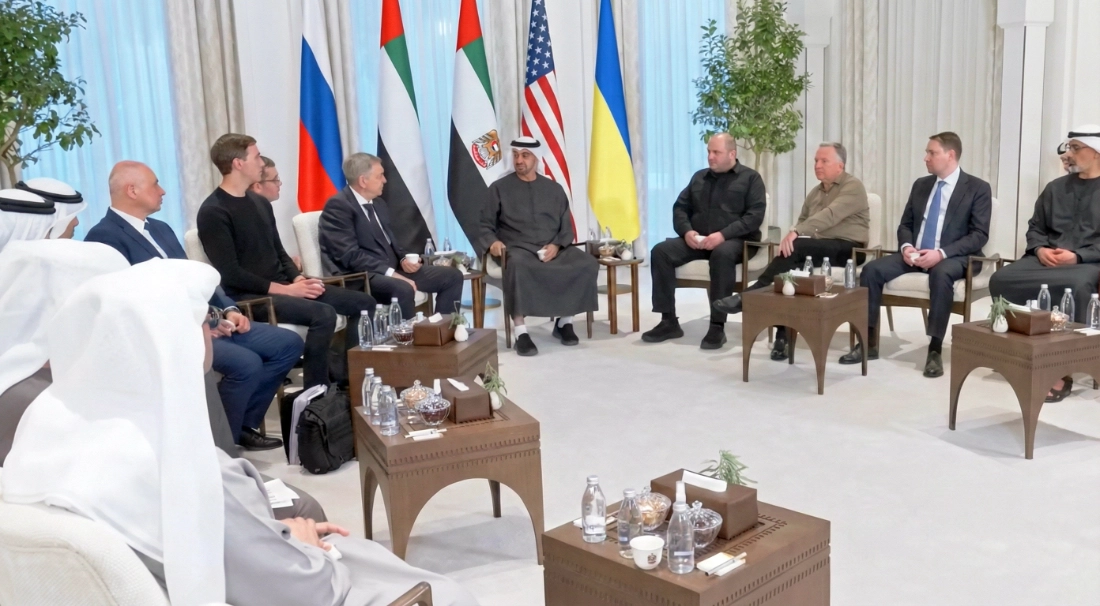
On 4 February, a new round of trilateral talks among Ukraine, the US, and Russia began in the United Arab Emirates, according to Secretary of the National Security and Defense Council of Ukraine Rustem Umerov.
The meeting takes place against the backdrop of massive Russian attacks on Ukraine’s energy infrastructure during severe frosts, which effectively ended the so-called energy truce.
Talks in Abu Dhabi continue under the sounds of Russian strikes on pregnant women
The Russian “truce” usually serves as a pause for missile accumulation, says Presidential Advisor Mykhailo Podoliak. These attacks are aimed at pressuring the Ukrainian leadership to accept Russia’s capitulation terms.
These negotiations have been ongoing for more than a year, but they have produced no results, except that the number of killed civilians has dramatically increased.
Meanwhile, the US has applied no pressure and provided no military aid packages for Ukraine.
Kyiv remains heavily dependent on US Patriot missiles for air defense and reconnaissance. At the same time, US President Donald Trump continues to push the negotiations, during which civilians continue to die or freeze in their own homes.
Despite Russia continuing to target maternity hospitals, civilian buses, and thermal power plants while simultaneously claiming to pursue peace, the American president does not see these attacks as unpredictable.
"Diplomacy" under fire
A notable feature of the latest talks is the inclusion of Head of the Office of the President, Kyrylo Budanov, and Servant of the People faction leader, Davyd Arakhamia, on the negotiation team. Budanov served for a long time as Ukraine's defense intelligence chief.
This forced the Kremlin to change tactics: instead of historical lectures on how Ukraine never existed as a country, Russian negotiators now discuss concrete deadlines and guarantees, Ukrainska Pravda writes.
“Previously, we had to listen to hour-long sermons about who conquered whom and when in the past,” an anonymous source said.
Now the talks are conducted by Russian military officials rather than Kremlin ideologists.
The Abu Dhabi negotiations demonstrate that real security for Ukraine and the stability of the negotiation process depend not only on diplomacy but also on combat readiness, air defense control, and energy security.
Massive Russian strikes and Ukraine's survival strategy
Umerov emphasizes that the Ukrainian delegation is working within the directives of President Zelenskyy to achieve a lasting and dignified peace.
“The negotiation process began in a trilateral format – Ukraine, the US, and Russia. Then work continues in separate groups by sector, followed by a planned joint synchronization of positions,” Umerov states.
The Secretary of the NSDC assured that the Ukrainian leader is informed about the progress of each stage of the negotiations.