On 27 January, three Shahed drones struck a passenger train in Kharkiv Oblast. Six people died — their remains so badly damaged that DNA forensics were needed to identify them.
There were 291 passengers on board, including children. A soldier pulled a woman and her baby from a burning car. The drones were reportedly equipped with Starlink.
Days later, Defense Minister Mykhailo Fedorov announced that he’s working with SpaceX to crack down on Russia’s use of this tech. That includes setting overland speed limits on Starlink-equipped devices and a more sweeping change: the creation of a “white list” of legitimate registered users. Everyone else will be cut off.
Fedorov explained that this is a priority because Starlink-equipped Russian drones are "hard to shoot down, fly at low altitudes, are resistant to electronic warfare, and are controlled in real time even at long distances.”
Here is how Starlink gave Russia its latest drone advantage—and what can be done to stop it.
A growing trend
Russians have been putting Starlink on their drones since at least 2024. This practice greatly increased toward the end of last year, multiple Ukrainian sources said.
These include UAVs like the Shahed, Russia’s primary weapon of terror that has been attacking Ukraine’s civilian infrastructure and civilians themselves, often in conjunction with ballistic and cruise missiles, plus many decoys that jam up Ukraine’s air defenses.
Starlinks have also been found on smaller, mid-range UAVs like the Molniya (Lightning) and the BM-35.
The plywood Molniya series is designed to strike targets beyond the line of battle, such as logistics, equipment, or rear positions. They are extremely cheap, easy to make, and highly configurable.
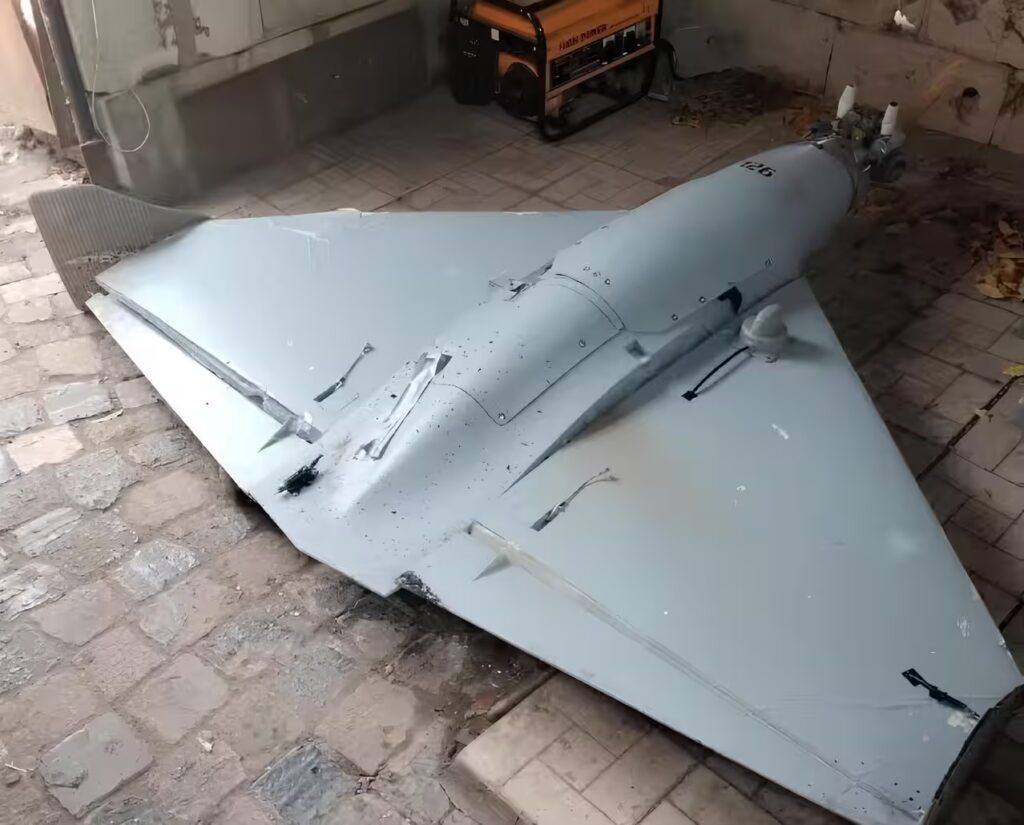
BM-35, from the Italmaz drone lineage, resembles a miniature Shahed with a frontal propeller. Its mission also appears to be sniping high-value targets behind the front. The Russians claimed they used a BM-35 to destroy a Patriot missile’s radar system last month.
Starlink-equipped drones are still in the minority. Kostyantyn Kryvolap, a former aviation test engineer at the Antonov Design Bureau, estimates that only a single-digit percentage of Russian drones in Ukraine use this technology. However, this is still a threat.
“The most vulnerable hits we receive are from Shaheds, which are equipped with Starlink,” he told Euromaidan Press. “They are getting through.”
Russian terror attacks and hit percentage rose in 2025

As part of their doctrine of terrorizing civilian populations into surrender, the Russians have committed to their strategy of massing strike drones on cities and civilian infrastructure.
According to the Institute for Science and International Security, the Russians have gone from 2,629 launches of Shahed-like drones in January to a peak of 6,297 launches in July. Since then, the number of launches has gradually decreased, hitting 5,131 in December.
Meanwhile, the percentage of successful hits has gone up, while the percentage of interceptions has gone down. The Institute calculated 90 successful hits in January and 886 in December.
The percentage of interceptions fell from 96.58% in January 2025 to 82.7% in December. Since April, the interception percentage never rose above the 80s.

There are multiple reasons for these trends. The Russians have improved on their tactics. The numbers consume Ukraine’s anti-air munitions. The drones started flying faster, while continuing to pepper the mix with decoys. There have been many strikes on areas close to the front line, allowing for shorter flight times and efficient route planning.
But, the institute mentioned two other reasons for the improvement: advancements in navigation systems that allow drones to counteract Ukrainian electronic warfare and the integration of online cameras and modems that allow real-time adjustment of flight trajectories and evasive maneuvers.
While Starlink wasn’t mentioned by name in the report, those things are this system’s bread and butter.
Reliable connection
Starlink adds a big dose of reliability to a drone.
When a UAV loses its signal to the operator, it has often to fall back on pre-programmed parameters or inertial navigation, although both sides have developed imperfect work-arounds. With Starlink, loss of connection is less likely.
The earliest Shaheds would fly pre-programmed GPS routes to fixed coordinates, without operator input or course correction.
With a satellite internet connection, the operator is more likely to maintain control throughout the flight.
The tech can also give a constant live video feed to the pilot — who can be anywhere in the world with working satellite coverage — letting them see from the drone and react in real time.
This improves the odds of delivering a payload on target.
“Russian forces wanted to maintain remote control between the operator and the drone to enable real-time and accurate long-range strikes, especially against high-value targets such as airbases, logistic areas, and other critical infrastructure,” said Federico Borsari, a security fellow at the Center for European Policy Analysis.
Trending Now

High frequency
Starlink’s biggest claim to fame is arguably its resistance to jamming.
Drones are controlled at certain frequency ranges, measured in gigahertz (GHz). To jam a connection, the electronic warfare system should match the target frequency. Both sides regularly switch or “hop” between different frequencies to evade disruption.
Most drones used in Ukraine are in the single-digit gigahertz range. A Ukrainian unmanned systems engineer, who asked not to be identified by name, said the highest frequency the Ukrainian forces typically use is 6.7 GHz.
Starlink operates at frequencies between 11 and 20 GHz. The higher the frequency, “the more complex the jamming solution has to be,” the engineer said.
That doesn’t mean Starlink can’t be jammed. Ukraine and Russia have ways to disable Starlink connections over an area.
But firstly, this requires the deployment of powerful, expensive hardware, and secondly, it shuts down communication over a very wide range of frequencies, making it impractical or counterproductive to military operations.
Orbital advantage
Starlink’s space connection provides other benefits in the jamming resistance department.
“It is pointed straight up at the satellites above your head,” said James, an American engineer and head of the Azov International Battalion’s fiber-optics laboratory. He asked for his last name to be omitted for security purposes.
“Those waves are traveling in one direction, and the most ground-based EW and radar systems are traveling horizontally… So it is more difficult in theory to block those signals.”

Borsari put it this way: “By leveraging Starlink’s low Earth orbit links and phased-array technology, operators can achieve fairly stable command-and-control and telemetry beyond the reach of radio EW.”
In other words, a Starlink drone can hop from satellite to satellite while in flight, fundamentally undermining Ukraine’s conventional electronic warfare.
Intelligence integration
The Russians synergize these technological advantages with reconnaissance data to evade Ukrainian defenses, Kryvolap said.
“The Russians have intelligence and can plan routes based on it. They probably know the locations of our mobile fire teams” and other air defenses, he said.
“Changing these locations is very difficult because there are firing sectors, and it's crucial that your machine gun, cannon, or missile doesn't hit civilians.”
He added that the Russians have also mapped out the topography of those areas, to be able to fly low, to evade both radar and air defenses where possible.
Ukraine’s countermeasures
Fedorov announced that he’s working with SpaceX to create a “white list” of legitimate Ukrainian users, which includes civilians and military units. Kryvolap estimated that Ukraine has 30,000 active accounts. All non-whitelisted accounts will be cut off.
The ministry is also implementing overland speed restrictions on Starlink terminals inside the country, to prevent Russia’s fast-flying drones from taking advantage. A half-dozen interviewed experts approved of the solutions.
“This will complicate Russia’s use of one-way attack UAVs, depriving them of a key feature to enhance their performance in terms of real-time maneuver and terminal accuracy,” Borsari said.
Kryvolap called it “the simplest and most effective first step” to taking these tools away from the enemy.
“The Russians will try to find ways around it somehow,” he added. “And we will build on various ways to filter them out.”