


Denmark has emerged as the world's leading supporter of Ukraine's military when measuring aid against national economic output, according to a new report from the Peterson Institute for International Economics (PIIE), titled "The European Union and the War in Ukraine: More Money, but Not More Europe." Northern and Eastern European nations dominate the top of the ranking, while the rest of Europe and the US trail far behind.
The PIIE analysis covers the period from January 2022 to October 2025. The current picture likely differs significantly, as several governments have shifted their Ukraine policies since October 2025 — for instance, the US under President Donald Trump and Slovakia under Prime Minister Robert Fico have both cut military aid to Kyiv.
The report's findings indicate that geography and fiscal capacity, rather than broad political solidarity, largely shape European military support for Ukraine. This trend may reduce the EU's role in European defense, as ad hoc coalitions of the willing increasingly take the lead in defense matters instead of collective action through Brussels, the study says.
Denmark's leadership
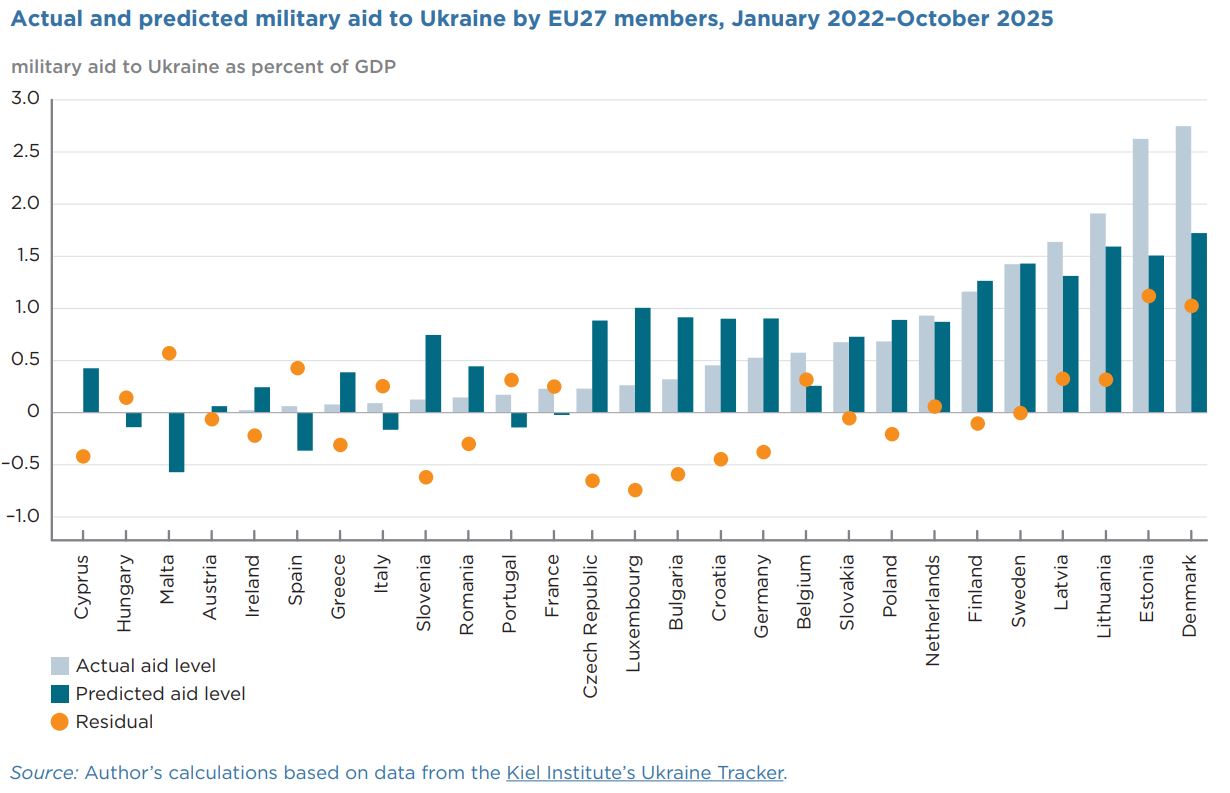
Denmark tops the PIIE ranking with 2.75% of its GDP committed to bilateral military aid between January 2022 and October 2025, according to the Kiel Institute's Ukraine Tracker data cited in the report. Estonia follows at 2.63%, with Lithuania at 1.91%, Latvia at 1.64%, and Sweden at 1.42%. Finland contributed 1.16%, the Netherlands 0.93%, and both Poland and Slovakia gave 0.68% of their respective GDPs.
The ranking drops among larger Western European economies. Belgium committed 0.58%, Germany 0.53%, and France just 0.23% of GDP. Italy gave 0.09%, Greece 0.08%, and Spain 0.06%. Hungary, Cyprus, Austria, Malta, Japan, South Korea, and Switzerland each allocated less than 0.01% of their GDP in military aid to Ukraine.

Among non-EU European NATO members, Norway contributed 1.00% of GDP and the United Kingdom 0.50%. The US gave 0.32% and Canada 0.25%, making Denmark's contribution nearly nine times larger than America's as a share of economic output.
Geographic proximity drives aid decisions
The PIIE report found that geography explains almost half of the variation in European military aid levels. Plotting bilateral military support against the distance between each country's capital and Moscow shows that countries closer to Russia consistently give more. National debt levels provide the second major predictor. EU countries with lower debt when Russia invaded had more room to boost defense spending without sacrificing other needs. Together with geography, debt levels explain about 60% of the differences in how much military aid EU members gave Ukraine.
Denmark and Estonia far exceed expectations
The PIIE model identifies which countries gave more or less than their geography and fiscal position would predict. Only two EU members significantly exceeded their expected contribution: Denmark and Estonia. Latvia, Lithuania, and Belgium also performed above expectations, while Sweden, Finland, the Netherlands, and Slovakia matched their predicted levels.
Poland and Germany both fell below what the model predicted they would give. The report identifies Croatia, Bulgaria, Luxembourg, the Czech Republic, and Slovenia as the main "Ukraine laggards" within the EU, each contributing roughly 0.5 percentage point of GDP less than expected.
Neutrality correlates strongly with low contributions, according to the study.


