

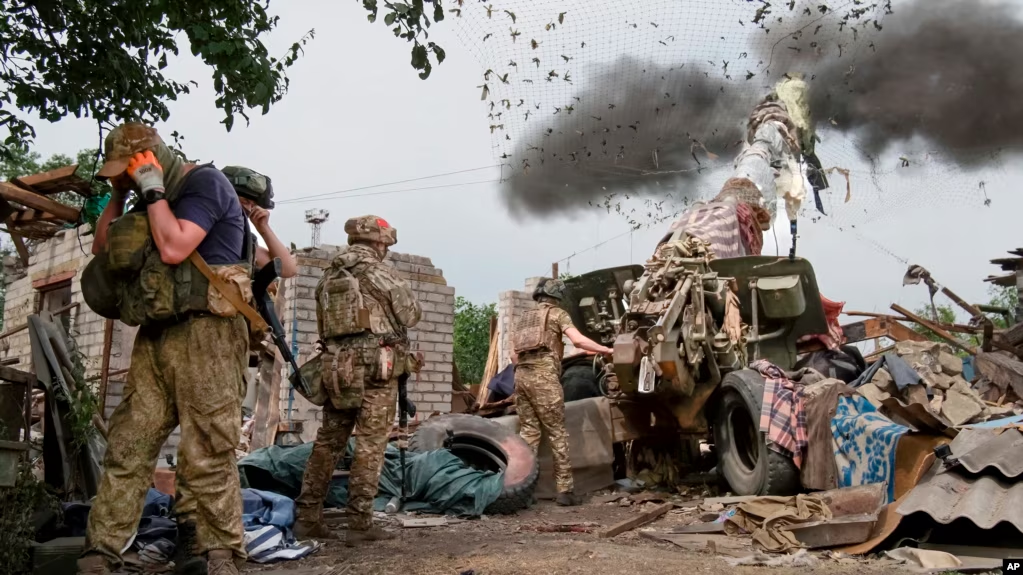
Russia pulls artillery farther from the front due to fear of Ukrainian drones. In 2025, Moscow significantly increased orders for long-range propellant charges for 152-mm Msta artillery systems, aiming to operate artillery farther from the front line, reports Militarnyi, which obtained Russian procurement documents.
Long-range charges for the Msta: Russia’s response to Ukrainian drones
According to the documents, last year the Russian army was expected to receive about 1.1 million artillery rounds for Msta howitzers. Of these, nearly one million were full-charge rounds, while about 100,000 were long-range variants.
For comparison, in 2024, Russia’s defense industry received orders for 831,000 such rounds: 540,000 with full charges and 96,000 long-range. Thus, in 2025, Russia clearly prioritized increasing firing range.
The cost of war: how much Russia pays per artillery round
Analysts note that a standard Msta artillery round costs about $1,250. Long-range variants are significantly more expensive, around $1,550.
A complete artillery “round” supplied to the Russian army consists of the projectile, fuze, and propellant charge.
New shells and “mobilization” explosives
In addition, Russia has developed a new high-explosive fragmentation shell, the OF-64, for Msta-type systems. Its elongated shape and cavity in the base improve aerodynamics and, combined with the howitzer’s longer barrel, increase firing range.
At the same time, amid the full-scale war against Ukraine, Russia’s GosNII Mash switched to filling ammunition with a so-called “mobilization” explosive mixture TA-20, a combination of TNT and aluminum powder in an 80/20 ratio, instead of the more powerful hexal.
Plans for 2026: guided shells
The analysts also report that for 2026, Russia has ordered 100 guided 122-mm artillery shells under the unknown designation KV122. These are likely a modernized version of the Kitolov-2M munition.
Read also
-
German company that already supplies Ukraine with drones has unveiled Shahed-hunter aircraft with four weapons categories on single airframe
-
15 tons of diesel, $22,500 in damages: Ukraine charges eight in Poltava military fuel-theft scheme
-
Russia trained 900 more Ukrainian children at Volgograd — the camp Britain sanctioned in 2024


