

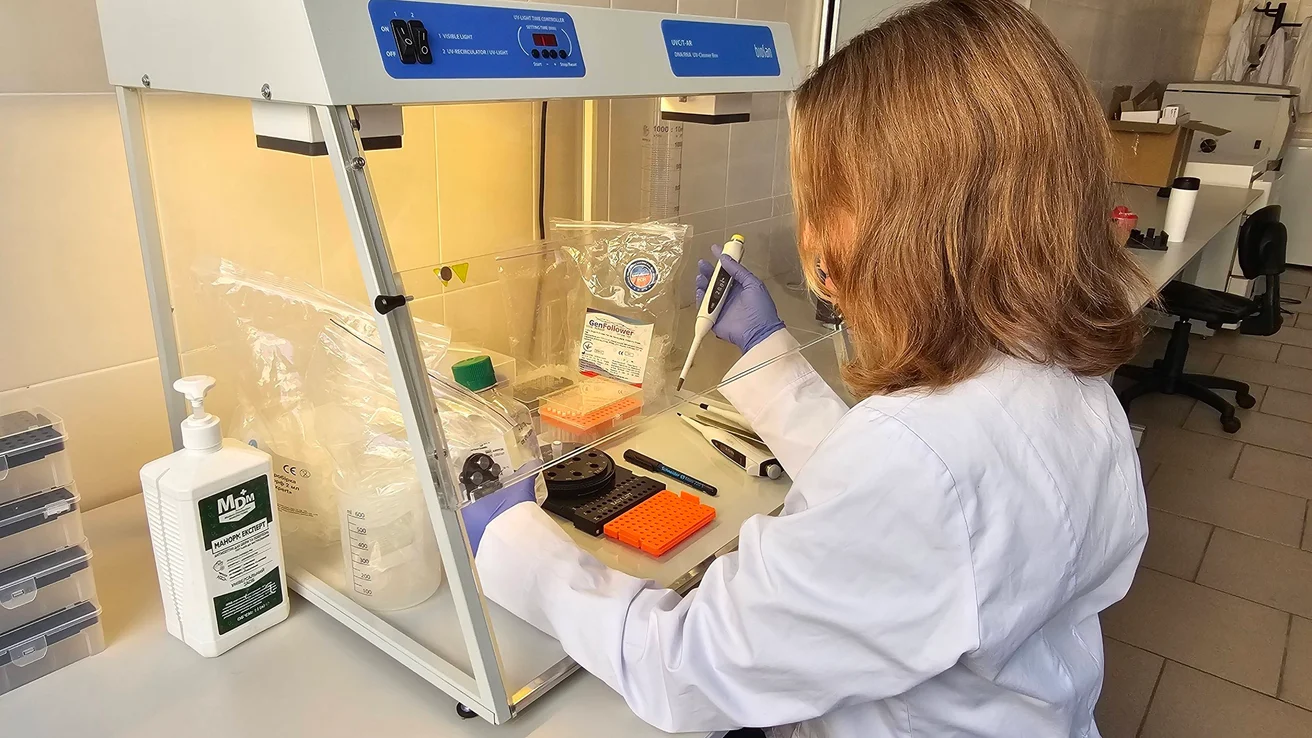
Ukraine has launched its first polar biology laboratory to analyze biological samples brought from Antarctica, the National Antarctic Scientific Center (NASC) reports.
"Previously, samples from Antarctica were brought to Kyiv and distributed among various institutions of the National Academy of Sciences of Ukraine and universities, and also sent abroad for analysis," the Center states. The volume of work by NASC biologists became "so significant" that the question of creating a dedicated modern laboratory arose.
The Kyiv Aviation Institute (KAI) provided the laboratory space. "Of course, during the war, no one would spend funds on construction: the laboratory premises were kindly provided by the Kyiv Aviation Institute. NASC brought in equipment and literally launched operations 'right off the wheels,'" said Center Director Yevhen Dykyi.
Part of biological research is conducted directly at the Ukrainian Antarctic station "Akademik Vernadsky." Another part takes place aboard the research icebreaker vessel "Noosfera." Other work happens in well-equipped laboratories on the "mainland."
The laboratory is headed by Maria Pavlovska, whose specialization includes marine microbiology and environmental DNA analysis (eDNA). This method allows identification of literally all biodiversity in a single sample: from bacteria and viruses to fish or whales.
The laboratory now provides a full cycle of molecular genetic research using modern equipment. Among its priorities is bioprospecting—searching Antarctic plants and microorganisms for substances potentially useful for medicine, food industry, and other fields, such as new antibiotics or antioxidants.
Scientists study complex interactions between organisms in polar ecosystems—from the exchange of biosynthesis products between bacteria and microalgae in the Southern Ocean to the fine-tuning of symbiotic relationships between Antarctic insects and plants with bacteria inside them.
"Such an interweaving of fundamental and applied research requires many workers, so students are actively involved in the work. They get the opportunity to complete coursework and diploma projects in the laboratory. These are both 'local' biotechnology students from KAI and representatives of Taras Shevchenko National University of Kyiv, and in the future—other universities," the Center noted.
The main partner of NASC at the Kyiv Aviation Institute is the Department of Biotechnology.


