


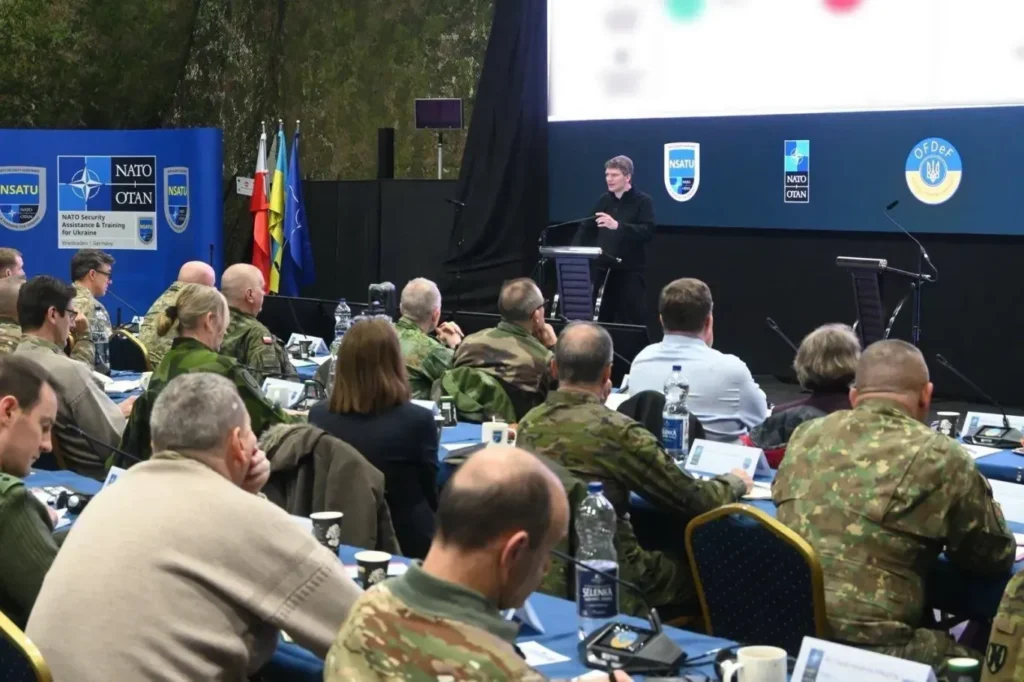
Ukraine plans to make 7 million military drones in 2026, deputy defense minister Serhiy Boev said at NATO’s Operational Force Development Framework (OFDeF) conference.
So far, Ukraine has been able to roughly double its drone manufacturing count each year, producing at least 4 million in 2025, 2.2 million in 2024, and 800,000 in 2023. In contrast, the US makes just 100,000 combat drones per year, according to Bloomberg.
Despite this, Ukrainians need more. The Center for Eastern Studies estimated in October that a single brigade uses several hundred FPV drones per month, but they require around 2,500 per month. This agrees with testimonials from multiple units.
The following step will be to widen the frontline kill zone from a depth of 20 to 100 kilometers by hitting the Russians’s rear, Boev told the NATO conference, whose goal is to coordinate military support for Ukraine.
Other prongs of Kyiv’s strategic planning include improving air defenses against Moscow’s terror strikes, getting more extended-range artillery, and continuing to target the pressure points of the Russian war machine.
“Together with partners, we have formed a military strategy that provides for the protection of Ukrainian cities and critical infrastructure, stabilization of the front, defeating Russian logistics in operational depth, and strikes on strategic enemy facilities,” Boev said.
To implement this strategy in 2026, Ukraine will need $120 billion, according to the Ministry of Defense. Ukraine is planning to source $60 billion from its own budget and EU loans. The rest would have to come from allies as security assistance.
About 80% of this money should go to UAV production, air defense systems and missiles, and artillery ammunition, Boev said.
He pointed out that on top of attacking civilian infrastructure, Russia has intensified its offensive actions along the entire front since September, and is preparing for more escalation.
If international support is maintained, he said Russia won’t achieve any of its operational goals.
A game of drones: a song of tech and scaling
Drone warfare has indeed helped Ukrainians prevent Russian forces from meeting their operational goals, in large part by making up for missing capabilities.
But Russia has been no slouch in pumping out its own drone solutions en masse. This has resulted in a prolonged and terrible stalemate.
Throughout much of the full-scale invasion, Ukraine has largely been ahead in innovation, while Russia has been ahead in scaling and standardization.

However, the Russians are perfectly capable of innovating. The advent of the Center for Advanced Unmanned Technologies “Rubicon” has shown this, as have Moscow’s constant improvements to its long-range strike weapons.
Right now, the Russians are ahead in some important areas — for example, their adoption of drones controlled through optic fiber, which are immune to conventional electronic jamming.
According to frontline military researcher Rob Lee, 30-50% of all FPV drones fielded by some Russian units are fiber-guided. Ukraine’s proportion of fiber optic drones is closer to 15%, Oboronka reports.
Ukraine also depends on foreign components, a trend it’s been trying to reverse. According to Zmiinyi (Snake) Island Institute, domestic manufacturers cover 70% of the need for communication systems for controlling drones, and 55% for analog video transmitters. The institute believes that Ukraine has the potential to cover 100% of the market in these three categories.
Trending Now
On the other hand, Ukrainian manufacturers produce just 25% of flight controllers for domestic FPV drones, and only 14% of the thermal cameras and electric motors. China is still a critical supplier.
Kyiv has created support programs for domestic parts makers to try to help the industry stand on its own.
A profitable industry
Other countries are going to play a role in Kyiv’s plan to boost production. For example, the UK recently launched Project Octopus, a joint program to help Ukraine scale production of air defense drones.
Under this initiative, Ukraine will design drone interceptors, which will be manufactured in the UK, then sent back to Ukraine for testing and operational deployment.
Berlin is also going to help mass-manufacture Ukrainian-designed drones, harnessing Germany's potent industrial base and automated production lines.
And yet, a commander from Ukraine's Unmanned Systems Forces told NV that he expects the 2026 “drone production surge” to be primarily a domestic affair. This commander, who goes by “Charlie,” said the results will become visible in 2026.
Despite the growing cost of these production surges, the economics make sense, according to the Center for Eastern Studies. The drone sector’s financial performance has improved rapidly as the invasion dragged on.
In 2022, the sector suffered net losses of over 2 billion hryvnias (about $46 million). By 2023, the net profit of the drone industry reached 4.6 billion hryvnias ($107 million), with revenues surpassing 44 billion ($1 billion.)
In 2024, drone companies achieved sum revenues of up to 100 billion hryvnias ($2.3 billion), with net profits exceeding 13.8 billion ($303 million).
Drones for export
Ukraine doesn’t just want to make more drones to feed the front lines.
Kyiv is working towards creating a legal framework to export its battle-tested technology. The revenue can be used to buy critical weapons and fuel the country's strained wartime budget.
A dedicated arms export office opened in Berlin last month, with a similar office to open up in Denmark. According to the Independent Anti-Corruption Commission, interest is growing in Norway, the UK, Lithuania, Finland, and Poland.
A new legal framework called Defense City aims to cut down how long it takes to review products for export.
However, Ukraine still has a long way to go before it’s ready for large-scale exports. Euromaidan Press’s source in the Ministry of Defense said that progress towards creating a robust legal framework is very slow.
“Unfortunately, despite the recent media coverage, there have been no changes in practice so far,” the source said. “The current situation regarding exports remains exactly the same.”
Read also
-
Russia just accidentally crashed its first Tu-95 bomber in 11 years. Its missiles will keep striking Ukraine anyway
-
In Ukraine’s Vivaldi offensive, nobody rides in the BTR-60s. Bulgaria’s old troop carriers go into Russian bunkers packed with mines
-
Ukraine’s tanks are fighting from kilometers back. A 1960s Soviet model does that nearly as well


