


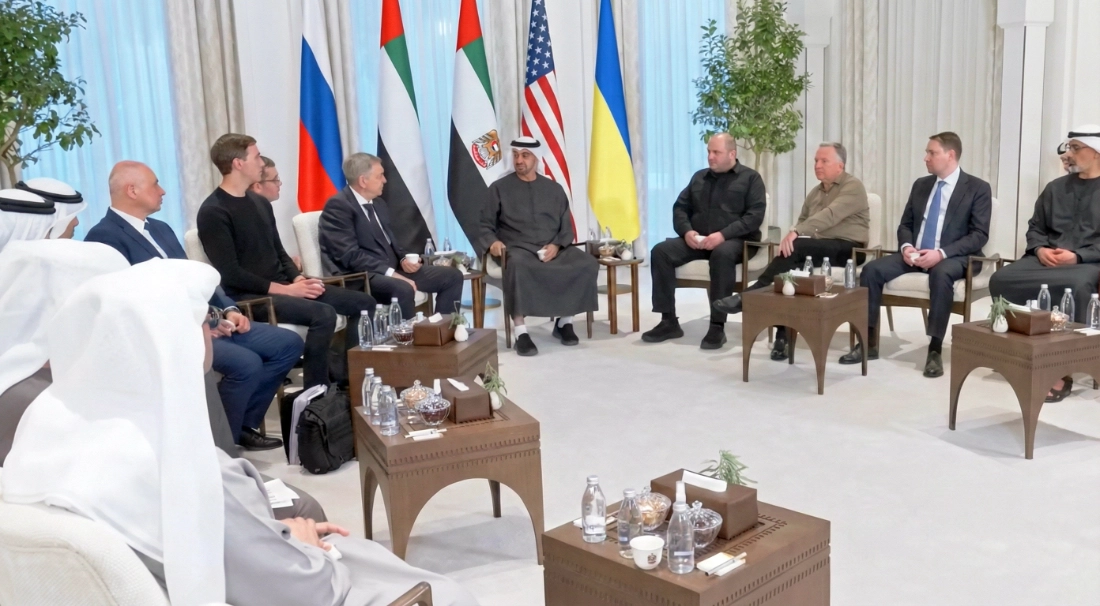
The first-ever Ukraine-Russia-USA format talks took place in Abu Dhabi on Friday and Saturday—an extraordinary event that warrants careful analysis. Now that a day has passed and all who wanted to speak have spoken, we can assess what was agreed upon and what was not.
There are positives, but there are also obvious negatives. The format itself is interesting. It is very good that the Russians are sitting with us at the same table with the mediation of the United States of America.
But the negative is the absence of Europeans. Under the Trump administration specifically, it is extremely difficult for Ukraine to defend its position without Europeans. This is particularly concerning given that Americans are in a hurry—Donald Trump and his party face an election year, and they are more inclined to pressure Ukraine than Russia.
For the next rounds, Ukraine must insist on European participation. And Europeans, for their part, need to finally decide who represents them. There has already been information about a decision to appoint a special representative being prepared, but this decision must be implemented. A powerful figure with negotiating experience needs to be identified who would also sit at the negotiating table. Then Ukraine would have fewer chances of being pressured from two sides.
Working groups signal practical orientation
The negotiations lasted two days in two working groups—political and military. This is a positive. It demonstrates that the Russians are at least thinking about ending the war through peaceful means, and they showed readiness for practically oriented work.
Clearly, they are still not ready for any compromises, but this first round where work concentrated on practical issues in the political group and military group is important.
The political group discussed which peace plan to proceed with, the question of agreeing on 20 points, territorial issues, and security guarantees. The military group addressed monitoring, ceasefire, and energy matters, among others.
At the same time, it is bad that no negotiation protocol was signed and no joint press appearance was made. The parties agreed exclusively on one thing: that they will continue to negotiate. Namely, the next round of talks has been announced for 1 February.
Russia refuses energy ceasefire amid brutal winter
The most unpleasant thing for us is that the Russians did not agree even to an energy ceasefire. This is a very serious negative in a situation where we are experiencing a harsh winter. They are trying to finish off our energy sector. This is very bad.
There is reason for cautious optimism at the second round—perhaps there will be some vision for an energy ceasefire, which we desperately need right now.
We may have to sacrifice strikes on Russia's oil refining complex or shadow fleet tankers, but at least we would survive the winter, because as of now the situation is quite critical.
Russia's team change: Professionals replace political mouthpieces
The Russians changed their negotiating team. Medinsky and MP Slutsky—the people Putin sent to voice ultimatums—were no longer there. Instead, there were technocrats from the Defense Ministry, intelligence, and Russia's Foreign Ministry.
Their names are unknown, but the very fact that the negotiating team changed and professionals were sent instead of political appointees is an interesting signal. It means there is a chance that something can actually be agreed upon.
Ukraine's delegation: strengths and gaps
It was somewhat surprising that the Ukrainian delegation had few diplomats and representatives from ministries that should lead directions related to reconstruction and monitoring.
But the presence of Kyslytsya [First Deputy Head of the Presidential Office] as one of the best diplomats, the presence of Budanov [Head of the Presidential Office, former Head of Defense Intelligence], and Arakhamia [Head of the Servant of the People parliamentary faction]—this is positive. The delegation consists of people who know what they are talking about and have carte blanche from President Zelenskyy.
Arakhamia's presence is also important because he understands the political moods inside the country and in the Verkhovna Rada. He likely had the opportunity to clearly convey to both the American and Russian sides what can and cannot be accepted in Ukrainian politics and society.
Cautious hope, but no breakthroughs
So the talks have taken place. There are no breakthroughs, but hope remains that at least some solutions will be found. The parties are commenting very cautiously on what happened. No one seems to want to provoke any rupture of a format that has only just been born.
We await 1 February with certain hope, we're not in despair. Everything will still depend on Ukraine's Armed Forces and our European partners. We believe in Ukraine and in its victory.
The best way out of this war is Ukraine's victory, and all efforts and resources must be invested in this. Plus, we need to work with our partners so that they increase the volume of assistance.
Vadym Triukhan is an international lawyer and former Ukrainian diplomat. This analysis is based on his video commentary"Triukhan's Diplomatic Kitchen."


