

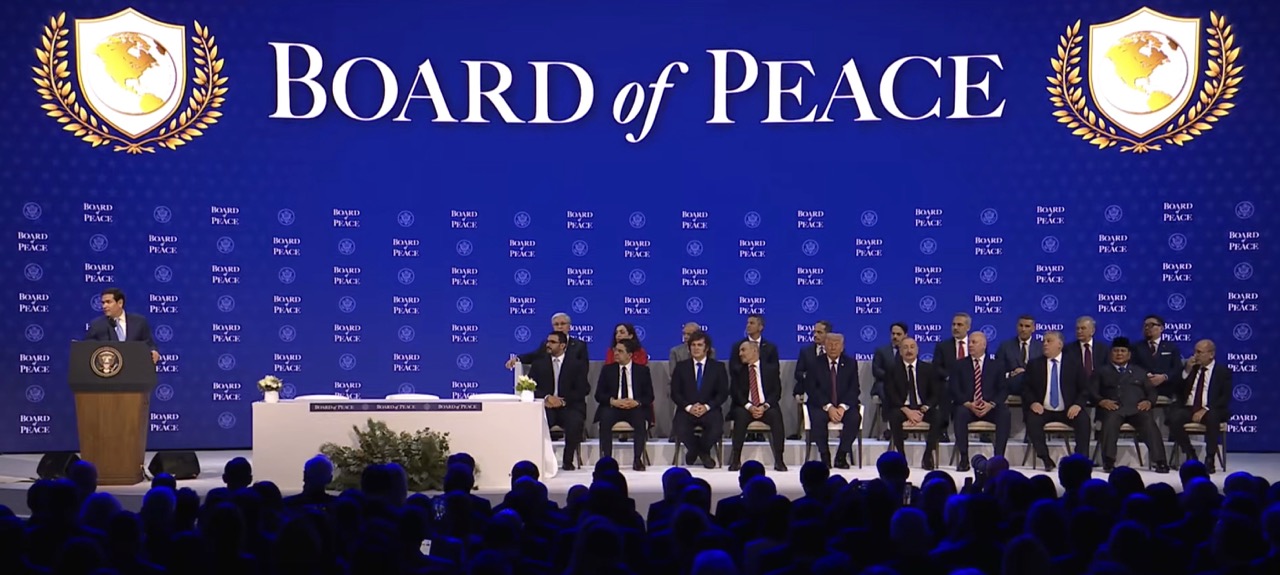
US President Donald Trump formally launched his Board of Peace at a signing ceremony in Davos on 22 January 2026, calling it "one of the most consequential bodies ever created"—but Russia was notably absent despite Trump's claim that Putin had accepted membership.
The ceremony exposed a gap between Trump's claims and Moscow's position. Trump told reporters on 21 January that Putin "was invited, he's accepted."
Hours later, Putin told the Russian Security Council the Foreign Ministry was still studying the proposal and would respond "in due course," according to TASS.
Russia's conditional interest
Putin proposed using frozen Russian assets to pay the $1 billion membership fee. "We could send 1 billion US dollars from Russian assets frozen during the previous US administration to the Board of Peace," he stated, according to RT, citing Moscow's "special relations with the people of Palestine."
Remaining frozen assets could fund post-war reconstruction "after the conclusion of a peace treaty between Russia and Ukraine," EADaily reported.
The Kremlin stressed it needs time. "The Russian Foreign Ministry was instructed to study the documents received by us, consult with our strategic partners on this matter, and only after that we will be able to respond," Putin said, according to EADaily.
Who signed, who didn't
More than 20 countries signed the charter in Davos, including Argentina, Hungary, Qatar, Saudi Arabia, Türkiye, and the UAE, according to ABC News. Russia was not among the signatories.
Key US allies also stayed away. France, Norway, and Sweden rejected invitations, Euronews reported.
The UK declined, with Foreign Secretary Yvette Cooper telling BBC News it's "a legal treaty that raises much broader issues." She cited concerns about "President Putin being part of something which is talking about peace when we still have not seen any signs from Putin that there will be a commitment to peace in Ukraine," Reuters reported.
Trump's vision vs. strategic reality
Trump framed the ceremony as historic progress. "Just one year ago the world was actually on fire. A lot of people didn't know it," he said.
"We've settled eight wars, and I believe another one's coming pretty soon—you know what that is, the one that I thought was going to be an easy one, turned out to be probably the most difficult."
On Ukraine, Trump cited grim casualty figures: "Last month, 29,000 people died, mostly soldiers. Think of that: 29,000, 27,000 in the month before, 26,000 in the month before that. It's terrible. But we have meetings where we think we're making a lot of progress."
Jared Kushner signaled no fallback plan: "People ask us what our Plan B is—we do not have a Plan B. We have a plan, we signed an agreement, we are all committed to making that agreement work."
Parallel Ukraine talks
While Russia skipped the signing, Putin's envoy Kirill Dmitriev was in Davos for separate discussions. He met Witkoff and Kushner for over two hours on 20 January, TASS reported.
Dmitriev called the meetings "constructive," adding that "more and more people are realizing the correctness of Russia's position," according to EADaily.
Witkoff and Kushner are scheduled to travel to Moscow on Thursday evening for direct talks with Putin regarding the Ukraine war settlement.
Russia's dual approach—studying the Board of Peace while pursuing separate Ukraine talks—suggests Moscow is extracting concessions on Ukraine while keeping options open on broader diplomatic architecture.


