

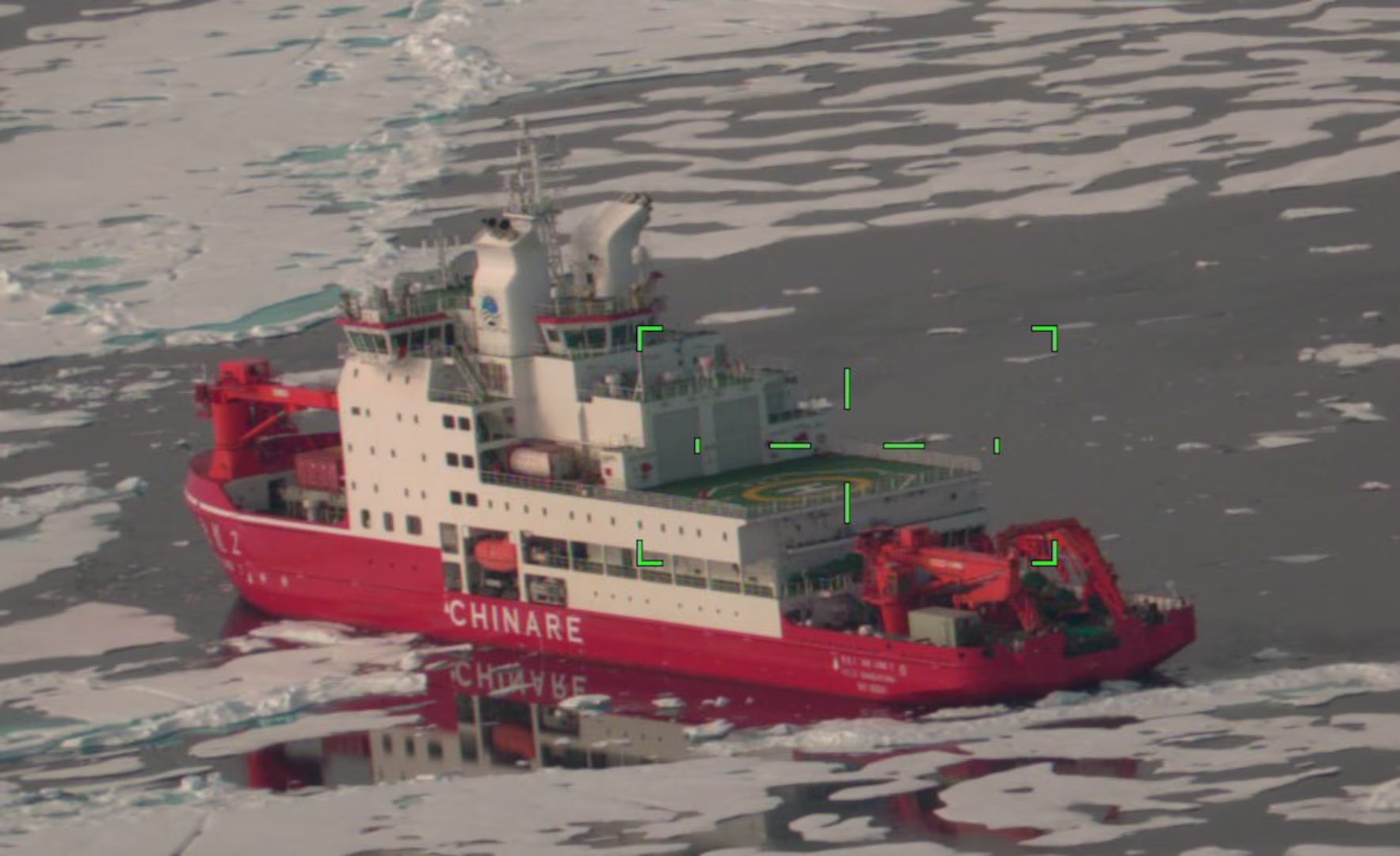
The European Centre of Excellence for Countering Hybrid Threats has published a 43-page assessment of Russian and Chinese capabilities in the Arctic. The paper, authored by Johan Schalin and Sophie Arts, documents how Moscow and Beijing are converting scientific expeditions, shipping infrastructure, and satellite systems into instruments of hybrid warfare.
Hybrid threats already observed in the region include sabotage of communication cables, GPS jamming, hacking of Norwegian ports and universities, espionage by fishing vessels, and covert influence campaigns targeting Indigenous communities. The paper warns these risks will grow as Russia and China field additional capabilities.
"Reconnaissance and intelligence-gathering missions"
China has cast itself as a "polar power" aiming to become a "polar great power" by 2030. Scientific research has been its primary vehicle for Arctic access.
Under China's Military-Civil Fusion strategy, all scientific efforts must be viewed as inherently dual-use. Chinese expeditions have deployed sonar-equipped underwater vehicles in the Barents Sea, installed acoustic buoy systems in Arctic high seas, and tested underwater navigation technologies in polar conditions. In 2025, China conducted its first manned deep-sea dive under Arctic ice.
Chinese strategists have been explicit about the purpose. A lecturer at the PLA's National Defense University stated the military can engage in Arctic affairs through "search and rescue operations, entering into security cooperation with Arctic countries, and undertaking reconnaissance and intelligence-gathering missions."
Chinese universities linked to the defense industry, including the "Seven Sons of National Defence" network overseen by the Ministry of Industry and Information Technology, conduct Arctic research closely aligned with defense industrial development.
Russia provides the icebreakers
Russia makes up 53% of the Arctic Ocean coastline and is developing the Northern Sea Route (NSR) into a commercial corridor with Chinese investment. In 2024, a Russia-China Subcommittee began coordinating navigation safety, cargo planning, and ice data exchange. Chinese operators have signed agreements with Rosatom to establish year-round Arctic shipping.
The paper is explicit: "Russia–PRC cooperation in developing the NSR also provides an opportunity to introduce Chinese assets into the Arctic to support these different missions."
Every voyage requires Russian icebreaker escorts and permits. The infrastructure supporting commercial shipping—ports, surveillance systems, search and rescue—simultaneously supports military operations and hybrid threat activities.
Satellites for "information dominance"
Both countries are building satellite constellations for polar coverage. China's Ice Pathfinder satellite has a 744-kilometer field of view—vastly wider than Western equivalents—and tracks ships via Automatic Identification System. China's BeiDou navigation system includes two-way messaging enabling location tracking outside cellular coverage.
The paper warns that establishing primacy in the digital domain and physical infrastructure "provides capabilities that could allow the domination of the information space, creating dependencies in services and exerting influence that targets local communities."
Documented hybrid activities
The paper catalogues threats already observed in the Norwegian High North: hacking of Tromsø port and university, espionage by fishing vessels and drones, GPS jamming, and sabotage of communication cables. Russia has assets focused on "maritime special operations" directed by the GRU, Russia's military intelligence agency.
In the Canadian Arctic, covert cyber influence campaigns related to mining projects have been attributed to China, while Huawei has marketed telecommunications to Indigenous communities—exploiting "fraught relations between Arctic peoples and the federal government."
The growing number of incidents targeting undersea infrastructure in the Baltic Sea "suggests that EU member states and NATO allies should be prepared for similar incidents in the strategically important Arctic in the future."
What this means for Ukraine
Russia's Northern Fleet, headquartered at Severomorsk less than 200 kilometers from the Finnish border, hosts much of Russia's nuclear deterrent. Chinese investment in Russian Arctic projects, including stakes in Novatek's Yamal LNG and Arctic LNG 2, provides revenue that helps sustain Russia's war economy.
The paper observes that Russia's growing isolation "and subsequent dependence on the PRC seem to have eclipsed much of Moscow's historic mistrust for China for now."
What to watch
The paper warns that "special attention should be paid to Russia's and China's focus on disabling critical infrastructure"—particularly in the period before a potential military confrontation, when hybrid attacks can weaken an adversary without triggering a direct response.
Russia's 2014 military doctrine highlights the "comprehensive use of military force, political, economic, informational, and other non-military measures." The paper concludes that Moscow has "grown bolder in its hybrid threat operations since 2022."
Hybrid CoE Paper 28, "Bracing for a cold front," is available here.


