


By now, it's a time-honored tradition in Russia's 47-month wider war on Ukraine. The Russians develop some new innovation to protect their tanks from the tiny explosive drones that are everywhere all the time along the 1,100-km front line.
Within weeks, the Ukrainians copy the innovation for their own tanks.
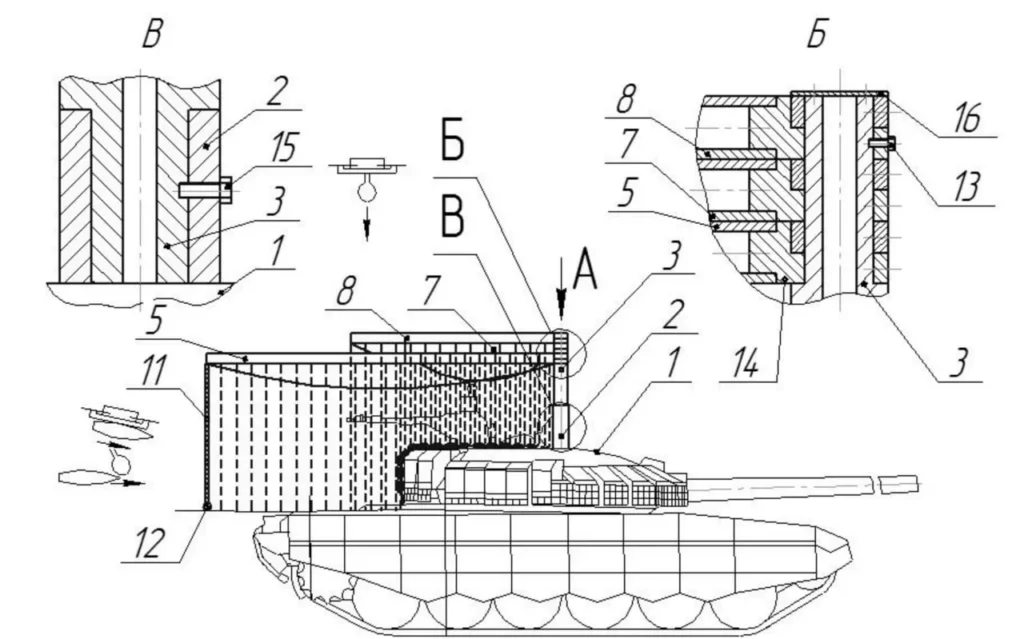
The latest is an add-on metal cage that helps protect a tank from attacking drones—but still allows the tank's turret to rotate left and right so that it can aim its main gun.
The turret cage solves a persistent problem. Most field-installed anti-drone armor—the shells, spines, and screens that have become ubiquitous along the front—prevents a tank from fully rotating its turret. The gun can't aim. The Omsk design, and now the Ukrainian copy, changes that.
A photo of a Ukrainian tank fitted with the boxy turret cage recently appeared online. The cage is fixed to the base of the turret rather than the tank's chassis, "in a way that [the] tank gun still can move freely while being protected from the drone threats," Ukrainian soldier Dimko Zhluktenko wrote.
The Ukrainians' new anti-drone armor appeared just a few weeks after blueprints for a similar Russian tank modification circulated on social media.
Those new blueprints, reportedly drawn up by the Omsktransmash tank plant in Siberia—which produces new T-80 tanks—point to a new Russian effort to mass-produce anti-drone protection.
While some new T-90 tanks roll off the assembly line at Uralvagonzavod in the Urals with purpose-made anti-drone cages, most Russian anti-drone protection is hastily applied in front-line workshops on the basis of whatever ideas and hard-earned experience the local engineers possess.
From cope cages to factory blueprints
Russian anti-drone armor has evolved fast:
- Cope cages (2022): Basic slat or mesh protection over turrets
- Turtle tanks (2023): Full metal shells encasing vehicles
- Porcupine tanks (2024): Thick metal spines added to shells
- Hedgehog tanks (2025): Thousands of metal "hairs" from unwound cable
- Hinged turret cages (2026): Factory-designed protection that restores gun rotation
Most of this armor is messy and chaotic. And it's how some engineers sometimes lose the plot—for instance, welding shipping containers atop some tanks in the hope the containers' thin metal will block drones.
As protection, a cage made of stronger metal would beat a shipping container any day.
Field-installed armor is only as good as the local workshop is skilled—and heavy shells can burn out a tank's transmission before it travels 10 kilometers. Standardizing the extra armor and installing it at the factory should allow the Russian military to consistently boost anti-drone protection across its thousands of tanks.
Aimable guns
Trending Now
The new blueprints from Omsk also address one of the bigger problems with field-installed anti-drone cages, screens, shells, and spines. Namely, many of the do-it-yourself anti-drone applications prevent a tank from fully rotating its turret and aiming its main gun.
The latest Russian turtle tank bridgelayers—tanks wrapped in metal shells and carrying 15-foot assault bridges on front-mounted gantries—can't use their main guns at all.
The Omsk design solves the gun problem by adding what amounts to a hinge to the middle of the anti-drone screen fitted atop the tank. The crew can unpin the front half of the box-like metal installation and fold its sides backward, freeing the turret to rotate around half its axis.
"One of the advantages of this design is the ability to relatively quickly transfer the device from combat to stowed position," armor observer AndreiBtvt noted. "In principle, this is yet another timid step in Russia toward fold-able protective structures."

Turtle, porcupine, and hedgehog tanks don't normally function as tanks. Instead, they're assault vehicles. Up-armored against drones and fitted with mine-clearing rollers, their mission is to lead less heavily-protected infantry carriers across the drone-patrolled, mine-seeded no-man's-land, detonating mines and absorbing strikes by small drones as they shepherd the infantry carriers toward contact with the enemy.
Last summer, one up-armored Russian porcupine tank survived more than 70 drone strikes before finally succumbing. "It was very difficult to find a weak spot," the Ukrainian Deep State analysis group observed.
As assault vehicles, the up-armored tanks are drone sponges. They aren't expected to fire their guns. But that doesn't mean they wouldn't benefit from doing so. A stabilized 125-millimeter gun is still useful for suppressing enemy troops during the dangerous run across no-man's-land. But the gun is only as useful as it's aimable.
The Omsk design makes tank guns aimable again on a battlefield dominated by drones. It's no wonder the Ukrainians have rushed their own version of this innovation into use.

Read also
-
Ukraine needs 3,000 intercepts monthly to match Russia’s 100 Shaheds per day. Kyiv launches advanced solution to help
-
From Ukraine testing to “Golden Dome”: US defense company wins contract after secretly deploying Tempest system to Kyiv troops
-
North Korea sent its 22-rocket M-1991 to Russia. Ukrainian drones found it, and that wasn’t only target that night (VIDEO)


