

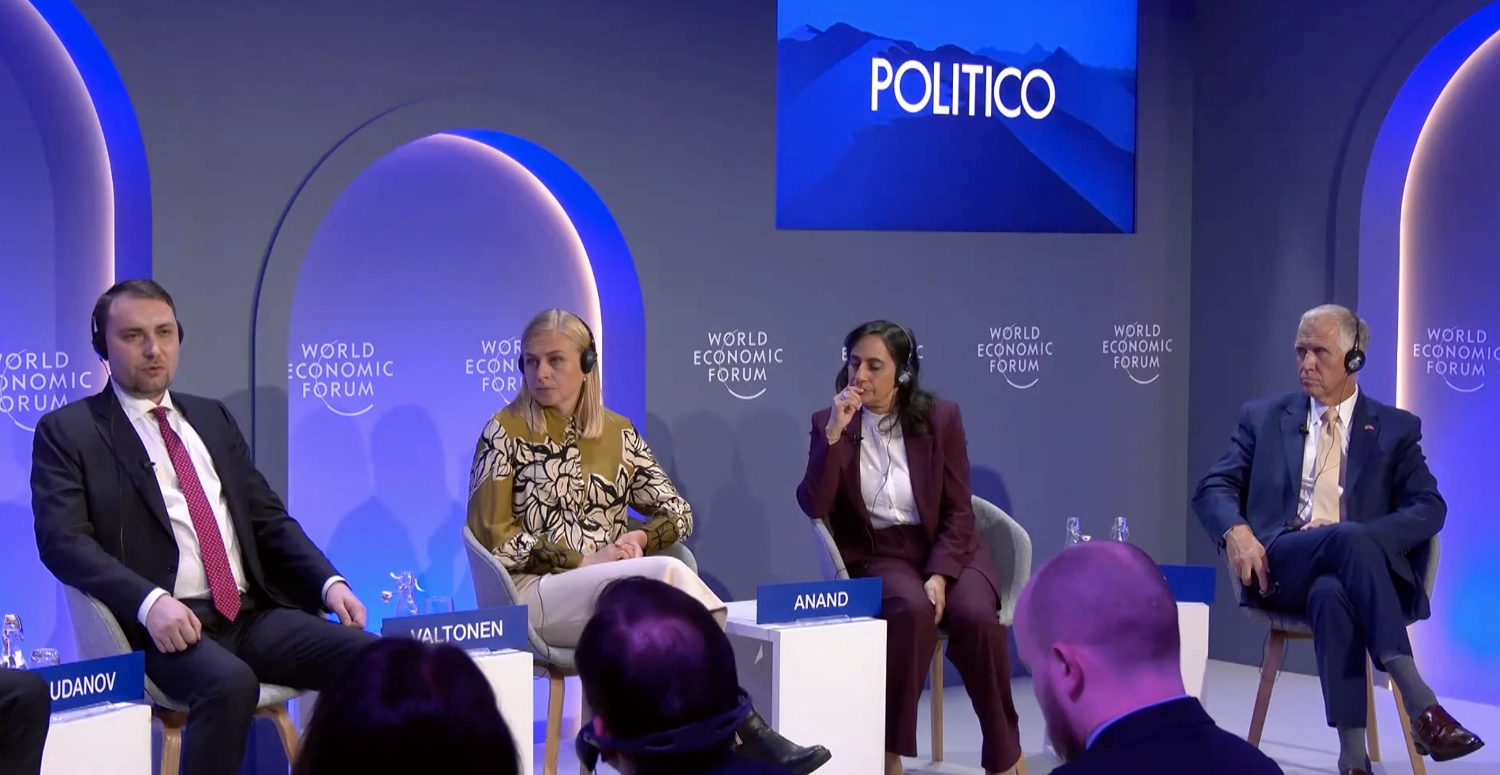
Ukraine's presidential chief of staff Kyrylo Budanov disclosed at the World Economic Forum in Davos on 20 January that he had been conducting "preparatory work with representatives of President Trump" in Miami immediately before flying to Switzerland, confirming Kyiv's direct involvement in ongoing peace negotiations.
Budanov, who served as head of Ukraine's military intelligence (HUR) before Zelenskyy appointed him to lead peace talks earlier this month, challenged the narrative that Ukraine risks being sidelined in talks about its own future. "We are in the process. Understand it correctly. This process, thank God, does not go on without us," he said at the panel "Path to Peace in Ukraine: By Might or by Accord?"
Budanov pushes back on "sidelined Ukraine" framing
The former spy chief took issue with how Western allies framed Ukraine's position at the negotiating table, calling it "a bit incorrect" when panelists emphasized that Ukraine "must have a place" in negotiations.
"I came here, I'm telling you directly, from Miami," Budanov said, adding that the identities of Trump's representatives were already publicly known.
But he coupled this assertion with a plea for allied unity: "Please be with us, let's discard all these misunderstandings that exist between the countries that have been helping us all this time"—a likely allusion to the Greenland crisis dominating Davos discussions—"Let's accumulate efforts, mobilize and bring the matter to an end."
Budanov was blunt about the stakes. Without Western support, "our position will weaken even more. With a weak position, again, it will be quite problematic to talk. It's basically impossible."
"Putin is a murderer and a liar"
US Senator Thom Tillis, wearing Ukraine's colors "intentionally," delivered the panel's sharpest condemnation of the Kremlin leader.
"Vladimir Putin is a murderer. He's a liar on his best day. And what we're seeing in Ukraine are his worst days," Tillis said, recounting his visit to Bucha after the Munich Security Conference. "You can't trust him."
The Republican senator insisted any agreement must be "very specific" with "consequences for violating it," and predicted Congress would pass an appropriations measure demonstrating continued financial support for Ukraine "in the coming weeks."
Tillis also rejected the premise that Russia was winning: "The reason why the Russians are at the table, Putin's at the table, is because we've proven that NATO technology is superior to them."
Canada pledges continued support
Canadian Foreign Minister Anita Anand underscored her country's "distinct relationship" with Ukraine, citing $22.5 billion in military, economic, and infrastructure support—the largest per capita contribution of any ally.
Anand noted that Canada hosts the world's largest Ukrainian diaspora, announcing the country would host a global conference in Toronto this fall focused on returning 20,000 deported Ukrainian children.
She repeatedly stressed the principle of "nothing about Ukraine without Ukraine," arguing that without Kyiv at the table, "the resolution would not be just."
Budanov on China: enrichment, not arms
Asked about Beijing's role, Budanov offered a detailed account of how China exploited Russia's desperation after 2022 sanctions.
Budanov described a progression: first electronics and microchips, then machine tools, then materials for weapons production. "Russia paid huge amounts of money for this, much more than any country for such goods paid before, but they didn't have basically any other option," he said.
But he noted a critical distinction: "China did not transfer any finished unit of weapon. No matter how we treat China, good or bad, but it didn't do this. Not a single finished unit of weapon."
The result, Budanov argued, is Russia's growing dependence on Beijing—something he said Russians themselves recognize. "It's painful for them to admit it, but they know it perfectly well."
On NATO: "Let's see"
Budanov acknowledged Russia would "definitely insist" that Ukraine not join NATO—a demand Moscow has used to justify its aggression since 2014.
"Whether Russia will insist that Ukraine does not become a member of NATO? They will definitely insist. What will come of it? Let's see," he said. "Any negotiation process, it generally loves silence, but partially you will still see it all."
Finnish Foreign Minister Elina Valtonen dismissed Russia's NATO security concerns as "complete bollocks," noting that Russia has moved troops away from the Finnish border since Finland joined the alliance—contradicting claims that NATO expansion threatens Moscow.


