
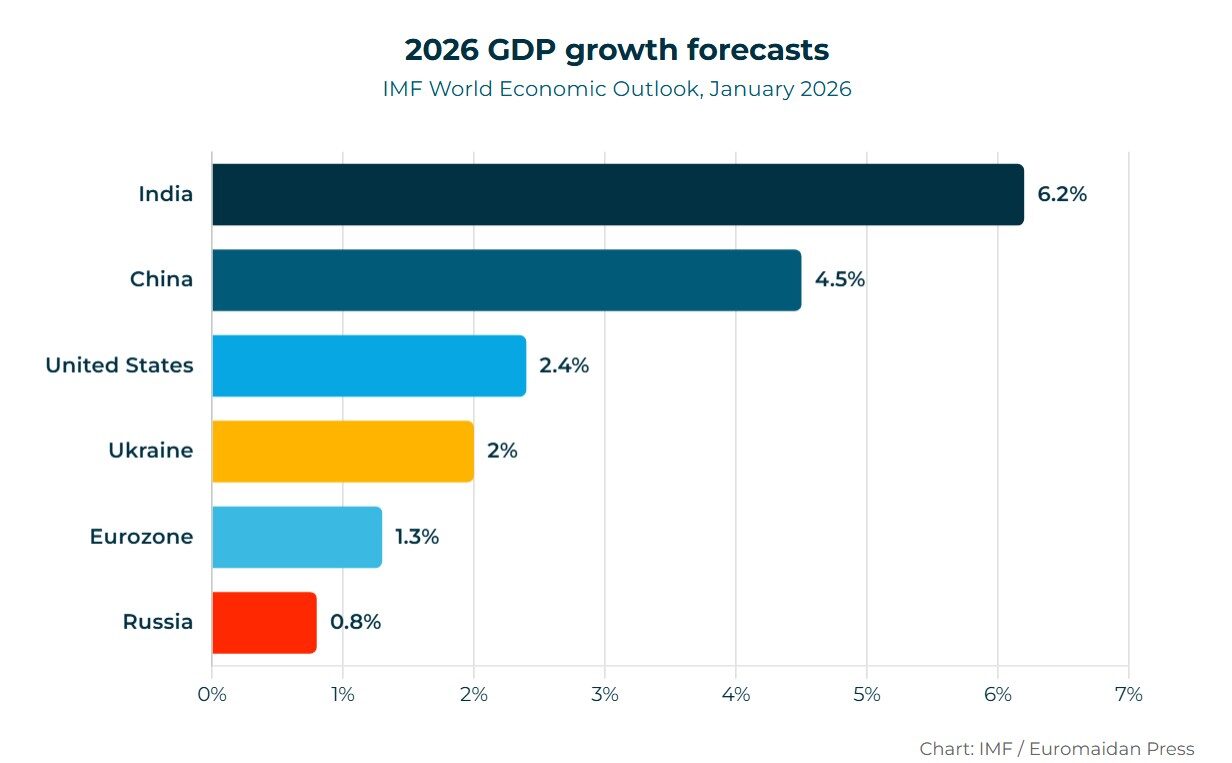
The International Monetary Fund cut Russia’s 2026 growth forecast to 0.8% on Monday, while projecting Ukraine, still under Russian bombardment, to grow 2% this year.
The revision means the country financing the war will grow slower than the country absorbing its missiles. In October, economist Volodymyr Vlasiuk told Euromaidan Press that Russia had 12-18 months of war funding left. Three months into that window, the IMF data suggests the clock is ticking as he projected.
Russia at the bottom
The 0.2 percentage point downgrade places Russia at the bottom of major economies. India is forecast to grow 6.2%. China: 4.5%. The United States: 2.4%.
Even the sluggish eurozone is expected to expand 1.3%, The Moscow Times reported. And Ukraine, still absorbing Russian missiles daily, is projected at 2%, while Russia sits below them all.
Oil revenue collapse accelerates
The IMF revision landed the same day Reuters calculated that Russia’s January oil and gas tax revenue will plunge 46% year-on-year to around 420 billion rubles ($5.4 billion)—the lowest monthly intake since August 2020, when the pandemic crushed global fuel demand.
Russia lost nearly all its European customers after pipeline flows through Ukraine stopped in January.
The full-year 2025 numbers were already dire. Russia’s Finance Ministry reported that oil and gas revenues fell 24% last year to 8.48 trillion rubles ($108 billion), the lowest since 2020. Gas revenues alone dropped over 30% as Russia lost nearly all its European customers after pipeline flows through Ukraine stopped in January.
Russia’s 2026 budget assumes Urals crude will average $59 per barrel, Finance Minister Anton Siluanov told RBC media in September. Analysts at Goldman Sachs, JPMorgan, and the World Bank forecast Brent crude at $55-62.
With Urals trading $20-27 below Brent since November US sanctions hit Rosneft and Lukoil, Russia faces an effective price closer to $40-45 per barrel—roughly 25-30% below what Moscow budgeted, according to Re:Russia.
Trending Now
Reserves running down
Vlasiuk calculated that Russia’s National Wealth Fund—the emergency reserve that plugs budget gaps—could cover perhaps six months at current deficit rates. “They cannot finance the war of the present intensity for a long time,” he said. As Meduza pointed out, the fund’s liquid assets stood at $53.4 billion on 1 December—less than Russia’s projected 2025 deficit alone.
China, Vlasiuk noted, had refused Moscow’s request for macroeconomic aid.
Vladimir Putin has asked his government and central bank to return Russia to “balanced growth” in 2026.
The Kremlin raised VAT from 20% to 22% on 1 January, lowered thresholds to pull more small businesses into the tax system, and hiked corporate taxes. The Free Russia Foundation estimates the VAT hike will generate roughly 1.7 trillion rubles ($21.8 billion) in additional revenue—not enough to cover half the projected deficit.
President Vladimir Putin has asked his government and central bank to return Russia to “balanced growth” in 2026. The Central Bank forecasts GDP growth between 0.5% and 1.5% for 2026. The Economic Development Ministry projects 1.3%. The IMF’s 0.8% falls in the lower half of Russia’s own estimates.