

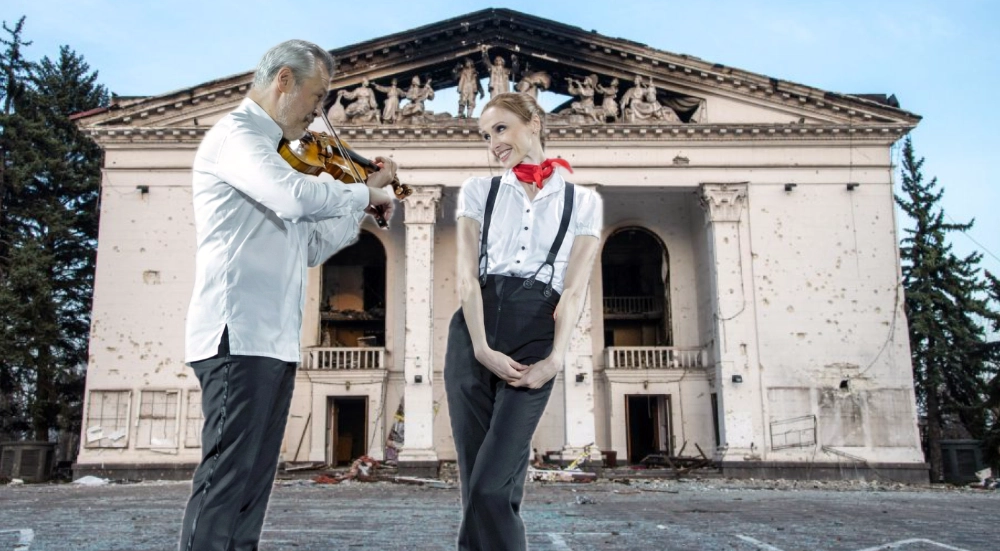
The Teatro del Maggio Musicale Fiorentino, one of Italy's most prestigious opera venues, has suspended a scheduled performance by Russian ballerina Svetlana Zakharova and violinist Vadim Repin after Ukrainian diaspora groups called for the cancellation, citing the couple's documented support for Vladimir Putin's regime and its war of aggression against Ukraine.
The suspension comes as Russia systematically destroys Ukrainian cultural heritage — theaters, museums, UNESCO sites — while its cultural ambassadors continue performing in European capitals. The European Parliament has recognized Russia as a state sponsor of terrorism, making the Teatro's original decision to host regime loyalists particularly jarring.
Putin's "trusted representative" on Italy's stage
The Teatro's website announced the performance "Pas de deux for toes and fingers," scheduled for 20-21 January 2026, was "temporarily suspended due to the ongoing international tensions."
But the petition filed by the Network Associazioni per l'Ucraina, provided to Euromaidan Press by Arts Against Aggression coordinator Dmitry Smelansky, laid out something more specific than "tensions" — a documented record of regime collaboration.
Zakharova has been a member of the United Russia party since 2007. That same year, she was elected to the State Duma, serving as a deputy until 2015 in the fourth and fifth legislatures. In 2014, she signed an official letter supporting Russia's illegal annexation of Crimea and parts of Donbas. In 2024, she was designated as a "trusted representative" of Putin.
The Kremlin has awarded her the Order "For Merit to the Fatherland," 2nd class — recognition typically reserved for individuals who actively serve state interests.
"This is not a matter of opinion"
The coalition's letter to Florence Mayor Sara Funaro, Tuscany Region President Eugenio Giani, and Italy's Culture Minister Alessandro Giuli didn't mince words: "The Russian invasion of Ukraine is not a matter of opinion nor a cultural controversy, but a violent war of conquest and large-scale destruction, recognized and condemned by the international community."
The letter noted that the Teatro receives public funding, including EU resources — making the choice to host Putin's cultural representatives while the EU faces Russian destabilization particularly incongruous.
"The use of European funds to offer visibility to figures symbolizing such a regime raises profound questions regarding consistency with the EU's founding values: peace, respect for international law, and the protection of human rights," the petition stated.
Ukraine's cultural heritage under siege
The suspension marks a rare victory for civil society efforts to hold Russian artists accountable for their political choices — not their nationality, but their active collaboration with a regime the International Criminal Court has charged with war crimes.
It's not Zakharova's first cancellation: in June 2024, Ljubljana canceled her scheduled Modanse performance after similar pressure from Ukraine's embassy and Slovenia's Ukrainian community, RFE/RL reported.
While Zakharova performed in world capitals, Russian forces have damaged or destroyed more than 1,500 Ukrainian cultural sites since February 2022, according to UNESCO monitoring.
The Donetsk Academic Regional Drama Theater in Mariupol, where civilians sheltered under a sign reading "children" visible from space, was bombed in March 2022. Russia destroyed the Skovoroda Literary Memorial Museum in Kharkiv Oblast. Countless churches, libraries, and theaters across occupied territories have been systematically erased.
The coalition posed two questions to the Teatro's management: "Are you aware that you are about to offer visibility and legitimization to people who support the aggressor regime?" and "Is it acceptable for your Foundation to contribute to the normalization of violence as a political tool?"
The Teatro's answer — suspending the show — suggests at least one European cultural institution recognized the cost of silence.
What the protest cost, and what it won
The Network Associazioni per l'Ucraina and Arts Against Aggression coordinated across multiple organizations to mount a sustained campaign. They wrote formal letters, engaged media, and made their case through legitimate civic channels rather than threats.
What they won was not censorship — Zakharova remains free to perform wherever venues choose to host her. What they won was accountability: forcing a public institution receiving EU funds to acknowledge that hosting regime loyalists while that regime commits documented atrocities is itself a political choice.
The Teatro's statement blamed "international tensions." The petition's language was more precise: the tensions aren't floating abstractions.
They're Russian missiles striking children's hospitals, mass deportations of Ukrainian minors, and the systematic destruction of a nation's cultural identity — while its Duma deputies dance in Florence.


