

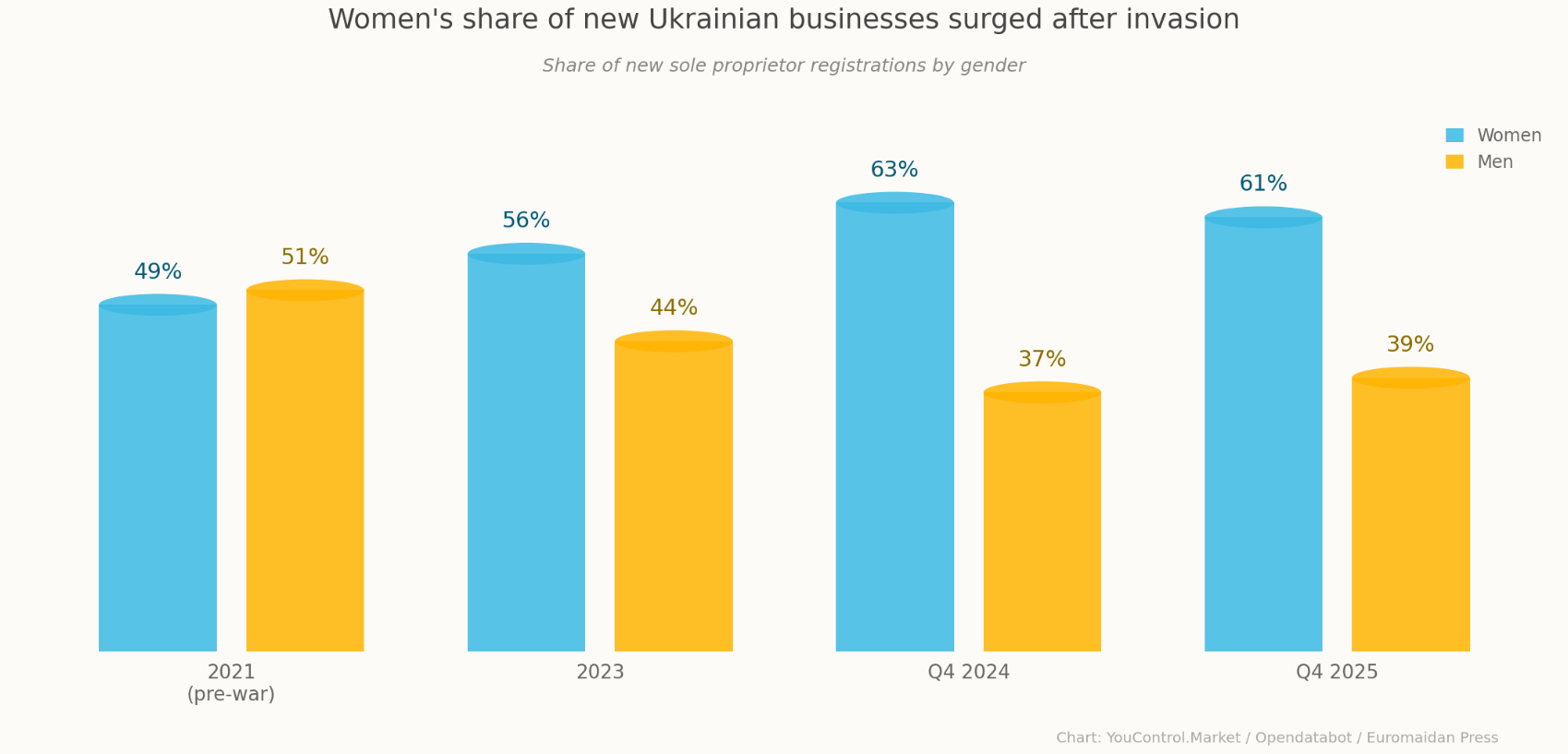
Women now register 61% of Ukraine’s new sole proprietorships, up from 49% before Russia’s full-scale invasion. The 12-percentage-point shift represents a structural transformation—with men mobilized and millions abroad—women have built Ukraine’s wartime small business economy largely on their own.
New data from analytics platform YouControl.Market shows that the trend continued through Q4 2025: women opened 36,000 new businesses, while men opened 22,300. For the first time since the full-scale invasion, registrations exceeded closures—7,700 more businesses opened than shut down.
“This trend has become even more pronounced after the full-scale war began, when many women started their own small businesses to support their families and the economy,” YouControl analysts noted.
The pattern extends beyond entrepreneurship. “There is a noticeable shift away from gender and age bias in candidate selection as employers adjust criteria to attract needed employees,” the Kyiv School of Economics observed. “This trend also extends to entrepreneurship, where the share of female entrepreneurs is growing significantly.”
Men slowly returning
The latest data suggests the gender gap may have peaked. Women’s share actually dipped from 63% in Q4 2024 to 61% in Q4 2025, while men’s share rose from 37% to 39%. Men registered 22,300 new businesses in the quarter—still far fewer than women’s 36,000, but the highest male share since the invasion began.
Whether this reflects demobilization, adaptation, or simply more men finding ways to work while avoiding conscription remains unclear.
The quarterly surge—with a caveat
Ukraine recorded 58,200 new sole proprietor registrations in Q4 2025, representing a 40% increase over the same period last year. For the first time since the full-scale invasion, registrations exceeded closures: 7,700 more businesses opened than shut down.
But YouControl flags an important caveat: a cyberattack disabled Ukraine’s state business registry from 19 December 2024 to 8 January 2025, artificially depressing Q4 2024 numbers.
Some of the year-on-year jump reflects delayed registrations, not new economic activity.
The full-year picture remains sobering: 244,000 registrations against 258,000 closures left Ukraine with 14,000 fewer sole proprietors than it started 2025 with.
The labor crisis in reverse
The entrepreneurship surge is the flip side of the employment crisis Euromaidan Press documented this week: 427,000 job openings in 2025, yet only 63% filled. When you cannot find a job matching your skills and location, you become your own employer.
Retail dominates new registrations—16,500 sole proprietorships, or 28% of the total, up 42% year-on-year. This aligns with the retail sector’s continued strength: the National Bank of Ukraine reported retail companies recorded their ninth straight month of positive expectations in November, even as manufacturing contracted.
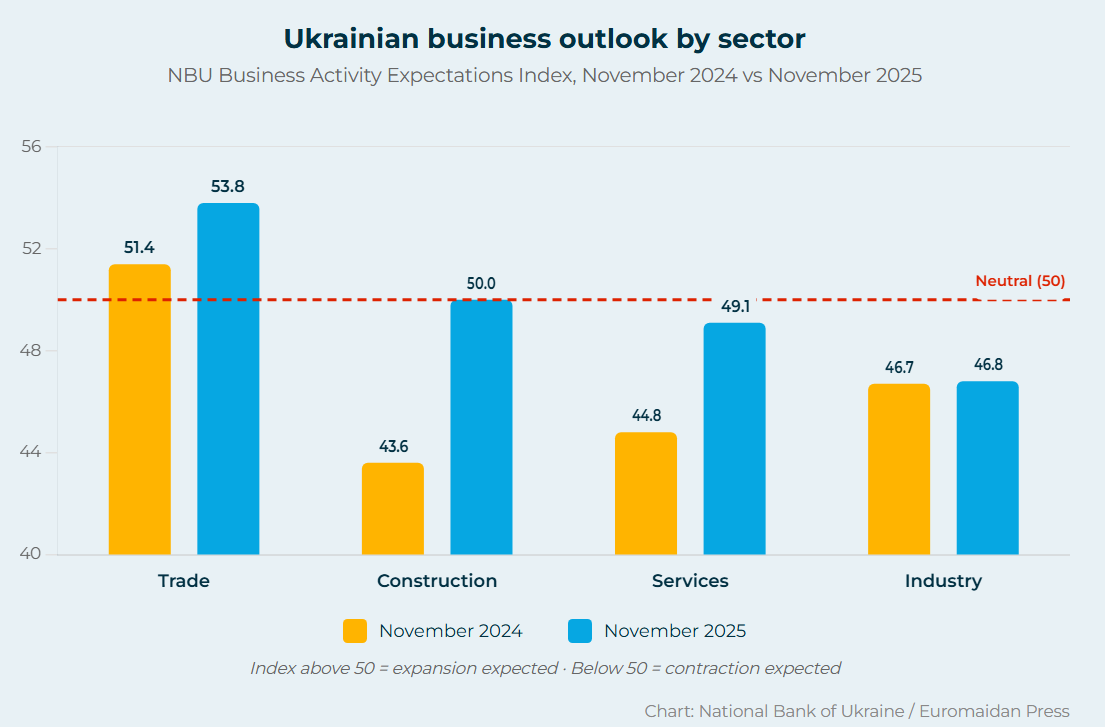
As Russian strikes hit industry, retail demand stays unexpectedly strong (INFOGRAPHIC)
Trending Now
Transport and logistics nearly doubled (4,500 registrations versus 2,600 last year)—an indicator of surging demand for couriers and cargo services. Education services jumped 63%.
The IT sector tells a different story: despite 7,700 new registrations, closures reached 9,900—a net loss of 2,200 IT entrepreneurs in a single quarter.
Geography follows safety
The regional breakdown traces Ukraine’s internal displacement. Kyiv leads with 8,000 new registrations (+20%), but the western regions show the sharpest growth: Lviv (+43%), Odesa (+52%), and Dnipropetrovsk (+46%).
YouControl notes that Lviv “has become one of the main refuges for business in wartime conditions and continues to build entrepreneurial potential.”
Almost every region outside active combat zones ended Q4 with net growth—a reversal from late 2024, when nearly every oblast recorded more closures than openings.
Frontline regions still bleed businesses. Donetsk lost 500 sole proprietors (698 registrations against 1,219 closures). But even there, the pace of closures has halved compared to last year.
The ceiling remains
The workforce aged 15-70 has shrunk by over a quarter compared to 2021. GDP expanded just 1.3% in the first nine months of 2025. Every unfilled vacancy represents productive capacity that Ukraine cannot utilize.
The economy keeps trying to expand. But it pushes against a demographic ceiling that will not lift until the war ends—and even then, luring back millions who have built lives in Warsaw, Berlin, and Prague will take more than a friendly invitation.


