

Today, the biggest updates come from Romania.
For nearly three years, Western aid to Ukraine has funneled almost entirely through a single vulnerable corridor in Poland, leaving Kyiv's forces perpetually at risk of logistical strangulation.
Now, with Romania stepping up to establish Nato's second-largest strategic logistics base for Ukraine, this precarious bottleneck is shattering, decisively transforming the war by guaranteeing Ukraine an unbreakable, multi-route lifeline that Russia can no longer hope to sever.

New hub operational by late January 2026
In a pivotal announcement confirmed by Major General Maik Keller, deputy commander of Nato's Security Assistance and Training for Ukraine, a new logistics and coordination hub, will become operational in by late January 2026.
This facility will operate in parallel with the primary hub in Rzeszow-Jasionka in Poland, which has long served as the main transit point for Western military aid to Ukraine. Under direct Nato command, the Romanian hub will integrate into Nato's Security Assistance and
Training for Ukraine system, matching donor supplies with Ukraine's urgent operational needs, including artillery, air defense systems, and electronic warfare equipment. To grasp the scale, the Nsatu system already facilitated the delivery of approximately 220,000 tons of military assistance in 2025 alone, involving 9,000 trucks, 1,800 railway wagons, and over 500 strategic airlift flights.
Romania stepping up transforms it from a supportive ally into a massive strategic war hub, providing Ukraine with a fortified rear base on Nato's eastern flank.

Shorter delivery times for critical weapons
The new Romanian hub dramatically boosts the volume and speed of military supplies reaching Ukrainian forces. By increasing the transit capacity, it enables the uninterrupted flow of critical weaponry, preventing the operational pauses that have plagued Ukraine due to delayed deliveries.

Priorities such as air defense missiles, artillery shells, anti-tank systems, and deep-strike capabilities can now be coordinated more efficiently. This massive war hub ensures that European-funded purchases of US weapons under mechanisms such as Purl arrive faster, sustaining high-intensity combat and allowing Ukraine to maintain pressure on Russian lines without exhausting reserves or risking human lives through lack of necessary equipment.

Ending Ukraine's single-point-of-failure problem
One of the most war-changing aspects is the creation of a resilient southern route, dramatically reducing dangerous dependency on the single Polish corridor through the overloaded and vulnerable Rzeszow-Jasionka hub.
Amid Russia's focused campaign of strikes on Ukrainian logistics routes and Western weapons transfers, Romania steps up by offering a backup logistics flow, enhancing overall supply chain security across Nato's eastern flank.
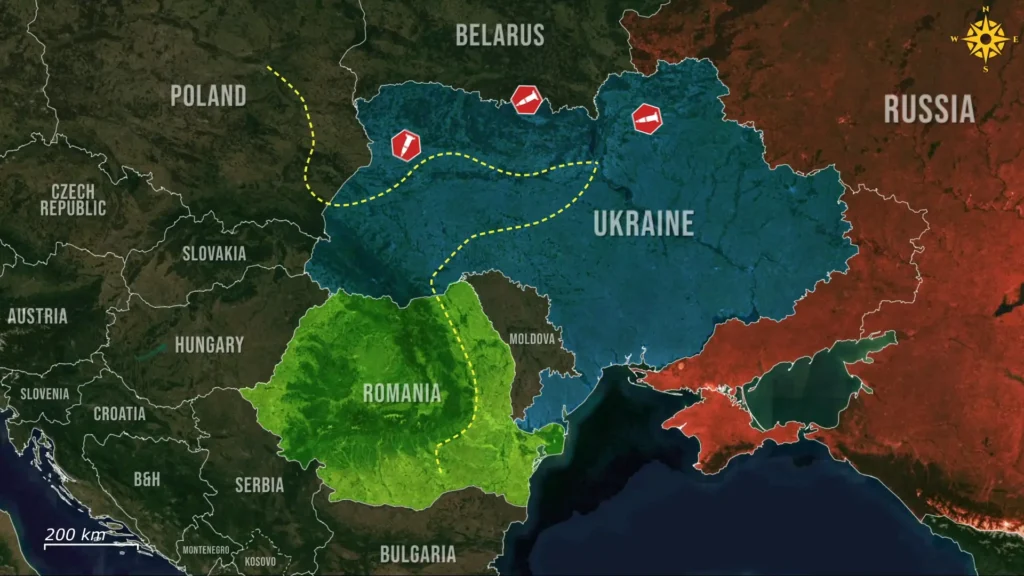
This diversification fortifies Ukraine's rear fortress against interruptions, forcing Russia to split its strike resources across multiple paths where saturation tactics once overwhelmed defenses, divided efforts will sharply reduce effectiveness, even with redistributed Ukrainian air defenses.
Moreover, harder-to-track deliveries diminish Russia's intelligence on Ukrainian weaknesses, ensuring consistent aid even amid hybrid threats or escalation, and markedly improving long-term sustainability in a protracted conflict.
Trending Now

Shorter routes to the southern and eastern fronts
Geographically, the hub provides targeted advantages for Ukraine's eastern and southern fronts. Supplies transiting through Romania can reach these critical areas more directly, supporting strikes into Russian-controlled territories and bolstering defenses against Russian advances in the south.
This positions Romania as a rear fortress enabling faster reinforcement of coastal and Donbas sectors, where Ukraine needs sustained artillery and air defense to counter aggression. The result is a strategic shift, empowering Ukrainian operations in high-stakes regions and altering frontline dynamics.

Signal of deeper NATO commitment
Romania's emergence as a massive strategic war hub signals deepened Nato commitment, deterring Russian escalation by strengthening the alliance's eastern posture. It reinforces collective defense, with the hub also serving to train Nato personnel in real-world logistics in supplying an ongoing full-scale war effort.
Amid ongoing airspace incidents and Black Sea tensions, this fortified base underscores Romania's role in safeguarding Ukraine's lifeline, raising the geopolitical stakes and solidifying Western resolve.

What the second corridor changes
Overall, Romania's decision to host Nato's second-largest logistics hub marks a decisive turning point in the Ukraine war, transforming a single point of failure aid system into a robust, multi-route network that guarantees Ukraine's long-term operational resilience.
By establishing a fortified rear fortress on Nato's southern flank, Romania has not only secured an uninterrupted flow of critical supplies but has also fundamentally altered the strategic calculus, with Ukraine now sustaining high-intensity combat across multiple fronts without the constant threat of logistical collapse.
This shift raises the cost of Russian escalation while deepening the alliance's irreversible commitment, making it far more difficult for Moscow to outlast Kyiv through attrition.
In the end, Romania stepping up has turned a vulnerable lifeline into a massive, enduring war hub, decisively tilting the balance toward Ukraine's ability to fight on its own terms and forcing Russia to confront the reality of a prolonged, increasingly unwinnable conflict.
In our regular frontline report, we pair up with the military blogger Reporting from Ukraine to keep you informed about what is happening on the battlefield in the Russo-Ukrainian war.