


President Volodymyr Zelenskyy for the first time shed details on the most recent draft of the peace plan with Russia.
This draft, as reported by Suspilne, contains 20 points, which call for "strong security guarantees" and EU membership for Ukraine, $800 billion in reconstruction financing, and binding non-aggression from Russia. It marks the first time Kyiv has publicly outlined terms it could accept — though Russia has yet to agree to any of them.
Ukraine would agree to an 800,000-strong peacetime military and to hold elections as soon as possible after an agreement goes into effect.
At least two points — which territory each side will control, and the status of the Russian-held Zaporizhzhia Nuclear Power Plant — are still disputed.
"I am now ready to discuss a draft 20-point document. This document is called a framework — a basic political document on ending the war between us, the United States, Europe, and the Russians," Zelenskyy told reporters at a 24 December press briefing.
According to Zelenskyy, the latest draft reflects a joint Ukrainian-American position, and while some issues have yet to be resolved, "we have significantly moved closer to finalizing the documents." The president said Ukraine is ready to meet with US leadership to resolve the more sensitive questions.
The Kremlin said Vladimir Putin has been briefed on the proposal — but offered no indication of whether Moscow would accept it.
What changed from the original US-Russia plan
The 20-point draft is the latest version of a document that has been revised repeatedly since a controversial 28-point US-Russia framework leaked in November. That original plan, drafted without Ukrainian input, was widely criticized as a "Russian wishlist."
The new draft drops several of Moscow's most contentious demands:
- The cap on Ukraine's military rises from 600,000 to 800,000
- The constitutional ban on NATO membership disappears entirely
- Blanket amnesty for war crimes is replaced with a humanitarian committee focused on POW exchanges and returning abducted children
- The 100-day election deadline becomes "as soon as possible"
- Demands to make Russian an official language and lift restrictions on the Russian Orthodox Church are replaced with general EU rules on minority rights
- The $800 billion reconstruction target replaces a US proposal that would have given Washington half of all investment returns
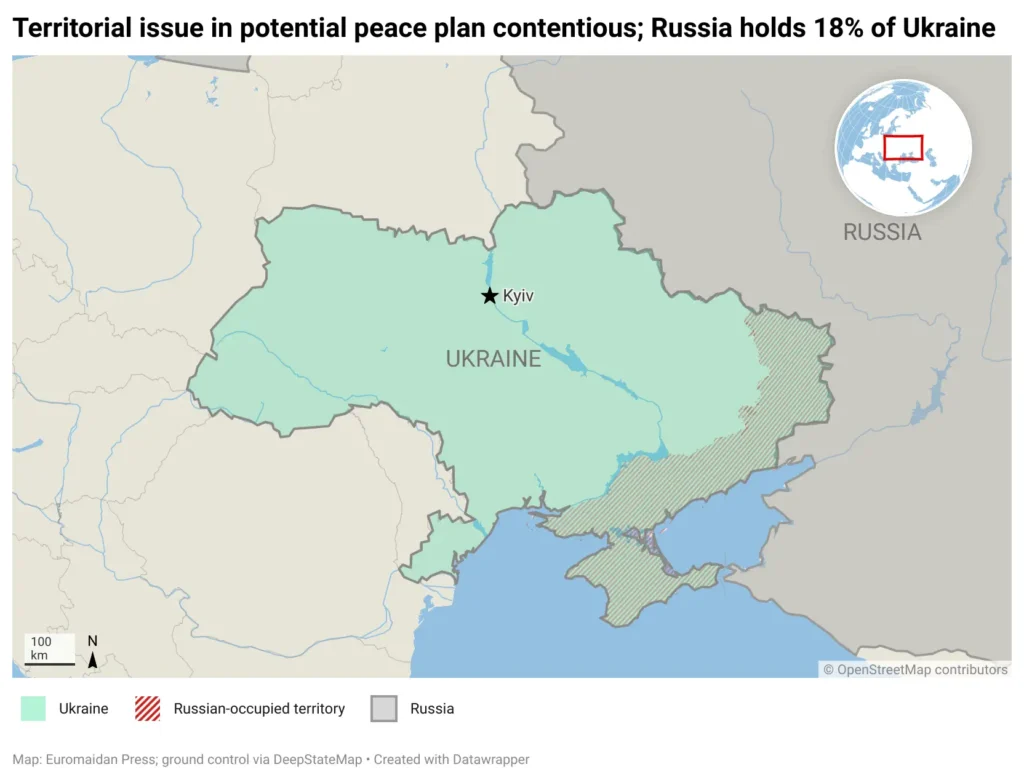
But fundamental questions remain. Both territorial options under discussion — freezing at current lines or creating a demilitarized Donbas zone — leave Russia in control of roughly 18% of Ukraine's internationally recognized territory. And while "Article 5-like" guarantees sound robust, they lack the automatic response obligation of actual NATO membership.
The full 20 points
Point 1: Sovereignty
Ukraine's sovereignty will be reaffirmed. The document confirms that Ukraine is a sovereign state, with all signatories affirming this through their signatures.
Point 2: Non-aggression
Full and unconditional non-aggression agreement between Russia and Ukraine. To maintain long-term peace, a monitoring mechanism will be established to oversee the line of contact using space-based unmanned monitoring, early-warning systems for violations, and conflict resolution mechanisms.
Point 3: Security guarantees
Ukraine will receive strong security guarantees.
Point 4: Military size
The size of Ukraine's Armed Forces will remain at 800,000 personnel in peacetime.
Point 5: Article 5-like guarantees
The United States, NATO, and European signatory states will provide Ukraine with "Article 5–like" guarantees.
Point 6: Russian non-aggression legislation
Russia will enshrine a policy of non-aggression toward Europe and Ukraine in all required legislation and ratification documents, including ratification by a constitutional majority in the State Duma.
Point 7: EU membership
Ukraine will become a member of the European Union within a clearly defined timeframe and will receive short-term privileged access to the European market.
Point 8: Development package
Ukraine will receive a robust global development package, to be defined in a separate agreement on investment and future prosperity, covering a wide range of economic sectors.
Point 9: Reconstruction funding
Several funds will be established to address economic recovery, reconstruction of damaged regions, and humanitarian needs. The goal is to raise $800 billion through equity, grants, debt instruments, and private-sector contributions.
Point 10: US free trade
Following the signing of this agreement, Ukraine will accelerate negotiations on a free trade agreement with the United States.
Point 11: Non-nuclear status
Ukraine confirms it will remain a non-nuclear state in accordance with the Treaty on the Non-Proliferation of Nuclear Weapons.
Point 12: Zaporizhzhia Nuclear Power Plant (disputed)
The Zaporizhzhia Nuclear Power Plant will be jointly operated by three countries: Ukraine, the United States, and Russia. However, details remain under discussion. Zelenskyy noted that Ukraine does not wish to negotiate directly with Russia "after everything that has happened."
Point 13: Education and minority rights
Both countries commit to implementing educational programs in schools and society at large that promote understanding and tolerance of different cultures and eliminate racism and prejudice. Ukraine will implement EU rules on religious tolerance and the protection of minority languages.
Point 14: Territory (unresolved)
The issue of the line of boundary and territorial control is still unresolved. Media outlets that attended the briefing reported two primary options.
Option 1: "We remain where we are." In the Donetsk, Luhansk, Zaporizhzhia, and Kherson regions, the line of troop deployment as of the date of the agreement would be recognized de facto as the line of contact, to be monitored by international forces.
Option 2: The establishment of a potential free economic zone in Donbas, accompanied by the demilitarization of the area. Ukraine opposes the withdrawal of its armed forces; however, should this option be implemented, it would require a reciprocal withdrawal by both sides, including Russian forces. Adoption of this option would be subject to approval through a nationwide referendum in Ukraine.
A final decision on territorial issues could be made at the level of national leaders.
Point 15: No forced border changes
Once future territorial arrangements are agreed upon, both Russia and Ukraine commit not to alter them by force.
Point 16: Maritime access
Russia will not obstruct Ukraine's use of the Dnipro River and the Black Sea for commercial purposes. A separate maritime and access agreement will be concluded, covering freedom of navigation and transport. As part of this agreement, the Kinburn Spit will be demilitarized.
Point 17: Prisoners and abducted children
A humanitarian committee will be established to address unresolved issues. This includes the exchange of all remaining prisoners of war, including those sentenced by the Russian system since 2014, as well as the return of all detained civilians and hostages, including children and political prisoners.
Point 18: Elections
Ukraine will hold elections as soon as possible after the agreement is signed.
Point 19: Enforcement
The agreement will be legally binding. Its implementation will be monitored and guaranteed by a Peace Council chaired by US President Donald Trump.
Point 20: Ceasefire
Once all parties agree to the document, a full ceasefire will take effect immediately.
How the plan evolved: a month of scrambling
The original 28-point framework, leaked on 20 November, was drafted in Miami by Trump envoy Steve Witkoff and Russian sovereign fund chief Kirill Dmitriev — without Ukrainian or European input.
It read like a list of Kremlin demands: Ukraine's army would be halved to 600,000, a constitutional amendment would permanently bar NATO membership, all war crimes would receive blanket amnesty, elections would be held within 100 days, and Crimea plus most of the Donbas would be recognized as Russian territory. The US would take 50% of reconstruction investment returns. A legal analysis found enforcing the plan would violate 71 US international commitments.

After three years of grinding losses, Trump’s plan gives Russia terms it couldn’t get in 2022
Bloomberg later published recordings of a 14 November call between Witkoff and Kremlin aide Yuri Ushakov, in which Witkoff coached Ushakov on how to present Russian ideas to Trump in ways he would accept. Witkoff said he "deeply respects Putin" and believed Russia "has always wanted peace."
The leak set off a scramble. Britain, France, and Germany drafted their own 28-point counter-proposal, raising the army cap to 800,000, removing the NATO ban, scrapping the war crimes amnesty, and eliminating the US profit-sharing clause. Kremlin aide Ushakov immediately dismissed these amendments as "entirely unconstructive and unsuitable for us."
US and Ukrainian delegations met in Geneva on 23-24 November for what participants described as "intense" talks that nearly collapsed before they started. Ukraine's First Deputy Foreign Minister Sergiy Kyslytsya told the Financial Times the US was willing to review every contested point. By the end, the document had shrunk to 19 points.
Further talks in Abu Dhabi and Berlin followed. The current 20-point version, which Zelenskyy presented on 24 December, incorporates many of the European amendments — but key issues remain unresolved, and Russia has not signed off on any of it.
What happens next
The US is expected to deliver the 20-point draft to Moscow on 24 December. If Russia accepts — a significant "if" given the Kremlin's rejection of earlier European amendments — the final document would need to be signed by the leaders of Ukraine, the United States, Europe, and Russia.
Which European leaders would sign on behalf of the continent remains undecided. And the document itself may continue to evolve: Secretary of State Marco Rubio has described the peace framework as a "living, breathing" text.
For now, fighting continues. Russian forces are pressing toward Pokrovske in Donetsk Oblast, and drone and missile strikes on Ukrainian cities show no sign of slowing.


