


- The fighting north of Pokrovsk and Myrnohrad in Donetsk Oblast is evolving as the contested terrain moves out of the ruined towns
- That has freed up Ukrainian assault units to hurry south toward Pokrovske and Huliaipole
- Russian forces have exploited gaps in Ukrainian defenses to advance in Dnipropetrovsk and Zaporizhzhia Oblasts
- The redeploying assault troops aim to plug those gaps
Ukraine is reinforcing the 35-km sector between Pokrovske and Huliaipole at the junction of Dnipropetrovsk and Zaporizhzhia Oblasts in eastern Ukraine. Unit Observer was among the first to draw attention to the troops' reshuffling.
The shift from urban to open terrain north of Pokrovsk has changed the defensive calculus. Drones work better in fields than ruins—freeing infantry-heavy assault units to reinforce the vulnerable 35-km sector where Russian tank and motor rifle divisions have been exploiting gaps.
As the 92nd Assault Brigade arrived around Pokrovske on or just before Monday, one of its first actions was to strike, with first-person-view drones, a pair of Russian troopers riding toward Ukrainian lines on horseback.
Why Ukraine can spare assault troops now
The redeployment of Ukrainian forces comes at a critical time. The Russian Center Group of Forces has consolidated in the ruins of Pokrovsk and Myrnohrad in Donetsk Oblast and now controls most of both towns.
From these new positions, they're striking out—and beginning the long, hard march toward the twin cities of Kramatorsk and Sloviansk, 50 km to the north.
Open terrain flips the tactical equation
To reach those cities, the Russians will have to advance across kilometer after kilometer of open terrain. They can't always repeat the urban assault tactics—small infantry groups leapfrogging through town ruins—that helped them win in Pokrovsk and Myrnohrad.
Infantry are best not only for urban attacks, they're also best for urban defense. But many Ukrainian brigades are desperately short of infantry. What they have in abundance are drones. And drones work best over open terrain, where the enemy has nowhere to hide.
Why does open terrain favor Ukrainian drones?
In urban areas, Russian infantry can shelter in buildings and basements, limiting drone effectiveness. Open fields offer no cover—every vehicle and infantry group becomes a visible target for FPV strikes.
So the Ukrainian brigades north of Pokrovsk and Myrnohrad are pivoting back to a drone-first defense bolstered by careful mining and heavy artillery fire. On Monday, the Ukrainian 4th National Guard Brigade and adjacent units repelled a powerful Russian mechanized assault involving four armor columns with potentially dozens of vehicles.

Methodical dismantling
Trending Now
The 4th National Guard Brigade mined the likeliest approach vectors and then sent in FPV drones and fired a lot of artillery and rockets. "Targets are tracked, fixed, and methodically dismantled," the brigade reported. Note the absence of major infantry action in the Ukrainian defense. That could become more common as Ukrainian forces defend the open terrain between Pokrovsk and Kramatorsk.
This ongoing shift apparently reassured Ukrainian commanders that they could spare some or all of several brigades and regiments from the Pokrovsk-Myrnohrad sector—and send them south.
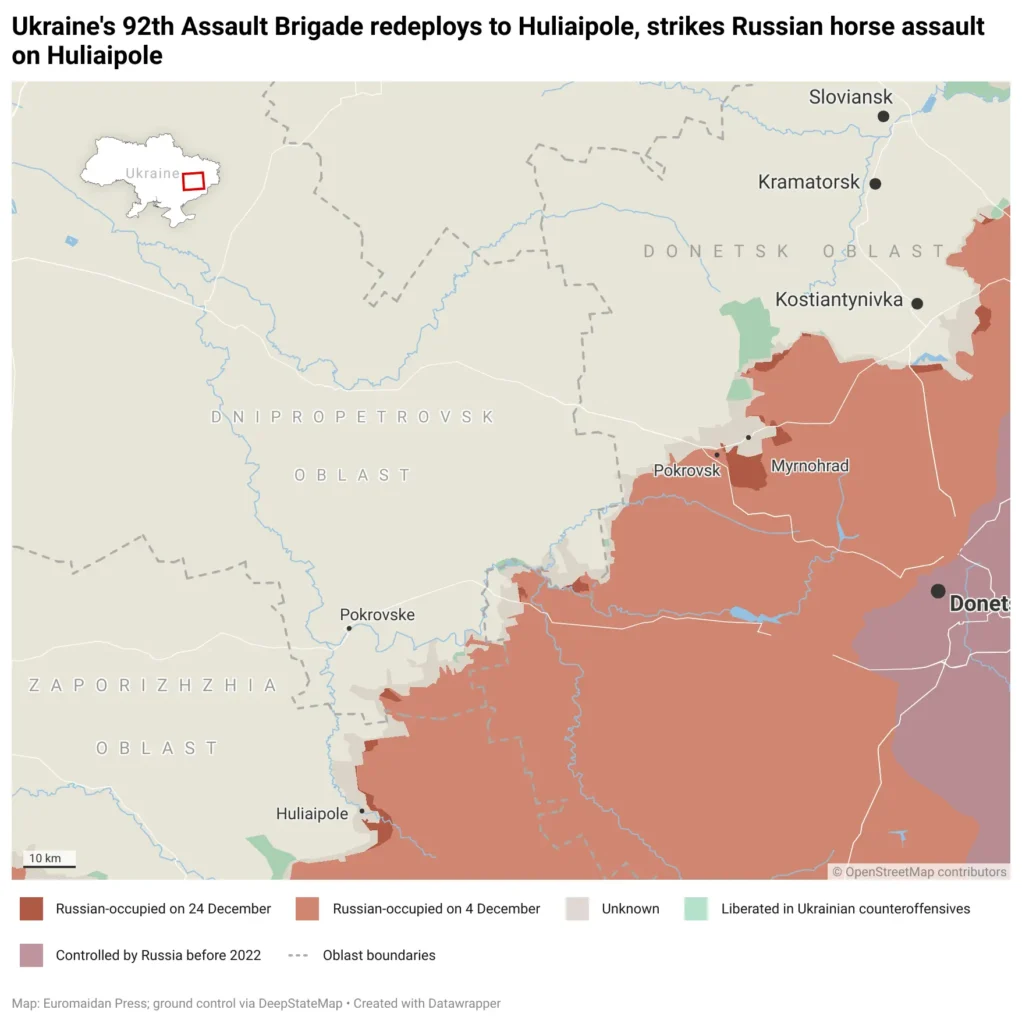
Ukrainian reinforcements heading to Pokrovske-Huliaipole sector:
- 92nd Assault Brigade
- 1st Assault Regiment
- 225th Assault Regiment
Those units could stiffen a fragile Ukrainian line.
Filling gaps in the south
Even as all eyes were on Pokrovsk and Myrnohrad in recent months, the Russians were making their most dramatic gains in the direction of Pokrovske and Huliaipole. The powerful Russian Dnipro Group of Forces, anchored by the 90th Tank Division and the 127th Motor Rifle Division, pushed weary, outnumbered Ukrainian mechanized and territorial troops back tens of kilometers to the western banks of the Vovcha and Haichur Rivers.
Those rivers now trace the main line of contact between Pokrovske and Huliaipole. They're formidable barriers, but not uncrossable for Russian engineers and their pontoon bridges.
To advance as far as they have in recent months, the Russians in Dnipropetrovsk and Zaporizhzhia have exploited gaps in Ukrainian defenses resulting from a paucity of forces. Newly arriving assault troops could fill those gaps.
They'll fight with mines, drones, and artillery, of course. But as the Russians push closer to Pokrovske and make further plays for Huliaipole's outlying neighborhoods, the Ukrainian reinforcements may have to deploy their precious infantry, too.


