

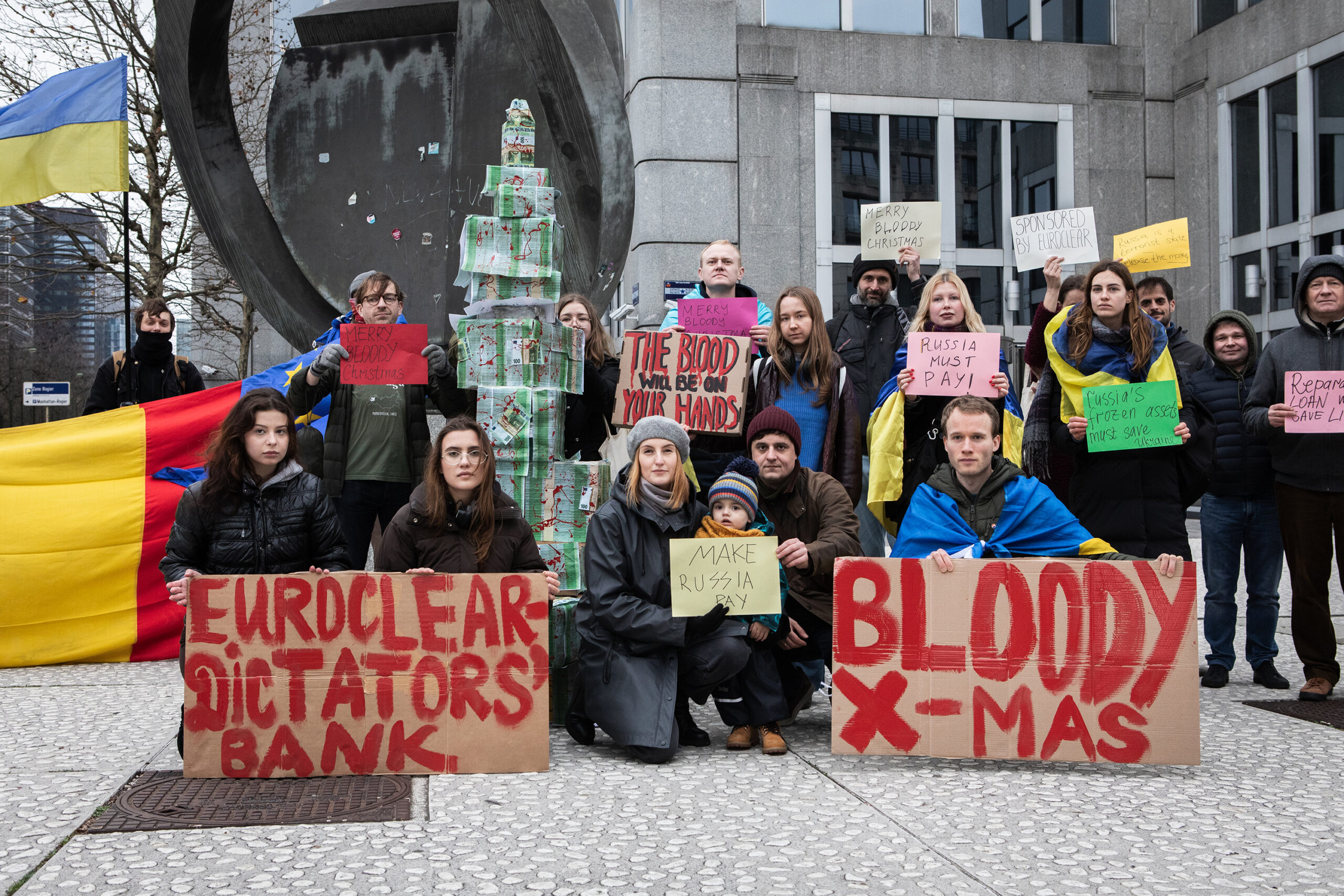
On 14 December, protesters gathered outside Euroclear headquarters with a Christmas tree that looked like it was made of blood-stained banknotes—a symbol of the Belgian profits from holding €200 billion in frozen Russian assets.
The actions were organized by the International Center for Ukrainian Victory, European Network in Solidarity with Ukraine, and Frozen Assets Action.
Two days earlier, activists rallied outside the European Commission under the banner “Ukrainian lives over profit.” Signs read “Belgium hesitates, Russia kills” and “Is De Wever the next Orbán?”—a reference to Belgian Prime Minister Bart De Wever, who on 2 December called Ukrainian victory “a fairy tale, a complete illusion.”

Belgium’s opposition could derail a European Council vote on 18 December to approve a reparations loan backed by profits from frozen Russian state assets. If the vote fails, European taxpayers—not Russia—would foot the bill for Ukraine’s defense funding.

Euroclear earns substantial revenue simply by holding the assets. Every month the decision is delayed, that revenue continues to flow.

“As a father, I cannot stand by while Ukrainian children are murdered and deported by Russia. Belgium has a moral choice to make: protect Russian money, or protect Ukrainian children,” said Antonio Albaladejo Román, who lives in Brussels.

Trending Now
The stakes extend beyond December. In January, the EU’s annual vote to extend sanctions on Russia requires unanimous approval from all 27 member states. Hungary has already announced it will veto. Without sanctions extension, the frozen assets argument becomes moot—and Russia regains access to billions.

The Brussels protests are part of a wider campaign across European capitals. Actions took place in Prague, Warsaw, Vienna, Stockholm, and Copenhagen in the lead-up to the 18 December vote.
Activists are calling on supporters to sign petitions, contact Belgian embassies, and pressure PM De Wever directly on social media using #MakeRussiaPay and #UnblockReparationLoan.


