


During an online press conference on 14 December, Ukrainian President Volodymyr Zelenskyy addressed questions about ongoing US-led indirect peace negotiations between Kyiv and Moscow. According to Euromaidan Press, he responded to US President Donald Trump's recent claim that Zelenskyy alone dislikes the peace plan, while his team allegedly loves it.
"The plan won't be one that pleases everyone," Zelenskyy said. "There are definitely many compromises in one format of the plan or another."
Berlin summit to discuss 20-point framework with ceasefire provisions
Zelenskyy spoke ahead of meetings with US and European officials in Berlin on 14-15 December. Asked whether the summit could change the situation, he replied:
"Definitely. Because we will be considering the 20-point framework plan, at the end of which there is talk of ceasefire. A ceasefire will definitely change the security situation on the ground."
He planned separate meetings with German Chancellor Friedrich Merz and other European leaders.
Ukraine's red line: no third Russian aggression
Zelenskyy emphasized that any agreement must serve Ukraine's interests and prevent future attacks.
"The most important thing is that the plan be as fair as possible, primarily for Ukraine, because Russia started the war," he said. "And the main thing is that it be effective, that the plan could truly be not just a piece of paper, but an important step toward ending the war."
The Ukrainian President stressed one non-negotiable requirement:
"After signing it, Russia must have no opportunity to start another, third aggression against the Ukrainian people."

NATO rejection forced Ukraine into bilateral deals
Zelenskyy explained how Ukraine's security strategy evolved after Western partners blocked its preferred path to obtain security guarantees from its allies.
"Ukraine's conditions from the very beginning — or maybe not conditions, correctly said, the desire — was NATO membership. And these were real security guarantees," he said. "Some partners from the United States of America and Europe did not support this direction."
Ukraine now seeks "Article 5-like" bilateral guarantees from the US, mirroring NATO's mutual defense clause.
"And this is already a compromise on our part," Zelenskyy noted, insisting that these arrangements must be "legally binding guarantees, not a Budapest Memorandum," and approved by US Congress.
Citing an unnamed US official, Axios said that Washington is "willing" to grant Ukraine a legally binding, congressionally approved security guarantee based on NATO’s Article 5.
Russia rejects "stand where we stand" ceasefire
The Ukrainian President says Ukraine's ceasefire position is straightforward:
"I believe that today a fair possible option should be: we stand where we stand," Zelenskyy said. "And this is true, because this is what a ceasefire is — the sides stand, and then diplomatically try to resolve all general issues."
Russia rejected this approach. "Russians respond that we must leave the Donbas or they will occupy it anyway," Zelenskyy said.
According to the President, the US then proposed a "compromise": Russian forces would not enter part of eastern Ukraine if Ukrainian forces withdrew.
"I don't consider this fair," Zelenskyy responded, adding: "If Ukrainian troops withdraw 5-10 kilometers, for example, then why don't Russian troops withdraw the same distance deeper into occupied territories?"
He called this "a question that has no answer yet. But it's very sensitive and very hot."
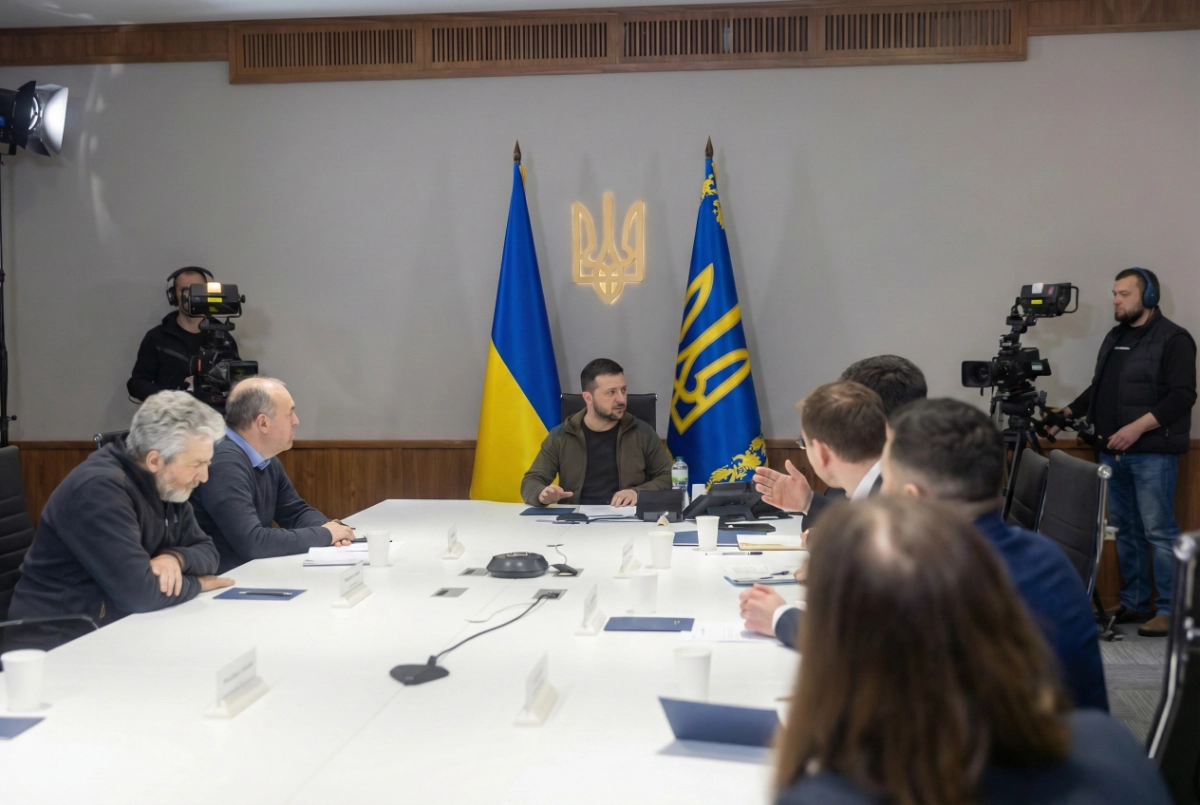
Ukraine denies agreeing to Donbas buffer zone, calls Le Monde report a misinterpretation
Russia seeks territorial gains without fighting for them
Zelenskyy accused Moscow of pursuing a strategy to avoid military costs.
"Russia wants to not expend forces and occupy our east through political means, diplomatic-political means," he said.
He cited Kupiansk as an example of Russian disinformation supporting this strategy.
Trending Now
"I was recently in Kupiansk and showed who controls this city," Zelenskyy said, adding that "There is a lot of such disinformation from the Russians," and saying to American negotiators: "Don't believe everything Russia says."

“Reality speaks for itself”: Zelenskyy visits Kupiansk as Ukraine traps remaining Russian forces
Ukraine expands negotiating team after Kushner joins US side
The addition of Jared Kushner, Trump's son-in-law and representative, to the US team brought an economic component to the talks. According to Zelenskyy, negotiations now cover three tracks: the 20-point framework, Ukraine's economic reconstruction, and post-war security.
Ukraine responded by expanding its delegation to include the Prime Minister, Economy Minister, Chief of General Staff Andrii Hnatov, and intelligence representatives.
Kyiv awaits US response to latest plan modifications
Zelenskyy confirmed he sent updated comments to Washington but received no formal response yet. Military officials met in Stuttgart, and Hnatov was traveling with the negotiating group.
"I think today or tomorrow I'll receive details. There are no more details for now."
The US speaks for Russia because Ukraine has no direct Kremlin contact
Since Ukraine has no direct dialogue with Moscow, American negotiators "represent the Russian side, if you can say so, because they convey their signals, demands, steps of readiness or unreadiness," Zelenskyy explained. Ukraine discusses both bilateral US-Ukraine matters and reactions to Russian positions with Washington.
Zelenskyy expressed confidence that pressure could work:
"If America pushes, if partners push, and if America wants to end this war the way they're demonstrating today at the highest level, I believe Russia will have to make compromises."
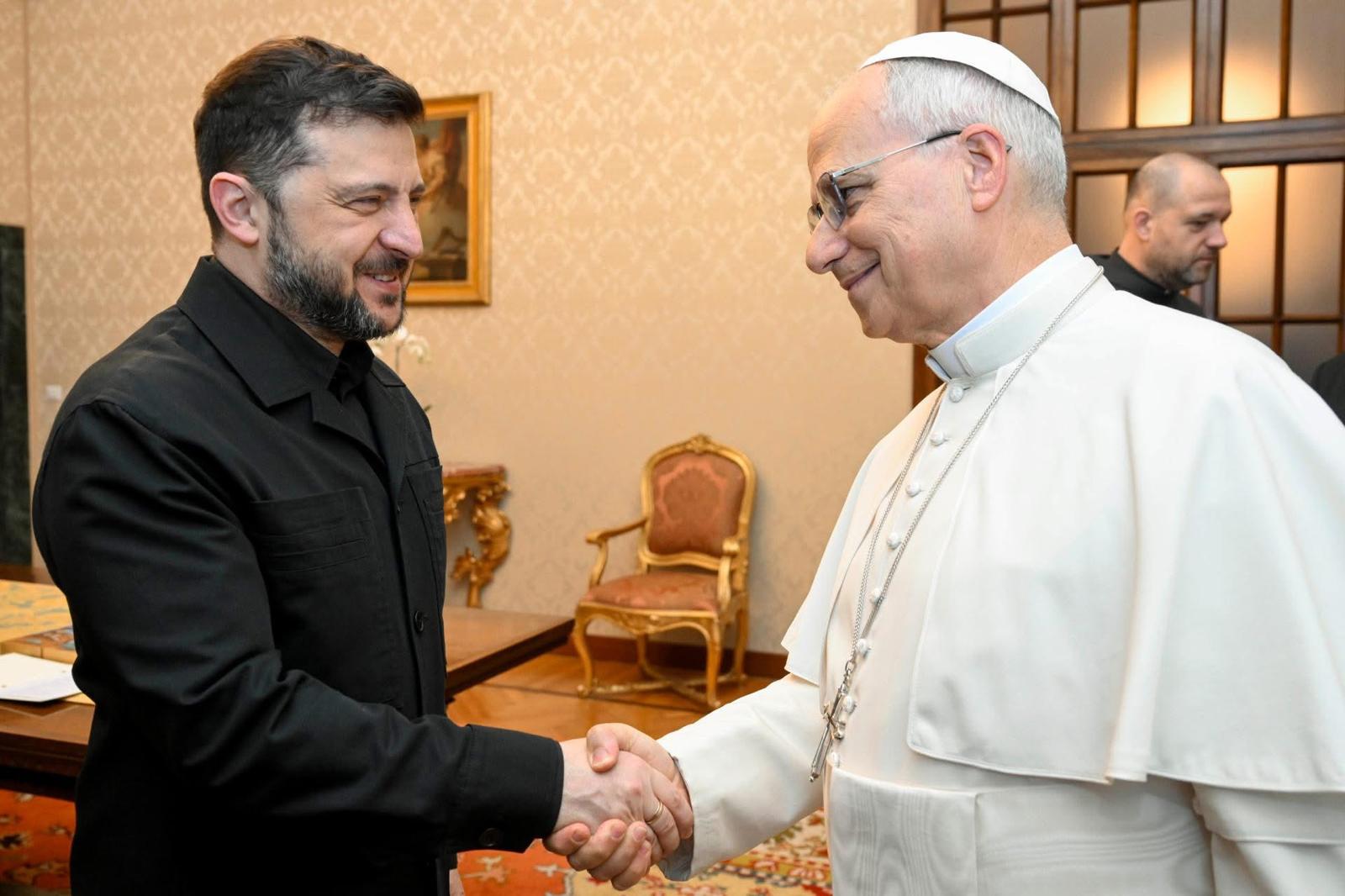
Pope Leo XIV warns Trump approach threatens US-Europe alliance after Zelenskyy meeting
"Current times demand respect only for strength"
Zelenskyy offered a blunt assessment of the current geopolitical reality.
"Today we're talking not about fairness, but about strength," he said. "And unfortunately, this time demands respect only for strength, not for values."
He recalled how international law failed to stop Russia earlier.
"If we were talking about fairness and values, about respect for international law, Russians should have been condemned from the very beginning, more than 10 years ago, for the invasion of sovereign Ukrainian land. This didn't happen. It was only in words."
This reality shapes Ukraine's insistence on enforceable guarantees.
"Today we want non-repetition of war after a ceasefire. And therefore legally binding guarantees are mandatory," Zelenskyy noted.
What if peace talks fail?
"We cannot afford to think about this," Zelenskyy said.
He acknowledged the need for realism but refused to dwell on failure scenarios.
"It's like running a long distance, like a marathon. You have to pull yourself together, find another path, and again do everything so that this war ends."


