

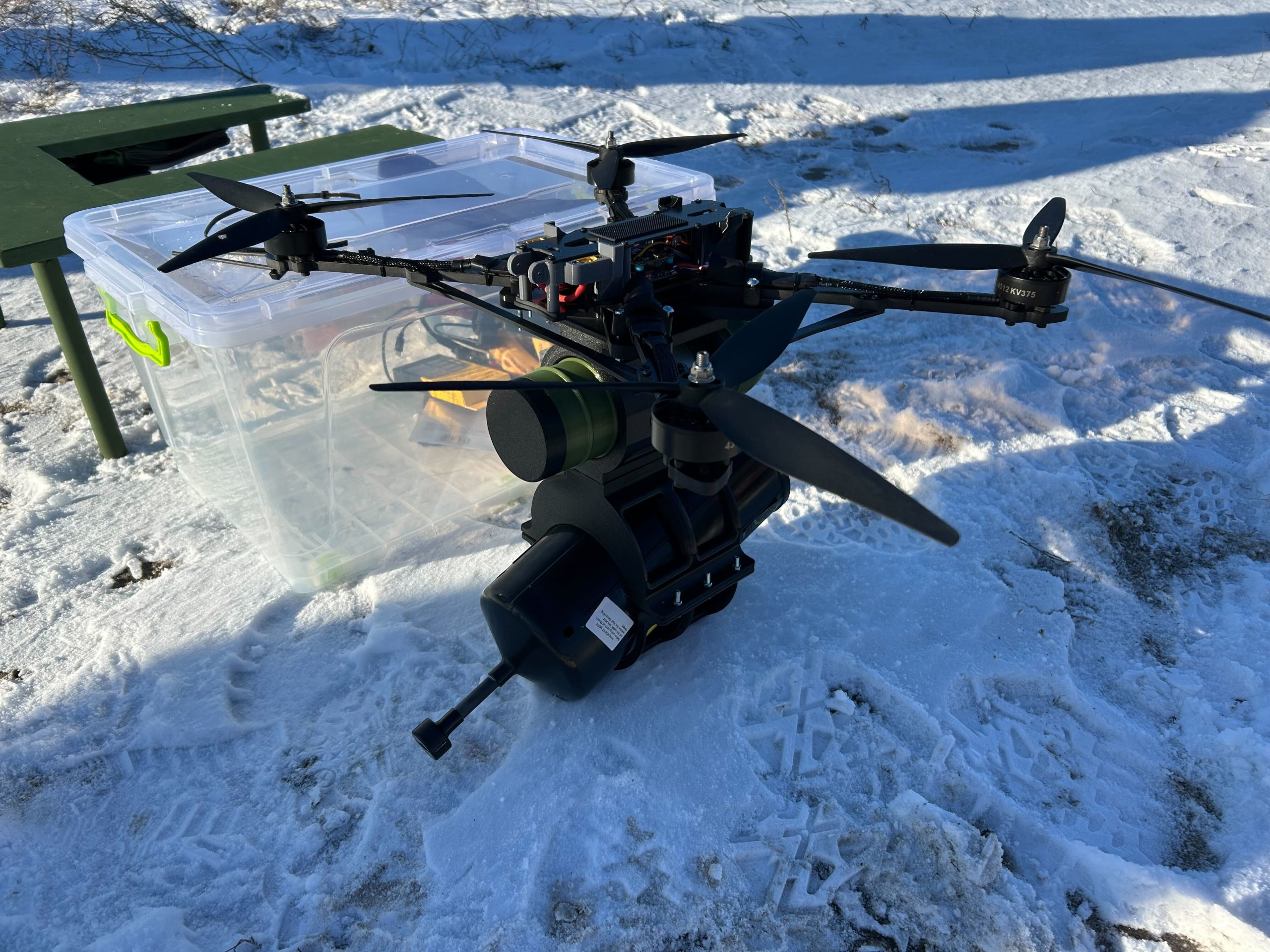
Fiber-optic drones were a game-changer: a way to scout and kill the enemy from far away, immune to electronic jamming. But then, the weather got cold.
As the mid-January freeze rolled across Ukraine, it exposed one weakness of this technology. Fibers froze on their spools and made unreeling difficult. Ice particles clung to deployed lines, making them hard and brittle.
This was enough to ground fiber-optic drones at the Dronarium training center in Kyiv, according to its press release. Elsewhere, Euromaidan Press heard that the freezing problem appreciably limits these drones’ possibilities in the field.
“I heard from ten drone teams that this was an issue,” a military UAV tester, who asked not to be identified by name, told Euromaidan Press.
According to open sources, Russians are taking advantage of these conditions by “intensifying assault operations on the front line, while Ukrainian forces continue to actively resist the enemy,” in part with fiber-optic drones, said Nazariy Barchuk, an analyst with the Ukrainian Security and Cooperation Center.
While both sides employ great numbers of fiber optic drones, Russia has been able to produce drones at a greater scale than Ukraine. Russian pilots are less limited by supply shortages.
Ice build-up
According to Richard Fellows, the retired head of an American fiber optics company, fiber itself doesn’t degrade from extreme cold. It’s the freezing moisture in the air that does the damage.
Most fielded drones that use this tech have unshielded spools. A protective sheath adds mass to the drone, making it heavier and increasing its visual cross-section — although sheathed systems are in use as well.
"Water is sticky. If ice forms between two fibers, it might not unspool easily," said Fellows, who provides technical aid through the organization Technology United for Ukraine. "When it tries to unspool, that might cause it to break."
The UAV tester added that fiber that has already unspooled can suffer ice buildup making it prone to snapping under strain. It also tends to get frozen to tree limbs and other obstacles.
This does not prevent fiber drones from operating. But the icing does limit how much a drone can turn and maneuver before microcracks and attenuation threaten to snap the fiber. To be effective, drones need to be able to move freely across great distances and take sharp turns when required.
In practical terms, this means that drones can’t fly as far, are easier to bring down, and have a greater risk of losing their link to the pilot.
Trending Now
The other problem is that the SFP modules that receive and transmit signals are typically rated for stable operations between 0 and 70 degrees Celsius, Barchuk said.
“Freezing of such equipment can lead to deterioration or loss of the signal due to condensation in the microcircuits and frequency drift (losses of 20–50%).”
Cold months expose the weakness of drones
The scourge of winter weather also affects drones in other ways. Valentyn Prokopchenko, a soldier with the 13th Khartia Brigade told Euromaidan Press that the cold reduces battery efficiency, while fighting against high winds wastes even more power.
Meanwhile, Dimko Zhluktenko, a recon drone pilot deployed near Pokrovsk, told Business Insider about how Ukraine's thick autumn fogs disabled surveillance from the sky, allowing Russians to advance.
Zhluktenko added that while Ukraine depends on drone warfare, this tech has its limits, and it cannot win the war single-handedly. According to him, Ukraine needs more artillery in particular. His recon drones weren’t very useful, when he’d call in an enemy position, and the artillery team would be unable to attack it, on account of having three shells per day.
Retired UK General Nick Carter wrote something similar for War on the Rocks: "Ukraine’s battlefield technologies — especially drones — do not yet constitute a new way of warfare."
"Instead, they function mainly as substitutions for missing capabilities and have produced stalemate rather than decisive maneuver."
Read also
-
“Cold will not win the war”: Zelenskyy responds to Russian winter offensive
-
Russia deliberately waited for temperature to drop to -15°C to maximize suffering of Ukrainians. And send message to Europe
-
A Russian drone flew into Ukraine’s “hidden” Krab gun — and exposed a billion-dollar flaw in artillery design


